
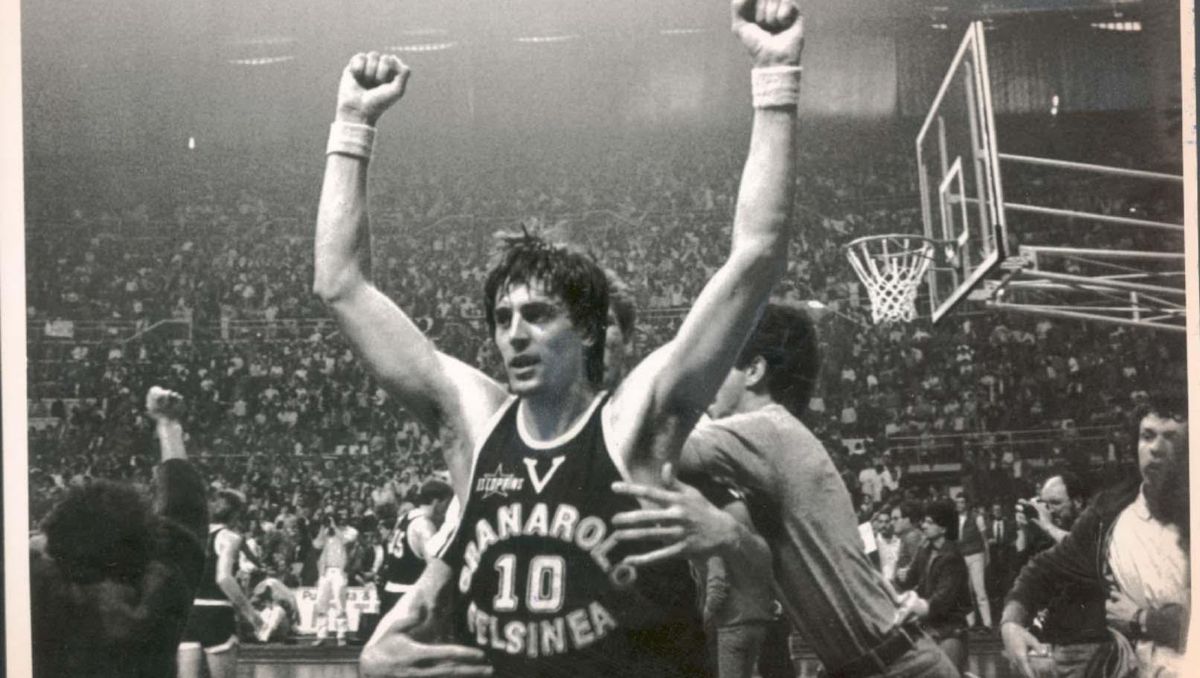
Renato Villalta — The Poet Under the Basket Who Saw What Others Couldn’t

The Poet Under the Basket
In the 1983 European Championship final in Nantes, France, Italy faced Spain. In the second half, the Italian power forward caught the ball on the right block, back to the basket. Spain’s defense collapsed. He did not turn to shoot. He glanced left — just glanced — and flicked his right wrist. The ball threaded through three defenders to a teammate cutting baseline. No-look pass. From a power forward.
He recorded seven assists in that final. Three of them, he never looked at the receiver.
The Italian press gave him a nickname that still floats through Italian basketball: il Poeta Sotto Canestro — the Poet Under the Basket.
The Player Who Passed Like a Guard
Villalta was born in 1955 near Venice. He stood two meters and six centimeters — tall but not towering. What he had was something distinctly Italian: rhythm. Not speed — rhythm. He knew when to speed up, when to slow down, when to pause just long enough for a defender to fly past.
In an era when power forwards were supposed to rebound, post up, and stay out of the way, Villalta moved the ball through the paint like a playmaker. He played with space. He saw angles that others did not.
He spent his entire career with Pallacanestro Treviso (Benetton), never chasing a bigger market or a larger contract. He was the heart of a franchise that grew into one of Europe’s most respected clubs.
Olympic Silver and European Gold
At the 1980 Moscow Olympics, Villalta helped Italy reach the gold medal game against Yugoslavia. Italy lost, but the silver medal was the country’s best Olympic basketball result in decades.
In 1983, he reached the peak. In the European Championship final against Spain, Italy won the title. Villalta’s seven assists from the power forward position — three of them no-look — became part of European basketball lore. He was named to the All-Tournament Team.
Return to the Ordinary
Villalta never played in the NBA. When his playing career ended, he did not become a coach or a commentator. He returned to his hometown and opened a sporting goods shop. He lives quietly, running the store, talking to customers about local sports.
Once, a reporter tracked him down and asked if he missed the game. Villalta said he still watched basketball. But the thing he missed most was not the applause or the medals. It was the feeling of a pass arriving exactly where he had visualized it — threading through traffic, hitting a teammate in stride, creating something from nothing.
That is what the Poet Under the Basket was born to do. He did it well. Then he went home.
References
- FIBA Europe — Renato Villalta profile
- Olympedia — Italy Basketball at the 1980 Moscow Olympics
- EuroBasket 1983 Official Report — Final: Italy vs Spain
- La Gazzetta dello Sport — “Il Poeta Sotto Canestro”