
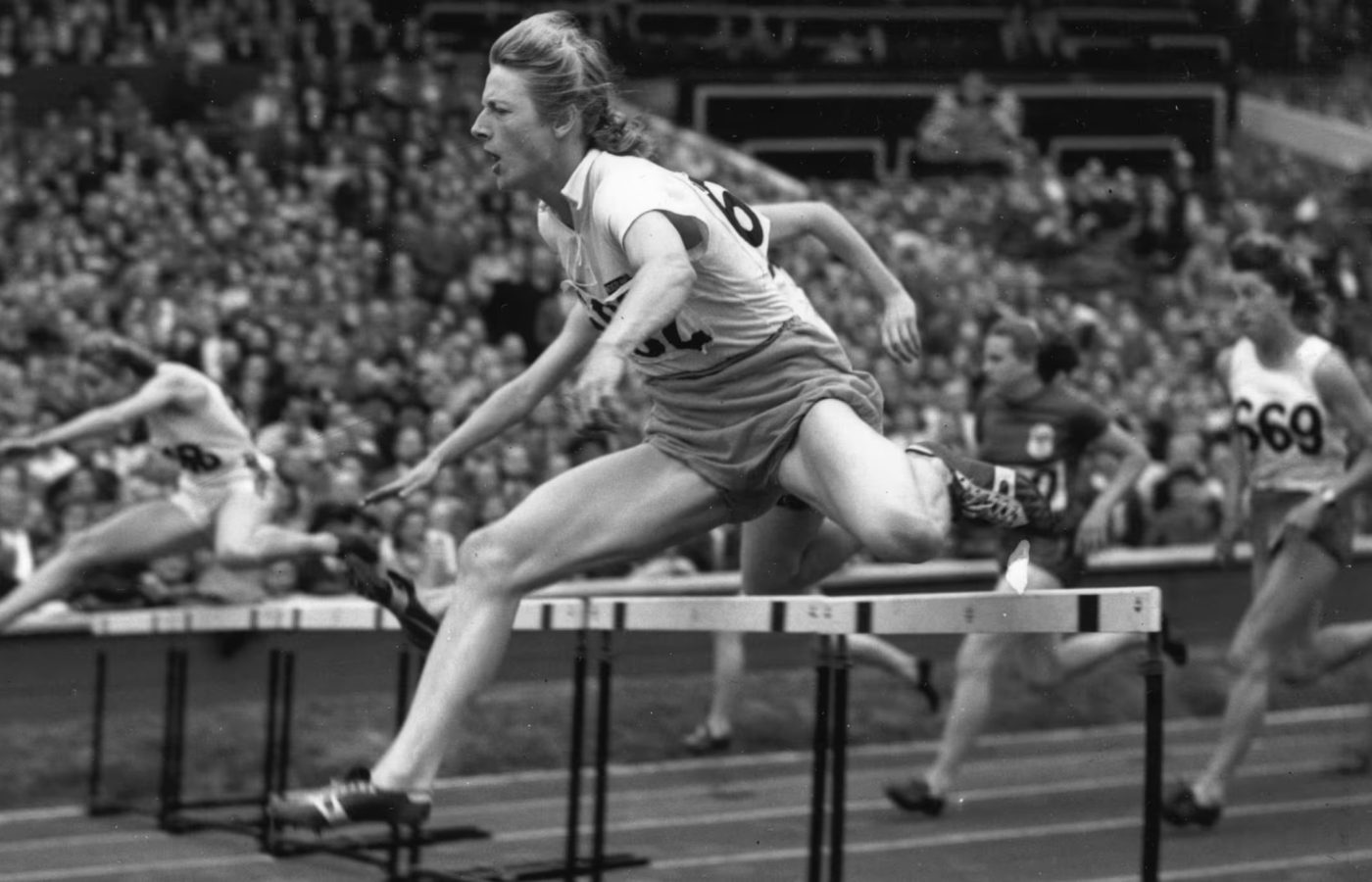
Four Golds at Thirty: The Unforgettable Story of Fanny Blankers-Koen

The Girl Who Could Do Everything
Fanny Blankers-Koen was born on April 26, 1918, in the small village of Lage Vuursche, in the central Netherlands. Her father, a government official, had been a shot putter in his youth, and he encouraged his daughter to take up sports. She showed talent early. By her teenage years, she was competing in swimming, fencing, gymnastics, and track and field. It was on the track, however, that the young Francina Koen truly shone – her natural speed and explosive power made her a standout in nearly every event she tried.
At just 17 years old, she represented the Netherlands at the 1936 Berlin Olympics. She finished equal fifth in the high jump and fifth as part of the 4×100-meter relay team. She watched Jesse Owens win four gold medals in Berlin and later said she dreamed of doing the same. But the world had other plans. The Second World War broke out in 1939, and the 1940 and 1944 Olympic Games were canceled. For Blankers-Koen, whose prime athletic years were being swallowed by war, the dream of Olympic glory seemed to slip further away with every passing year.
She did not stop competing. During the war years, Dutch athletes could still organize domestic meets, and Blankers-Koen used that time to push her limits. She set world records in events the women’s Olympic program did not even offer. In 1943, she leaped 1.71 meters in the high jump – a world record that would stand for eight years. She also jumped 6.25 meters in the long jump, another world record. At 6.25 meters, that mark would have won the Olympic gold medal in 1948 by nearly half a meter, but women were not allowed to compete in the long jump at those Games. The same was true of the pentathlon, an event she dominated locally. Under Olympic rules of the time, women were limited to three individual track and field events. She had more talent than the program could contain.
London 1948: The Week That Made History
By the time the 1948 London Olympics arrived, Fanny Blankers-Koen was 30 years old and the mother of two children, Jan Junior and Fanneke. The press called her “the old mother.” Journalists openly wondered whether a woman her age, with domestic responsibilities, could possibly keep up with younger, more dedicated athletes. The British press was particularly skeptical. One columnist wrote that she should “stay home and take care of the children.”
She did not stay home.
The 100 meters came first. Blankers-Koen won her heat and semifinal with ease. In the final, she crossed the finish line in 11.9 seconds, winning gold by a clear margin. It was her first Olympic title, but she had no time to celebrate. The 80-meter hurdles were scheduled two days later, and she faced a formidable opponent – Britain’s own Maureen Gardner, who had matched Blankers-Koen’s world record of 11.2 seconds. The final was a thriller. Blankers-Koen and Gardner were neck and neck over all eight barriers. Blankers-Koen dipped at the line and won by inches. The photo finish showed her torso crossing first. Two gold medals in two events.
The 200 meters was next – a distance that pushed her more than she expected. The final was held on a rain-soaked track. Blankers-Koen ran cautiously in the semifinal, conserving energy, but in the final she let go completely. She won in 24.4 seconds, a new Olympic record. The margin of victory was seven-tenths of a second – a staggering gap for a sprint final. No one in the stands doubted anymore. This 30-year-old mother was doing something historic.
The fourth gold came in the 4×100-meter relay. Running the anchor leg, Blankers-Koen received the baton in third place, behind Australia and Canada. She chased down the Australian runner over the final 100 meters and crossed the line first, completing a sweep that had seemed impossible a week earlier. Four gold medals – the same number Jesse Owens had won in Berlin twelve years earlier, the same number she had dreamed of as a teenager.
“The Flying Housewife” and the Weight of a Name
The international press could not resist a label. They called her “The Flying Housewife” – a nickname that was meant to celebrate her domesticity as much as her speed. But Blankers-Koen disliked the label. She felt it diminished her achievement, reducing four years of war-delayed dedication to a punchline about a mother who also happened to run fast. In interviews, she repeatedly pushed back against the image, insisting she was, above all, an athlete. “I was not a housewife who ran,” she said in a tone that made clear the subject was closed.
The tension between her public image and her private identity was a constant thread in her career. She was strong-willed and fiercely competitive, qualities that did not always sit comfortably with the post-war ideal of gentle femininity. She trained through pregnancy and returned to competition while breastfeeding. She argued with officials, demanded better conditions for women athletes, and refused to accept that age was a valid reason to stop competing. In an era when women’s sports were still treated as a novelty, she demanded to be taken seriously.
Her husband, Jan Blankers, was a former track athlete and her coach. Their partnership was complex – he pushed her hard in training, sometimes too hard, but he also believed in her talent when few others did. Jan managed the household while she trained, a reversal of gender roles that was almost unheard of in the 1940s. When critics asked how she could leave her children to compete, Jan answered bluntly: “She is an athlete. The children are fine.”
More Than Four Golds
Blankers-Koen’s Olympic performance in 1948 was the peak of her career, but not the whole picture. She set or tied twelve world records across multiple disciplines – sprints, hurdles, high jump, long jump, pentathlon, and relays. Her high jump world record of 1.71 meters, set during the war, remained unbroken until 1951. Her long jump mark of 6.25 meters held for more than a decade. She was, in the truest sense, a complete athlete, capable of competing at an elite level in events that required speed, power, and technique.
After London, she continued competing, though the pressure and fame took their toll. She retired from track and field in 1955 at the age of 37. Her final tally of Olympic gold medals – four – would have been higher if not for the event restrictions imposed on female athletes. She never got to compete in the high jump, long jump, or pentathlon at the Games, events in which she almost certainly would have medaled.
Decades later, the recognition finally caught up with her reputation. In 1999, the International Association of Athletics Federations (IAAF) voted Fanny Blankers-Koen the “Female Athlete of the 20th Century.” She was 81 years old. When told of the honor, she reportedly shrugged and said, “It took them long enough.”
The Quiet Champion
Fanny Blankers-Koen passed away on January 25, 2004, at the age of 85, in Hoofddorp, Netherlands. She lived long enough to see women’s track and field grow into a global phenomenon – longer distances, more events, equal opportunities that she had helped to create. Her four gold medals in London were not a fluke of a single great week. They were the product of talent that had been suppressed by war, discipline that had survived motherhood and skepticism, and a refusal to let other people define what she could do.
In the Netherlands, she remains a national hero. Statues stand in her honor. A sports stadium in Hengelo bears her name. But for the rest of the world, her story carries a different lesson: that greatness does not have a deadline. At 30, dismissed and underestimated, Fanny Blankers-Koen (Francina Elsje Koen) walked onto a track in London and proved that the best performances can come when the world least expects them.
References
- Blankers-Koen, F. (1949). Mijn Gouden Medailles. Amsterdam: De Arbeiderspers.
- Kooger, H. (2004). Fanny: De Biografie van Fanny Blankers-Koen. Amsterdam: Thomas Rap.
- Bijkerk, A. (2000). “Fanny Blankers-Koen: The Flying Housewife of the 1948 Olympics.” Olympic Review, 26(34), 45-50.
- Guttmann, A. (1991). Women’s Sports: A History. New York: Columbia University Press.
- International Association of Athletics Federations. (1999). “IAAF Athletes of the Century.” IAAF Centenary Publication.