
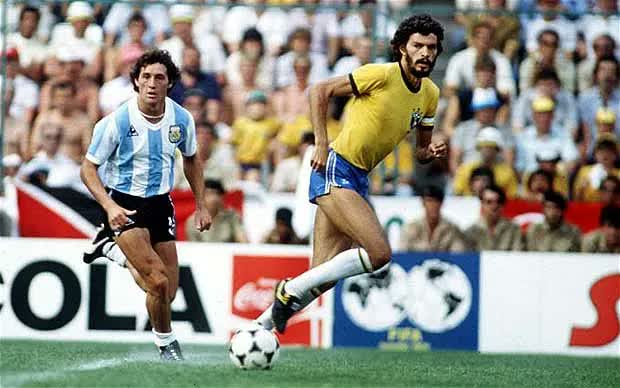
Sócrates: The Doctor Who Captained Brazil’s Greatest Team Never to Win

In the pantheon of Brazilian football, few figures are as fascinating as Sócrates Brasileiro Sampaio de Souza Vieira de Oliveira — known to the world simply as Sócrates. He was a midfield general, a doctor, a political activist, and the captain of perhaps the greatest Brazilian team never to win a World Cup. Standing 1.92 meters tall, with a receding hairline, a beard, and a brain as sharp as his passing, Sócrates was unlike any footballer who came before him — or after.
The Doctor Who Played Football
Sócrates was born on February 19, 1954, in Belém do Pará, in northern Brazil. His father, Raimundo, named him after the Greek philosopher — a decision that would prove eerily appropriate. The family moved to Ribeirão Preto in São Paulo state when Sócrates was a child, and it was there that his twin talents emerged: football and medicine.
While other Brazilian boys dreamed only of the ball, Sócrates pursued a medical degree. He studied at the University of São Paulo’s Ribeirão Preto campus, attending classes in the morning and training in the afternoon. He graduated as a doctor in 1978, specializing in orthopedic medicine. Throughout his football career, he insisted on being addressed as “Doutor” — Doctor.
His playing style matched his intellect. Sócrates played with his head up, his passes measured, his movements economical. He was not fast, but he did not need to be. He saw the game at a higher speed than everyone else. His trademark move — the blind back-heel pass — became a symbol of his genius. He could deliver a perfectly weighted through-ball without looking, as if he knew exactly where his teammate would be before the teammate knew himself.
Corinthians and the Democracy Movement
Sócrates played for Botafogo-SP and then, in 1978, joined Sport Club Corinthians Paulista in São Paulo. It was at Corinthians that he would make history — not just as a footballer, but as a political leader.
In the early 1980s, Brazil was still under military dictatorship. The country had been ruled by generals since 1964, and political expression was suppressed. Football clubs, like all institutions, were run autocratically. Players were told what to do, when to train, and how to behave. Sócrates rejected this. Along with teammates like Wladimir and Casagrande, he helped create the “Corinthians Democracy” (Democracia Corinthiana) — a movement in which all club decisions were put to a vote. Every player, from star to reserve, had an equal say. The movement extended beyond the club. Sócrates used his platform to speak out against the dictatorship, calling for direct elections.
In 1984, during a match at the Morumbi Stadium, Sócrates and his teammates wore shirts with the slogan “Voto Direto Já” (Direct Elections Now) written on the back. It was a moment of extraordinary political courage. The regime was threatened. But Sócrates was untouchable — he was the captain of the national team, the most famous footballer in Brazil, a doctor, and a man of unimpeachable integrity.
The 1984 Diretas Já movement did not succeed in ending the dictatorship immediately — the election bill was defeated in Congress. But it planted the seeds for Brazil’s return to democracy in 1985. Sócrates had used football as a weapon for change.
1982: The Greatest Team Never to Win
The 1982 World Cup in Spain was Sócrates’s moment on the global stage. Brazil’s team that year is widely considered one of the most beautiful sides in history. Coached by Telé Santana, they played a style of football that was pure artistry — attacking, fluid, and fearless. Sócrates captained the team from midfield, alongside Zico, Falcão, and Éder.
Brazil’s group-stage performances were breathtaking. They beat the Soviet Union 2–1, Scotland 4–1, and New Zealand 4–0. Sócrates scored a stunning goal against the Soviet Union, a curling shot from outside the box that left the goalkeeper motionless. In the second round, Brazil faced Argentina and Italy. They demolished Argentina 3–1, with Sócrates scoring again. Against Italy, they needed only a draw to advance to the semifinals.
What followed was one of the most famous matches in World Cup history. Italy’s Paolo Rossi scored a hat-trick. Brazil attacked relentlessly but could not break through. Sócrates scored a brilliant equalizer, but it was not enough. Brazil lost 3–2 and were eliminated. The team that had played the most beautiful football in the tournament went home without the trophy.
Sócrates returned for the 1986 World Cup in Mexico, but age and injury had taken their toll. Brazil reached the quarterfinals, where they lost to France on penalties. Sócrates, fittingly, took Brazil’s first penalty and missed. It was his last act in a Brazil shirt.
Legacy
Sócrates retired from football in 1988 at the age of 34. He returned to medicine, working as a doctor in Ribeirão Preto. He also wrote a column for a São Paulo newspaper, commenting on football, politics, and life with the same intelligence that had defined his playing career.
He passed away on December 4, 2011, at the age of 57, from septic shock caused by an intestinal infection. His death was mourned globally. FIFA President Sepp Blatter called him “a giant of the game.” Brazil declared three days of national mourning.
Sócrates was more than a footballer. He was a symbol of the idea that intelligence and athleticism are not opposites, that a man can be both a doctor and a World Cup captain, that football can be a vehicle for political change. He once said: “I want to be remembered as a man who tried to make things better.” He succeeded.
References
1. Bellos, Alex. Futebol: The Brazilian Way of Life. Bloomsbury, 2002.
2. Sócrates, with Claudio Carsughi. Democracia Corinthiana: A Utopia em Jogo. Panda Books, 2005.
3. Wilson, Jonathan. Angels with Dirty Faces: The Footballing History of Argentina. Orion, 2016.
4. FIFA World Cup 1982 Technical Report — Brazil Team Analysis.
5. “Sócrates obituary.” The Guardian, December 5, 2011.