
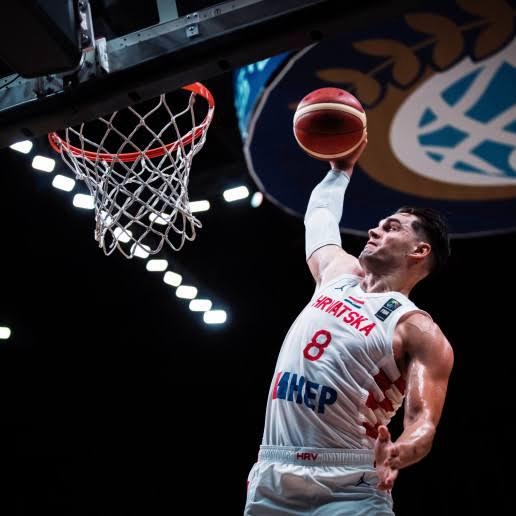
The Mozart of Basketball: Dražen Petrović and the Shot That Changed the Game Forever

Dražen Petrović — pronounced DRAH-zhen PEH-troh-vich, the \`ć\` a soft, almost whispered flourish at the end. A name that should be spoken the way he played: with precision, with grace, and with an urgency that suggested he always knew there wasn’t much time. They called him The Mozart of Basketball for the symphonic beauty of his game. He led an entire continent out of obscurity and toward the promised land of the NBA. But before any of those titles, before the roar of Madison Square Garden and the plush seats of team charters, he was just a boy from the Dalmatian coast who loved the ball more than anything else in the world.
Growing Up in Sibenik: The Boy Who Couldn’t Stop Shooting
The coastal town of Sibenik, Croatia — then part of the Socialist Federal Republic of Yugoslavia — is a place of limestone streets and Adriatic light, where the sea glitters like crushed glass under a Mediterranean sun. It was here, on October 22, 1964, that Dražen Petrović was born into a family where basketball was not a hobby but a birthright. His older brother, Aleksandar Petrović — known to everyone as Aco — was already carving a name for himself on the hardwood. Dražen was the kid who refused to be left behind.
By the time he was thirteen, Dražen was rising before dawn to practice. He would sneak into the local gym, often finding the doors locked, and shoot on outdoor courts until his fingers bled. His father, Jovan, a police officer, and his mother, Biserka, a librarian, watched their younger son’s obsession with a mixture of pride and concern. The boy was relentless. He played against men twice his age. He studied American guards on grainy VHS tapes — Pete Maravich’s ball-handling, Magic Johnson’s vision — and internalized their movements until they became muscle memory.
At fifteen, Dražen joined KK Sibenik, the local club, and immediately turned heads. He was skinny, almost frail, with an angular face and a mop of dark hair. But when he had the ball in his hands, he transformed. He saw passing lanes before they opened. He pulled up for jump shots with a release so quick it seemed to defy physics. Scouts from the powerhouse clubs in Zagreb and Belgrade began taking notes.
Cibona Zagreb and the European Throne
In 1984, at age nineteen, Dražen Petrović signed with KK Cibona Zagreb, one of the premier clubs in Yugoslav basketball. It was the move that would define his early career. Playing alongside his brother Aco, Dražen led Cibona to back-to-back EuroLeague championships in 1985 and 1986 — the first time a Yugoslav club had ever won Europe’s top prize.
The 1985 EuroLeague Final against Real Madrid is still regarded as one of the greatest performances in European history. Dražen scored 36 points, dished out assists with surgical precision, and played with a fire that left the Madrid defense in ashes. The following year, against Zalgiris Kaunas — led by the legendary Arvydas Sabonis — he did it again, dropping 22 points in a hostile Soviet arena to secure Cibona’s second consecutive title.
By 1987, Dražen was the best player in Europe not named Sabonis. He won the EuroLeague scoring title, the Yugoslav League MVP, and the European Player of the Year award. At the 1987 EuroBasket, he scored 37 points against a Soviet team that featured four future NBA players, announcing to the world that European basketball had produced a talent capable of competing at the highest level.
Real Madrid and the Atlantic Crossing
In 1988, Dražen Petrović made the most significant move of his European career, signing with Real Madrid. The club paid a transfer fee that shattered European records — approximately $4 million — a figure that reflected not just his talent but his growing legend. In Madrid, he averaged 28 points per game in the Spanish ACB League and led the team to the Copa del Rey title.
But the NBA was calling.
The Portland Trail Blazers had selected Dražen with the 60th pick in the 1986 NBA Draft — a third-round afterthought, a speculative gamble on a European nobody. When Dražen finally arrived in Portland in 1989, he found himself buried on a depth chart that featured Clyde Drexler, Terry Porter, and Danny Ainge. The Trail Blazers were a championship-caliber team, and their coaching staff saw no need to develop a skinny guard from Yugoslavia who didn’t speak fluent English and played a style so different from the NBA’s isolation-heavy offense.
Dražen averaged just 12.6 minutes per game in his first season, then 7.4 in his second. Frustration mounted. He considered returning to Europe. Instead, he demanded a trade.
Brooklyn: The Flowering
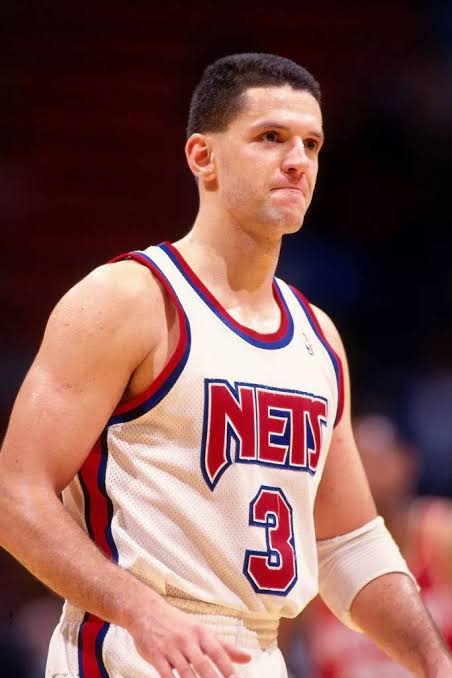
On January 23, 1991, the Portland Trail Blazers traded Dražen Petrović to the New Jersey Nets in a three-team deal that sent him to a franchise mired in chaos. The Nets were terrible — they had won just 26 games the previous season — but they had something Portland didn’t: opportunity.
From the moment Dražen stepped on the court for New Jersey, he was unleashed. In his first full season with the Nets (1991–92), he averaged 20.6 points per game, shooting 50.8% from the field and 44.4% from three-point range. The basketball world took notice. This was not a “European novelty” — this was a legitimate NBA star.
The 1992–93 season was his masterpiece. Dražen Petrović averaged 22.3 points, 3.5 assists, and 2.7 rebounds per game while shooting 51.8% from the field and 44.9% from beyond the arc. He was named to the All-NBA Third Team, the first European-trained guard to receive such an honor. His signature performance came on January 24, 1993, when he scored 44 points against the Houston Rockets, dismantling NBA defenses with a combination of off-ball movement, catch-and-shoot accuracy, and a pull-up jumper that his defenders could only watch.
Teammate Kenny Anderson described playing with Dražen as “watching a masterclass every single night. He didn’t just shoot — he orchestrated. Every movement had a purpose. Every pass had a destination.”
Two Silvers: Yugoslavia and Croatia
Dražen Petrović’s Olympic career tells a story of geopolitical upheaval as much as athletic achievement. At the 1988 Seoul Olympics, he played for the Yugoslavian national team — a powerhouse roster featuring the likes of Toni Kukoč, Vlade Divac, and Stojko Vranković. Yugoslavia reached the gold medal game but fell to the Soviet Union, 76–63, taking silver.
By 1992, the world had changed. Yugoslavia had dissolved in war. Croatia declared independence, and Dražen — a proud Croat from the Dalmatian coast — joined the newly formed Croatian national team. At the Barcelona Olympics, Croatia’s journey was nothing short of miraculous. They stormed through the tournament, defeating the Unified Team in the semifinals, and earned the right to face the original Dream Team in the gold medal game.
The result was never in doubt — the Dream Team won 117–85 — but the significance was not in the score. The Croatian flag flew at an Olympic medal ceremony for the first time in history. Dražen Petrović stood on that podium, silver medal around his neck, and wept.
The Autobahn
On June 7, 1993, Dražen Petrović had just finished playing for the Croatian national team in a EuroBasket qualifying match in Poland. The team’s flight arrangements were tangled, so he accepted a ride from a teammate’s girlfriend — a decision that would prove fatal.
Their Volkswagen Golf was traveling on the A9 Autobahn near Denkendorf, Germany, when it collided with a truck that had crossed the median. Dražen, sleeping in the front passenger seat, died on impact. He was 28 years old.
The news sent shockwaves through the basketball world. In New Jersey, fans gathered outside Brendan Byrne Arena, lighting candles and leaving flowers. In Zagreb, tens of thousands lined the streets for his funeral procession. The NBA held a moment of silence before the 1993 Finals. Magic Johnson, Michael Jordan, and Larry Bird all released statements mourning a player they had come to respect as an equal.
Legacy: The Bridge Between Worlds
Dražen Petrović’s death robbed the basketball world of a player who was just entering his prime. His trajectory was ascendant — the Nets had built their future around him, and whispers of MVP consideration had begun to circulate. But his legacy cannot be measured in what was lost. It must be measured in what he built.
Before Dražen, the NBA viewed European players with deep skepticism. They were considered soft, unathletic, fundamentally unsound. After Dražen, the door he kicked open became a floodgate. Toni Kukoč followed. Arvydas Sabonis followed. Peja Stojaković, Dirk Nowitzki, Pau Gasol, Giannis Antetokounmpo, Nikola Jokić — every international star who has ever thrived in the NBA owes a debt to the kid from Sibenik who refused to accept that his dreams had borders.
In 2006, the Croatian Olympic Committee created the Dražen Petrović Award, given annually to the best young Croatian athlete under 20, a fitting tribute to a man whose impact transcended borders.
Dražen Petrović was buried at Mirogoj Cemetery in Zagreb, beneath a headstone inscribed with his name and a simple basketball motif. But his real monument is on every court in every country where a child picks up a ball and dreams of something bigger. The Mozart of Basketball — his symphony never really ended. It just keeps playing.
References
1. Petrović, Aleksandar. Dražen: The Man They Called Mozart. Zagreb: VBZ Publishing, 2004.
2. NBA Encyclopedia. “Dražen Petrović: The Pioneer.” NBA Media Ventures, 2002.
3. FIBA Hall of Fame Induction Biography. “Dražen Petrović.” International Basketball Federation, 2007.
4. Vecsey, George. “A Star Cut Short: Remembering Dražen Petrović.” The New York Times, June 8, 1993.
5. Sports Illustrated Archive. “The Bridge: How Dražen Petrović Changed the NBA Forever.” Sports Illustrated, February 2020.