
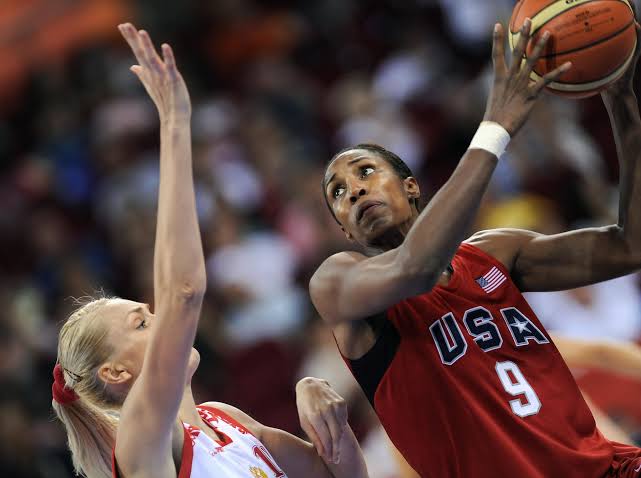
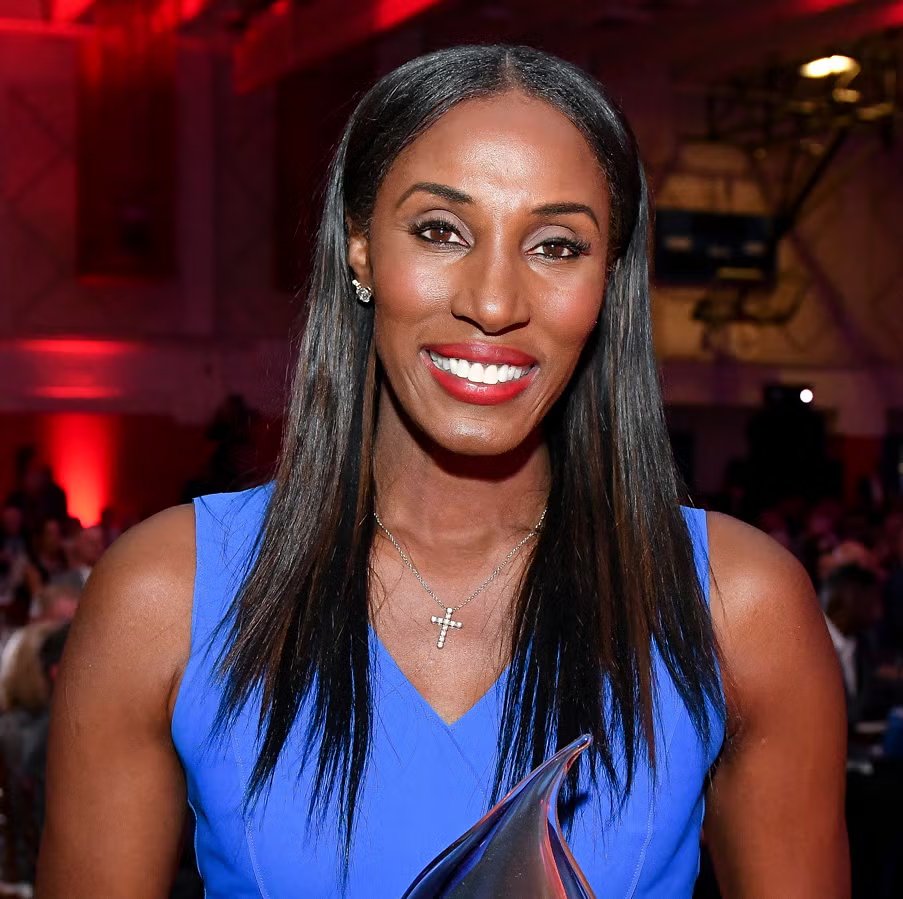
Lisa Leslie: The Trailblazer Who Changed Women’s Basketball Forever

Lisa Deshaun Leslie — known to fans as “LJ” or simply “The GOAT of women’s basketball” — didn’t just play the game. She redefined what was possible for women on the hardwood. At 6’5″, she was a force of nature: a four-time Olympic gold medalist, a three-time WNBA MVP, and the first player ever to dunk in a WNBA game. But her journey began quietly, with a classmate who encouraged her to pick up a basketball for the first time.
Growing Up in Gardena: The “Too Tall” Kid
Lisa Deshaun Leslie was born on July 7, 1972, in Gardena, California, a working-class city in Los Angeles County. Raised by her mother, Christine, after her parents divorced when she was young, Leslie grew up alongside her older sister and two younger brothers in a household that valued discipline and education above all else.
She was tall from the start. By the time she reached Morningside High School in Inglewood, she stood well over six feet — an awkward height for a teenage girl in the 1980s. Initially, she was not drawn to basketball; it was a classmate who encouraged her to try out.
“It was not love at first sight,” Leslie later recalled. “But once I started playing, I couldn’t stop.”
She found her way through local youth leagues, and within two years, she had transformed from a beginner into one of the most hyped high school prospects in the country.
The 101-Point Half
On February 7, 1990, Morningside High faced South Torrance in a regular-season game. Leslie scored at will. And then she didn’t stop.
By halftime, she had put up 101 points — the opposing team refused to take the court for the second half, effectively ending the game at halftime as a forfeit. The final was 105-24. Leslie had outscored the opposing team by 77 points all by herself.
The performance remains one of the greatest scoring displays in basketball history at any level, by any gender.
Trojan Glory: Dominating at USC
Leslie stayed close to home for college, committing to the University of Southern California (USC), where she would carry on the proud tradition of Trojan women’s basketball. Under head coach Cheryl Miller — herself a legend of the game — Leslie blossomed into a national force.
Over four seasons at USC (1990–1994), she averaged 20.1 points and 12.3 rebounds per game. She led the Trojans to the NCAA Tournament in each of her four years, including an Elite Eight run in 1994. She was named a Kodak All-American three times and won National Player of the Year in 1994.
Her impact went beyond stats. Leslie was a shot-blocking terror in the paint, a relentless rebounder, and a surprisingly graceful athlete for her size. She ran the floor like a guard and finished with the authority of a center. Scouts saw what the rest of the world would soon learn: this was a once-in-a-generation talent.
By the time she graduated, she ranked among USC’s all-time greats — third in both career points and rebounds behind Cheryl Miller and Cherie Nelson.
The WNBA and the Dunk That Changed Everything
When the Women’s National Basketball Association (WNBA) tipped off in 1997, Lisa Leslie was one of the league’s foundational stars. Selected by the Los Angeles Sparks as a cornerstone franchise player, she instantly became the face of the franchise and one of the most recognizable athletes in the league.
Her dominance was immediate. She led the Sparks to back-to-back WNBA championships in 2001 and 2002. She was named league MVP three times — in 2001, 2004, and 2006. She earned All-Star honors in eight of her twelve seasons.
But the defining moment of her professional career — and arguably of the entire WNBA’s first decade — came on July 30, 2002.
The Sparks were facing the Miami Sol at Staples Center in Los Angeles. In the first half, Leslie caught the ball on the block, turned, and elevated. She soared above the rim and threw down a one-handed dunk — the first dunk ever by a player in a WNBA game.
The crowd erupted. The replay looped on sports channels for days. The moment was seismic. In an instant, Leslie had shattered a glass ceiling, proving that women’s basketball could be every bit as explosive, athletic, and electric as the men’s game. She would go on to dunk in more WNBA games, but the first one — that July night in LA — was the one that made history.
“When I dunked, I wasn’t trying to make a statement,” Leslie later said. “I was just playing basketball. But I knew, in that moment, that little girls watching would believe they could do it too.”
Olympic Supremacy: Four Gold Medals
If Leslie’s WNBA career made her a star, her Olympic career made her a legend.
She represented Team USA at four consecutive Olympic Games: 1996 in Atlanta, 2000 in Sydney, 2004 in Athens, and 2008 in Beijing. She brought home gold every single time.
The 1996 team — the first women’s basketball “Dream Team” — set the standard. Coached by Tara VanDerveer and featuring icons like Sheryl Swoopes, Rebecca Lobo, and Dawn Staley, Team USA rolled through the competition, winning all eight games by double digits. It was Leslie’s introduction to the world stage, and she thrived.
In 2000, she was the team’s leading scorer and rebounder, carrying the offense through tight knockout rounds. In 2004, now the veteran leader, she anchored a team that faced its toughest test — a narrow 66-62 semifinal win over Russia — before taking gold. And in 2008, her final Olympics, she captained a squad that featured a young Diana Taurasi and Sue Bird, passing the torch even as she collected her fourth gold medal.
Leslie’s Olympic resume is immaculate: four gold medals, undefeated in Olympic play (32-0), and a legacy as one of the greatest competitors in Team USA history. Only Teresa Edwards had won four Olympic gold medals in basketball before her. Leslie set the standard for sustained excellence on the international stage.
Beyond the Court: Model, Actress, and Hall of Famer
Lisa Leslie was never just a basketball player. Throughout her career, she was a crossover star, appearing in magazines, television shows, and films. She worked as a model, landing campaigns and spreads that showcased her grace and poise away from the court. She acted in shows like The Game and One on One, and appeared in movies including Think Like a Man.
She used her platform to advocate for women’s sports, serving as a vocal ambassador for the WNBA and for young girls who dreamed of playing professionally.
When she retired in 2009, the honors poured in. She was inducted into the Women’s Basketball Hall of Fame and the Naismith Memorial Basketball Hall of Fame, both in 2015 — a rare double honor in the same year.
She didn’t stop there. Leslie remained involved in the game as a part-owner of the WNBA’s Los Angeles Sparks, and she became a mentor to the next generation, just as Cheryl Miller had been for her.
Legacy: The GOAT of Women’s Basketball
To call Lisa Leslie a pioneer is almost an understatement. She was the first. The first woman to dunk in a WNBA game. The first women’s basketball player to win four Olympic gold medals. One of the first truly global faces of women’s basketball.
She inspired generations. When Breanna Stewart dunked in college, she said she was emulating Leslie. When Brittney Griner throws down a two-handed jam, she’s walking through the door that Leslie kicked open. Every little girl who watches the WNBA today and dreams of soaring above the rim — that dream exists because Lisa Leslie made it real.
At 6’5″, with a smile that lit up arenas and a game that could dominate any court, Lisa Deshaun Leslie — “LJ,” the GOAT — didn’t just break barriers. She never believed they existed in the first place.
References
1. “Lisa Leslie: Basketball’s Trailblazer” — Women’s Basketball Hall of Fame, 2015 Induction Profile
2. “The First Dunk: How Lisa Leslie Changed the WNBA” — WNBA Historical Archives, 2002 Season Retrospective
3. “Four Gold Medals: Lisa Leslie’s Olympic Journey” — USA Basketball, Official Biography
4. “From Gardena to the Hall of Fame: The Lisa Leslie Story” — Naismith Memorial Basketball Hall of Fame, 2015 Induction Notes
5. “The 101-Point Game: Revisiting Lisa Leslie’s High School Masterpiece” — Los Angeles Times Sports Archive, February 1990