
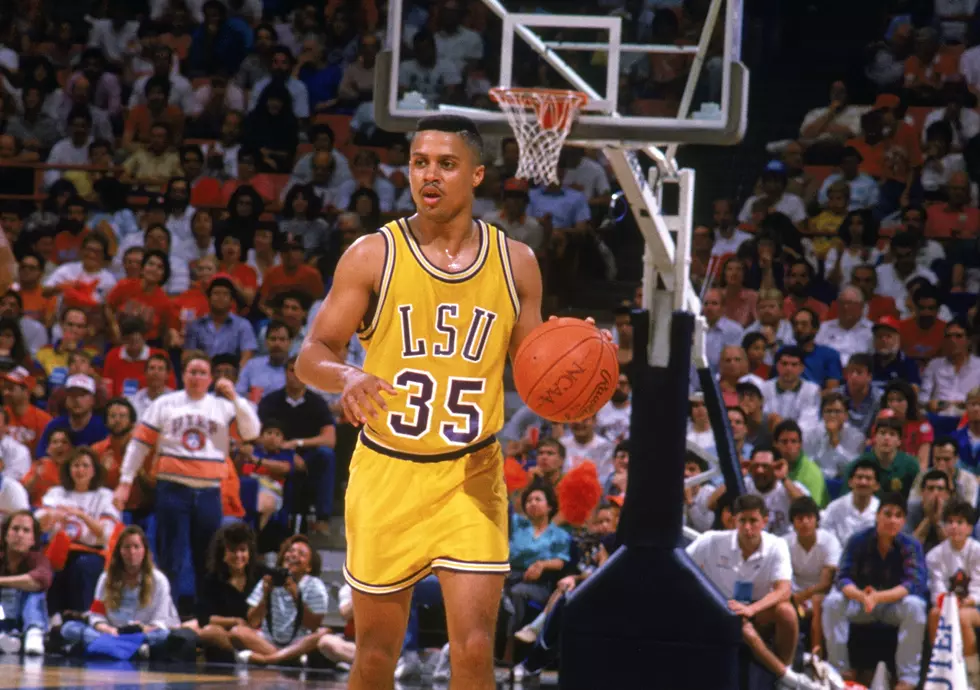
Hank Gathers: The Heart That Played Too Hard

Eric “Hank” Gathers led the nation in scoring for two straight seasons. He played through a diagnosed heart condition. On March 4, 1990, Hank Gathers collapsed on a basketball court and never got up. His story—and the story of the team that carried his spirit to the Elite Eight—remains one of the most heartbreaking, unforgettable chapters in college basketball history.
Philadelphia Beginnings
Eric “Hank” Gathers was born on February 11, 1967 in the Germantown section of Philadelphia, Pennsylvania. He grew up in the shadow of basketball greatness—the city had already produced legends like Wilt Chamberlain and Earl Monroe. But Hank carved his own path.
At Dobbins Technical High School, Gathers was a force. Long, explosive, and relentlessly competitive, he averaged 22 points and 15 rebounds per game as a senior. Yet despite numbers that would turn heads anywhere, the college recruiters did not exactly line up. He was considered undersized for a power forward at 6-foot-7, and his game was still raw.
Gathers spent one season at USC, averaging 8.3 points and 5.1 rebounds, showing flashes of the brilliance to come.
But it was a transfer that would define everything. After just one season at USC, Gathers decided to follow his childhood friend Bo Kimble to Loyola Marymount University in Los Angeles. It was a decision made on friendship and trust—and it changed college basketball forever.
The Run-and-Gun Show at Loyola Marymount
Under head coach Paul Westhead, Loyola Marymount ran the most frenetic offense in NCAA history. They pressed full-court for 40 minutes, shot within seconds of every possession, and averaged an astonishing 122.4 points per game during the 1989-90 season. It was basketball on fast-forward.
At the center of it all was Hank Gathers.
Playing alongside his best friend Bo Kimble, Gathers became a national phenomenon. In the 1987-88 season, he averaged 22.5 points and 8.7 rebounds, announcing himself as one of the most dominant forwards in the country. But the 1988-89 campaign was something else entirely. Gathers put up 32.7 points and 13.7 rebounds per game, leading the entire nation in both categories—a feat that only a handful of players in history have ever achieved. In the 1989-90 season, shortened by his death, he was still averaging 29.0 points and 10.8 rebounds per game and leading the nation in scoring for a second straight year.
He did it with relentless energy, running the floor like a guard, finishing above the rim with power, and crashing the boards with an almost desperate intensity. Kimble was the smooth scoring guard, but Gathers was the heart. Teammates would later say he practiced harder than he played, and he played harder than anyone they had ever seen.
By early March 1990, Loyola Marymount was 24-5, ranked nationally, and had just won the West Coast Conference regular-season championship. Everything was pointing toward a deep NCAA Tournament run. The Lions were the Cinderella story nobody wanted to miss.
A Heart Condition Revealed
During a game against UC Santa Barbara on December 9, 1989, Gathers collapsed on the court. The arena went silent. Teammates gathered around him, trainers rushed to his side. He was helped to his feet and taken to the hospital for evaluation.
The diagnosis was exercise-induced ventricular tachycardia—a potentially dangerous heart rhythm disorder. For most people, it would have meant the end of their athletic career. But Gathers, at 22, could not imagine his life without basketball. And the doctors told him it could be managed.
He was prescribed a beta-blocker medication called Inderal, which was meant to control his heart rate during exertion. After a period of rest and monitoring, Gathers was cleared to return to the court. The medical team, the coaching staff, and Gathers himself all believed the condition was under control.
But there were signs. Gathers complained that the medication made him sluggish. He felt it sapped his explosiveness, his edge. And so, at some point in the weeks that followed, he quietly stopped taking it. Whether he reduced the dosage or eliminated it entirely remains uncertain. What is known is that by March 1990, his heart was no longer being medically protected.
Teammates later recalled that he seemed tired in the days leading up to the conference tournament. He mentioned feeling off. But March Madness was about to begin, and Hank Gathers was not about to sit out.
March 4, 1990 — The Day the Game Stopped
The West Coast Conference tournament semifinal against the University of Portland was being played at Loyola Marymount’s home arena, Gersten Pavilion. It was a familiar setting, a winnable game, a stepping stone to the NCAA Tournament.
Midway through the first half, Gathers threw down a trademark dunk—a powerful two-handed jam that brought the crowd to its feet. Moments later, he casually knocked down a three-pointer. Everything seemed normal. He was laughing, high-fiving teammates, playing the game he loved.
Then came the alley-oop.
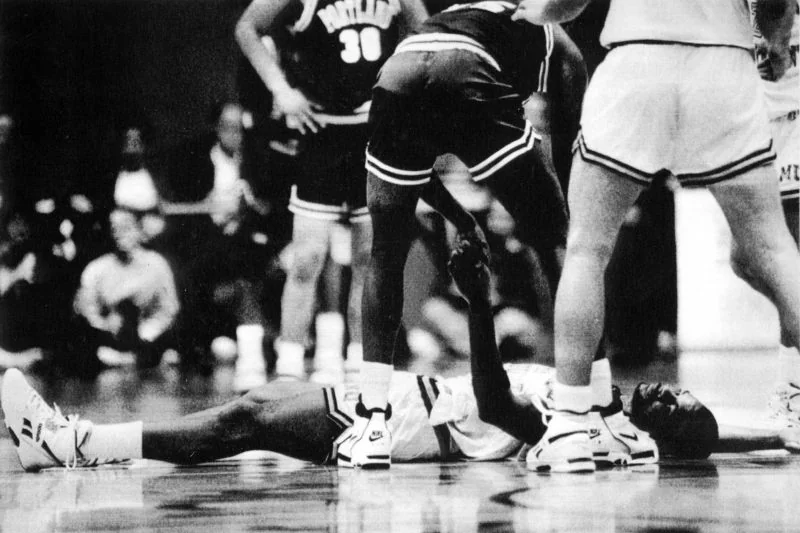
Gathers caught a lob pass near the basket and went up for the finish. It was a play he had executed thousands of times. But as he landed, his body went limp. He collapsed to the floor, face down, not moving.
At first, nobody panicked. He had collapsed before. He had gotten up before. But this time was different. His body began to convulse. His eyes were open but unseeing. Players from both teams backed away in shock. Bo Kimble rushed to his side, then stepped back, his face contorted with anguish.
The team’s medical staff and a cardiologist who was attending the game rushed to administer CPR. Paramedics worked on him for nearly an hour. He was transported to Daniel Freeman Marina Hospital, but it was too late. Eric “Hank” Gathers was pronounced dead at 6:55 p.m. He was 23 years old.
The official cause of death was idiopathic cardiomyopathy complicated by myocarditis — a structural heart defect whose exact classification remains a subject of medical debate.
The Lions Roar On — Bo Kimble’s Tribute and the Elite Eight Run
In the immediate aftermath, Loyola Marymount withdrew from the WCC tournament, unable to process what had happened. As WCC regular-season champions, the Lions received the conference’s automatic bid to the NCAA Tournament, and they made a decision that would define them forever: they would play.
They would play for Hank.
Bo Kimble, Gathers’ best friend since childhood, became the emotional center of the run. In the first-round game against New Mexico State, Kimble scored 45 points—and at the free-throw line, he made a promise. Gathers had always teased Kimble about his left-handed free-throw shooting. So Kimble stepped to the line, switched to his left hand, and sank the first free throw. It was a moment of raw, tear-streaked tribute that became the defining image of the entire tournament.
Kimble shot his first free throw left-handed in every game of the tournament. The Lions beat defending champion Michigan in the second round in one of the greatest upsets in NCAA history, winning 149-115 in a game that felt like a catharsis—a team playing faster and harder than any team had ever played before. In the Sweet 16, they faced Alabama, where Kimble scored 37 points, advancing to the Elite Eight.
They finally fell in the Elite Eight to UNLV, the eventual national champions, by a score of 131-101. But by then, the journey had transcended basketball. The Lions had won the hearts of a nation. Every game was played with an urgency that felt personal, as if Gathers was still running the floor beside them.
Legacy
Hank Gathers’ number 44 was retired by Loyola Marymount. The Hank Gathers Recreation Center in his hometown of Philadelphia bears his name. In Philadelphia, he is remembered as one of the most gifted athletes the city ever produced.
But his legacy is not measured in points or rebounds. It is measured in the way his story forced the conversation about athlete health and cardiac screening. His death prompted the NCAA to implement more rigorous cardiac testing for student-athletes. It raised awareness of cardiomyopathy, a condition that remains the leading cause of sudden cardiac death in young athletes.
And then there is the story of Bo Kimble—a man who carried his best friend’s memory through the brightest and darkest moments of his life, who shot free throws left-handed in a tribute that brought millions to tears. Their friendship remains one of the most beautiful stories in the history of sports.
Hank Gathers lived 23 years. He played basketball with a ferocity that few could match. And when his heart stopped, something else began—a legacy of remembrance, of awareness, and of a team that refused to stop running.
References
1. Harvey, R. (1990, March 5). Loyola Marymount’s Hank Gathers Dies After Collapsing During Game. Los Angeles Times.
2. Wolff, A. (1990, March 19). A Heartbreaking Loss. Sports Illustrated.
3. Anderson, K. (1990, March 26). The Lions’ Roar: LMU’s Miraculous Tournament Run. Sports Illustrated.
4. Wojnarowski, A. (2003, March). The Legacy of Hank Gathers. ESPN The Magazine.