He Won the Tour de France. He Also Saved 800 Lives. No One Knew.

The Tuscan Boy Who Loved to Ride
Gino Bartali was born on July 18, 1914, in the small village of Ponte a Ema, just outside Florence in the heart of Tuscany, Italy. He grew up in a poor farming family, the eldest of four children. His father worked the land, and his mother raised the children with modest means. Young Gino left school at age 13 to work in a bicycle shop, sweeping floors and fixing flat tires. It was in that cramped workshop, surrounded by grease and spare spokes, that he fell in love with the bicycle.
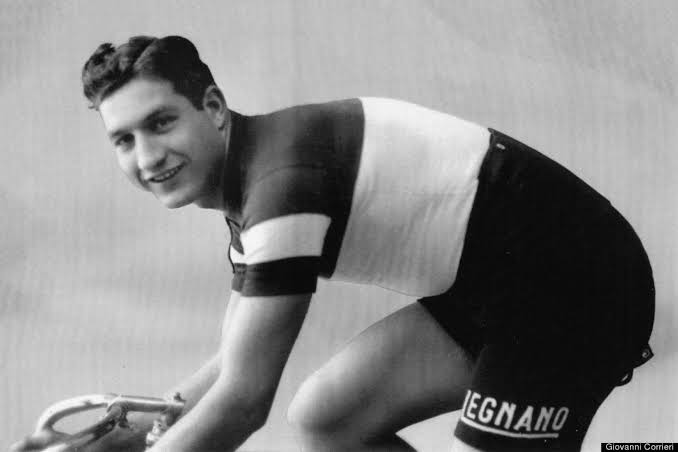
At 17, Bartali entered his first amateur race. He won. His raw talent on two wheels was unmistakable — powerful legs, relentless endurance, and a quiet determination that would define his entire life. By 1935, he had turned professional with the Frejus team. The following year he joined Legnano, quickly making a name for himself on Italy’s punishing road circuits.
King of the Road: Giro and Tour Victories
Bartali’s breakthrough came at the 1936 Giro d’Italia. At just 21 years old, he dominated the race, winning three stages and taking the overall classification. He repeated the feat the following year in 1937, cementing his reputation as Italy’s brightest cycling star.
Then came the Tour de France.
In 1938, Bartali entered his first Tour and stunned the cycling world. He won the mountainous stage to Briançon and the individual time trial, becoming the first Italian ever to win the Tour de France. He returned home a national hero. Benito Mussolini’s fascist regime tried to claim him as a symbol of Italian supremacy, but Bartali — a devout Catholic and a quietly apolitical man — kept his distance from the regime’s propaganda.
The war ended his prime years. The Giro d’Italia was suspended from 1941 to 1945, and the Tour was canceled. Bartali’s career, like Europe itself, was put on hold.
The Secret in the Frame
When World War II broke out, Bartali was at the peak of his fame. But he was not just a cyclist — he was also part of a clandestine network organized by the Associazione Nazionale Partigiani d’Italia and the Archbishop of Florence, Cardinal Elia Dalla Costa.
The plan was simple and audacious. Bartali would go on long training rides through the Italian countryside — rides of 200 kilometers or more. Hidden inside the hollow tubes of his bicycle frame were false identity documents, photographs, and counterfeit papers. At prearranged points along the route, he would pass them to members of the resistance, who would then deliver them to Jewish families trying to escape deportation.
Bartali’s cycling fame was his perfect cover. No Nazi checkpoint would stop the legendary Giro champion. No soldier would think to search the bicycle of a man who had made Italy proud on the roads of France. Ride after ride, month after month, Bartali carried documents that meant the difference between life and death.
He never spoke about it. Not to his wife. Not to his children. Not even to his closest friends. When asked decades later about rumors of his wartime activities, Bartali would only say: “I was just a cyclist. I rode my bicycle.” His son later revealed that his father rarely discussed those years and would become visibly uncomfortable when the subject came up.
The exact number of people Bartali saved may never be known. Historians estimate it was at least 800.
The Impossible Comeback
After the war, Bartali returned to cycling at an age when most champions had already retired. He was in his mid-thirties, with a decade of lost racing miles behind him. Many thought he was finished.
He proved them wrong.
In 1946, he won his third Giro d’Italia. But the greatest moment was yet to come. In 1948, at the age of 34, he won the Tour de France — 10 years after his first victory in 1938. This remains the longest gap between Tour de France victories in history. He staged a magnificent comeback on the brutal Alpine stage to Briancon, attacking alone in the rain and building a lead of over seven minutes. The news electrified Italy. Crowds poured into the streets in celebration.
Bartali’s rivalry with younger champion Fausto Coppi defined Italian cycling in the post-war years. The two men were opposites — Coppi the modern, elegant champion and Bartali the gritty, traditional fighter — but they pushed each other to extraordinary heights.
A Secret Carried to the Grave
The full story only emerged after Bartali’s death on May 5, 2000, at the age of 85. In 2013, Yad Vashem posthumously awarded him the title of “Righteous Among the Nations” — the highest honor given to non-Jews who risked their lives to save Jews during the Holocaust.
His bicycle, the same one he used to smuggle documents, was later displayed at the Yad Vashem museum in Jerusalem. In 2013, a plaque was unveiled in his honor at the Gino Bartali Cycling Sports Center in Florence. In 2018, the Italian government declared May 5 as “Gino Bartali Day.”
Gino Bartali lived two lives. One was lived in front of cheering crowds, crossing finish lines in triumph. The other was lived in silence — on lonely roads, with a bicycle frame full of paper, and the weight of hundreds of lives balanced on his handlebars. He never sought recognition. He never told his story. He simply rode.