Five Million Dollars and the Love of the Cuban People
In 1977, an American boxing promoter flew to Havana.
He brought a contract. It read five million dollars—five million in 1977, enough to buy a building in Manhattan or make a man forget what a bill looked like. The contract was for a heavyweight fight: Teófilo Stevenson versus Muhammad Ali. Ali was past his prime but still the one name that could set the world on fire. Stevenson was twenty-four, fresh off his second Olympic gold medal at Montreal, standing at the golden intersection of skill, power, and timing that no amateur heavyweight had ever occupied before.
The promoter sat in a hotel and waited for an answer.
Stevenson’s reply, relayed through official Cuban sports media, came as a single sentence. It would be translated into dozens of languages, printed on posters, used in documentary opening sequences, carved into the hardest stone of Cuban sports history. He said: “I would rather have the love of the Cuban people than their five million dollars.”
What that sentence weighs depends entirely on how you weigh it.
Some weigh it as loyalty. Some weigh it as naivety. Some weigh it as a young man caught inside the walls of revolutionary rhetoric, making a choice—or having a choice made for him. But however you scale it, the sentence is not as simple as it looks. Because when Stevenson said it, he understood exactly what five million dollars meant. He was not naive.
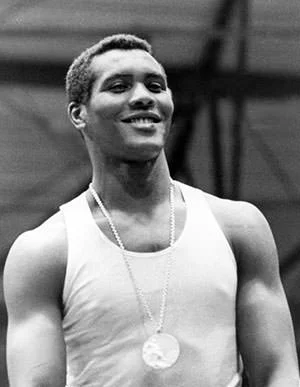
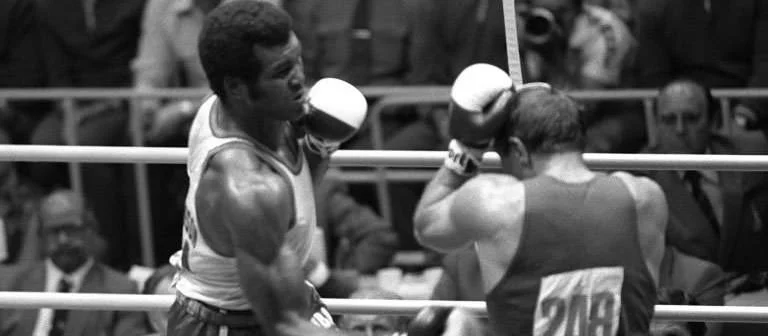
Teófilo Stevenson was born in 1952 in a small town in eastern Cuba, the son of an immigrant sugar mill worker from Saint Vincent. He started boxing at fourteen—late by the standards of the sport—but Cuba’s boxing system was the most powerful amateur machine in the world. He was selected, trained, shaped into a human apparatus built for the Olympic Games. He stood six-foot-five with an eighty-inch reach, and his right hand was said to be capable of punching through a thin wall. Starting with the Munich Olympics in 1972, he won three consecutive heavyweight gold medals—Munich, Montreal, Moscow. Three finals, three knockouts. Only two men in Olympic history have won three heavyweight golds. He was one of them.
But the title—”the greatest heavyweight in amateur boxing history”—always carries a qualifier, no matter how you phrase it: amateur. In boxing, a wall divides amateur from professional. Professional means money, global broadcasts, becoming a name like Muhammad Ali. Amateur means honor, national honor, winning fight after fight on the margins of world sport that no one pays to watch.
In 1977, the wall was pushed right up against Stevenson’s face. He only had to say one word—”Sí”—and he could cross it, into the lights of Las Vegas, into five million dollars, into a fight with Ali that would define the century. Nobody doubted he could compete. Ali, asked about it years later, smiled and gave no direct answer. He said only: “That Cuban is a mystery.”
Stevenson never crossed the wall. He stayed on his side. He kept fighting as an amateur, won his third gold in Moscow in 1980, and retired. He never fought a single professional match. His personal friendship with Fidel Castro became part of Cuban sports mythology. His loyalty was written and rewritten, turned into children’s book stories—”The Cuban Hero Who Refused the Money.” He worked for the Cuban boxing federation after retirement, training the next generation. He was not rich, but he was not poor—in Cuba, an Olympic champion wants for nothing essential. He had an apartment in Havana with a view of the sea.
He died in 2012. He was sixty. Two years before his death, a journalist asked him one last time about Ali. He was an old man by then, white-haired, speaking slowly, every word weighed. What he said, in essence, was: I have no regrets. I never fought to fight someone. I fought to win. I won.
That is a different unit of measurement. Not dollars. Not the love of the people. Not revolutionary loyalty. Just: I won. He won three Olympic gold medals. He won almost every fight he entered. What he never won was the fight that never happened—Stevenson versus Ali, the greatest amateur against the greatest professional. That fight exists only in the hypothetical, and precisely because it never happened, it remains eternal. In the hypothetical, he can still win. In the hypothetical, he never has to age, never has to be beaten, never has to be humiliated by a jab in the twilight of his career.
Ali’s late fights are hard to watch—the loss to Larry Holmes, the loss to Trevor Berbick, a man who once moved like lightning suddenly moving like someone pressed the slow-motion button. Stevenson never went through that. His career ended on a perfect period: his third Olympic gold in Moscow, 1980. He never lost a professional fight because he never fought one.
So the question—was his refusal of Ali an act of courage or of fear? Loyalty or a reluctance to risk?—may have been the wrong question from the start. Maybe what he refused was not Ali. Maybe what he refused was a way of life that required him to keep proving himself. Win a fight, you have to win the next one. Take a title, they ask when you’ll take the next. Professional boxing is a trade where the word “enough” does not exist. What Stevenson said in the face of five million dollars may not have been “I am loyal to the revolution.” It may have been “I have enough.”
It was the same word the Japanese swimmer Hidemi Hirayama said after crossing the English Channel: “I swam it. Then it was over.” The difference is that Stevenson’s “enough” was wrapped in political language for so many years that no one dared peel it back to see what was underneath.
We won’t peel it back either.
We only know this: a Cuban boxer named Teófilo Stevenson said no to five million dollars in 1977. He never left. He spent his life in Cuba. He fought in three Olympics and won three gold medals. He never fought Muhammad Ali. That fight is still there, in the hypothetical, intact, forever young.

Tags: #TeófiloStevenson #CubanBoxing #Olympics #MuhammadAli #AmateurVsProfessional #SportsAndChoice
Sources: International Olympic Committee official archives; 1972, 1976, 1980 Olympic boxing competition footage; multilingual international media coverage of Stevenson’s 1977 refusal; retrospective interviews, circa 2010.