2026年6月7日 Stories worth reading. Perspectives worth sharing.
She Took Off Her Hat and Won Gold
Other Sports

She Took Off Her Hat and Won Gold

Avatar photo
Clara June 6, 2026 5 min read

July 1912, Stockholm. The Fifth Olympiad.

Marguerite Broquedis walked onto the grass tennis court and did something that, in that year, was almost unthinkable. She took off her hat.

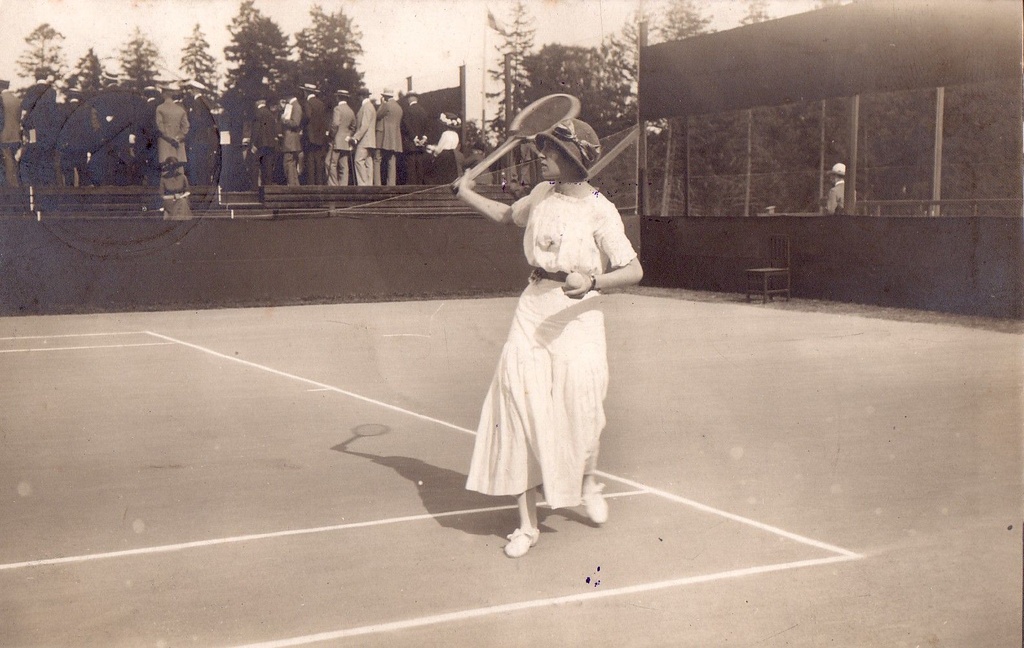
The summer sun fell directly on her hair. A murmur stirred in the gallery. She was not wearing the standard uniform of women’s tennis—the wide-brimmed hat, the long-sleeved blouse buttoned at the wrist, the ankle-length skirt. Her dress was hemmed a few inches higher. Her sleeves were rolled past the elbows. Her hat was not on her head but on the chair by the sideline. She stepped into a court bleached white by sunlight, her bare forearms and uncovered face making her look lighter than her opponent by an entire era.

She was nineteen years old. The first Olympic gold medal in women’s singles tennis for France was taking shape on her racket.

Women’s tennis in 1912 had an unwritten but rigorously enforced dress code. Hats were mandatory. Wide brims, tied under the chin, concealing the hair and most of the face. Long sleeves, fastened at the wrist. Skirts must cover the ankles. Playing a three-set match in this ensemble was less an athletic contest than an exercise in endurance. The fabric, soaked through with sweat, could gain several pounds. The brim blocked the sightline on the serve. The skirt snagged on every sprint.

Broquedis—a nineteen-year-old from the suburbs of Paris—dismantled these rules one by one. Hat off. Sleeves up. Skirt shortened. She issued no manifesto, demanded no reform, wrote no essay arguing for the necessity of athletic dress freedom for women. She simply placed her hat on the chair before the match and walked onto the court.

Her opponent in the final was Dorothea Köring of Germany. Köring wore the full regulation uniform—hat, long sleeves, long skirt. Broquedis lost the first set, then rallied to win the next two. The score was 4–6, 6–3, 6–4—women’s matches were still best-of-three. France had its first Olympic women’s tennis champion.

You could read this match as a footnote in a century-old history of women’s sports. But what I want you to notice is not the score. It is the hat on the chair. It sat there the entire match. The breeze occasionally stirred the tie strings. It stayed where it was—a piece of old equipment left on the shore while a small boat sailed farther out.

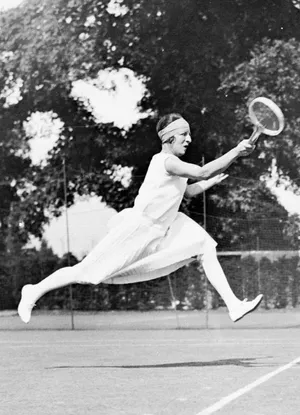
Broquedis was an anomaly in her era, and not only because of what she wore. Her game was different from the standard women’s tennis of the time, which revolved around baseline rallies, slow pace, light contact—a game considered suitably “graceful” for women. Broquedis was not that kind of player. She came to the net. She volleyed. She lunged for the ball the way the men did. Her service motion was large—high ball toss, distinct body rotation, weight shifting forward—all of which, in 1912, were considered ungraceful movements for a woman. But the ball landed in. Every point counted.

After the Olympics, she competed on the French and international circuit for nearly a decade. In 1913 and 1914, she won the French Tennis Championship—the precursor to what would become Roland Garros. She was the finest French female player of her generation and quite possibly the European player most willing to break the rules of dress. She later married a French journalist and became Marguerite Billout-Broquedis. After retiring in the 1920s, she faded from public view and died in 1963, at the age of eighty.

Her name is rarely mentioned in France today. Tennis history remembers Suzanne Lenglen—the empress of the 1920s, the woman who would dominate the sport with flapper daring and celebrity glamour—not the girl who, back in Stockholm in 1912, before anyone had begun to question the word “grace,” took her hat off and set it aside.

But the hat came off first. The skirt was shortened first. The sleeves were rolled first. These acts have no trophy, no monument. They happened in a corner no one was watching—a grass court marked by white lines in a Stockholm summer, a nineteen-year-old French girl placing her hat on a chair before her serve.

Then she won.

Every step of freedom in women’s sport was won not by declarations. It was won by a hat removed. A sleeve rolled. A skirt hemmed a few inches higher. A person making a small decision at the starting line—she would not wear it, she would let her hair catch the light, she would let the sun fall on her face, she would move across this court faster, lighter, freer than anyone else.

Then—only then—win the match.

Tags: #MargueriteBroquedis #FrenchTennis #1912Olympics #WomenInSport #DressCodeFreedom

Sources: 1912 Stockholm Olympic Games official records and photographic archives; French Tennis Federation historical documentation; European women’s sports history scholarship; 1912–1914 French Tennis Championship records.

Leave a Comment