
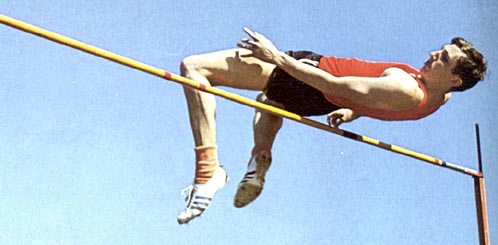
Dick Fosbury: The Man Who Jumped Backward and Changed Sports Forever

The Teenager Who Refused to Jump Normally
In 1963, Dick Fosbury was a 16-year-old high school student at North Medford High School in Oregon. He was not a natural athlete. The standard high jump technique at the time — the straddle, where the jumper clears the bar belly-down — did not work for him. He kept knocking the bar off.
So he improvised. He leaned back, arched his body over the bar headfirst, and landed on his back. It looked wrong. It looked ridiculous. His coaches told him to stop. His competitors laughed. But he kept clearing the bar.
Oregon State and the Birth of the Flop
Fosbury took his unconventional technique to Oregon State University. His coach, Berny Wagner, tried to change him — for two years. Nothing worked. Fosbury’s backward method was simply more effective for his body type. Wagner finally gave up and let him jump his way.
In 1968, Fosbury cleared 2.21 meters at the NCAA championships, winning the title. The technique now had a name: the “Fosbury Flop.” The track world began to take notice.
Mexico City 1968
At the 1968 Mexico City Olympics, the high jump final brought together the best jumpers in the world. Fosbury was the only one using the Flop. The crowd watched in disbelief as he approached the bar, curved his run, turned his back, and arched over.
He cleared 2.24 meters — an Olympic record. Gold medal. The stadium erupted. A journalist wrote: “He looks like a man falling out of a window.” But the window was 2.24 meters high, and he was falling upward.
The Technique That Took Over
After 1968, the Fosbury Flop spread rapidly. Within a decade, most elite jumpers had abandoned the straddle for the Flop. By the 1980s, the Flop was universal. Every Olympic high jump gold medal since 1972 has been won using the Fosbury Flop. Javier Sotomayor’s world record of 2.45 meters (1993) was jumped with the Flop.
Fosbury did not invent the concept of an arching back — but he was the first to prove it could work at the highest level. His willingness to look foolish changed the sport forever.
What He Left Behind
Fosbury returned to Oregon and became a civil engineer. He never sought the spotlight. He rarely gave interviews. But his name lives on in every high jump competition, every time an athlete turns their back to the bar and arches into the unknown.
He died on March 12, 2023, at the age of 76 — after changing the sport more than anyone since the invention of the starting gun.

References
- Olympedia — Dick Fosbury
- World Athletics — Dick Fosbury profile
- Encyclopaedia Britannica — Dick Fosbury
- Sports Illustrated — “The Flop That Changed the World” (1968)