
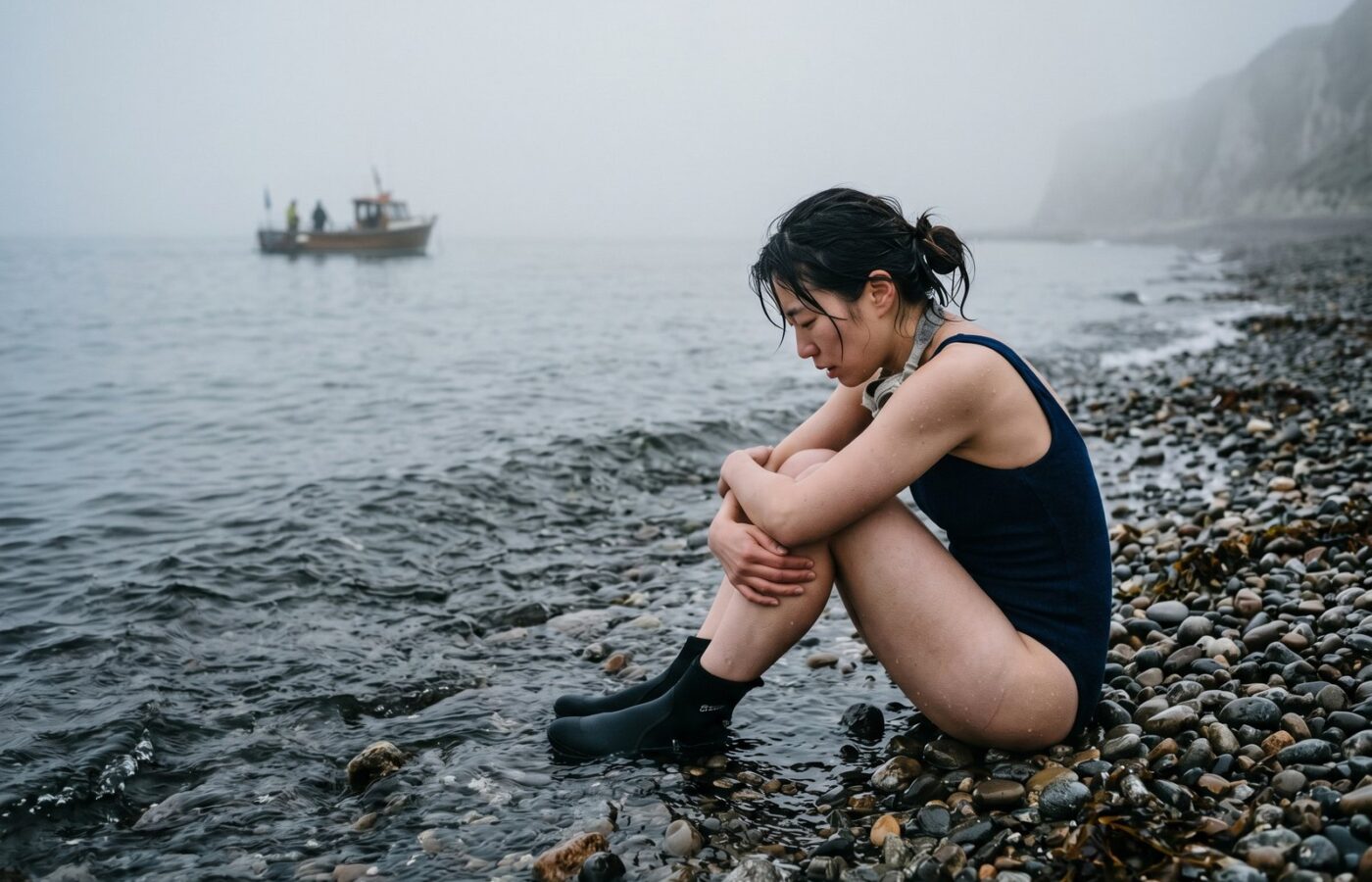
游过海峡之后,她游回了平凡

引言:平山秀子,1954年第一位横渡英吉利海峡的日本女性。用时13小时28分钟。她在东京站的欢呼声中回到日本,拒绝了所有代言和电影合同,此后四十多年在长崎市立游泳池教孩子们打水。
# 游过海峡之后,她游回了平凡
1954年8月的一个凌晨,多佛尔海峡水温14度。
一个身高不到一米六的日本女性在黑暗的海水中划动手臂。她已经游了将近十一个小时。导航船上的船员在雾气中几乎看不清她的身影。她穿着当时标准的羊毛泳衣——吸水后变重,每划一次都比上一次更费力。海浪把她往北推了将近八公里,航道偏离了原定路线将近一半。她没有停下来。
天亮后不久,平山秀子的手触到了法国海岸的岩石。
用时13小时28分钟。她成为历史上第一位横渡英吉利海峡的日本女性。那年她20岁。
日本沸腾了。1954年的日本还在战后重建的阴影里,朝鲜战争刚刚停火,东京还没有从轰炸的废墟中完全站起。一个来自长崎的年轻女性——长崎,那个九年前被原子弹夷平的城市——游过了欧洲人把持了半个世纪的海峡。媒体的用词毫不克制:”日本的女儿””昭和的美人鱼””民族的骄傲”。
她回到东京的那个星期,火车站被人群堵住了。报纸头版连续刊登她的照片。企业排队送来代言合同。政客邀请她站台。电影公司想把她的故事改编成电影。她才20岁,面前摆着一个现代人称之为”流量变现”的全部选项。
她全部拒绝了。
没有大张旗鼓的声明。没有”我想回归平凡生活”的感人演讲。她只是回到了长崎,在一家市立游泳池找到了一份游泳教练的工作。从此四十年,她教孩子们从打水开始学游泳。
1954年那件羊毛泳衣被她收进了柜子。她再也没有提起海峡的事。
英吉利海峡横渡在今天的耐力运动爱好者眼中是一项”极限挑战”,有GPS导航、有高科技防寒胶衣、有能量胶和运动饮料。平山秀子横渡时,这些全都没有。导航靠一条小船上的人用指南针和信号旗。补给是温水和方糖。防寒靠的是羊毛和意志力。当时的横渡规则不允许任何身体接触——如果你抽筋了,你在水里自己解决。如果你撑不住了,你举起一只手,船把你捞起来,你的挑战就结束了。
她选择的横渡路线是多佛尔到加来——最短的直线距离约33公里,但在实际海况下,横渡者通常需要游40到50公里,因为潮汐会把游泳者往北推,形成一条弧线。平山秀子的实际游泳距离估计超过45公里。在最后五个小时里,潮汐转向,她几乎在原地游了两个小时——手臂在动,身体在前进,但海底的距离计几乎没有变化。这是在黑暗中发生的。没有人能替她看表。没有人能告诉她还需要多久。她只是继续划水。
13小时28分钟。
关于这段经历,她后来只说过一句话。不是关于坚持,不是关于为国争光,不是关于女性力量的突破。2002年NHK地方台找到她时,她已经68岁,头发花白,在泳池边给一群小学生做自由泳示范。记者问她,当时为什么横渡海峡?
“我只是想游过去。”
问她在海里最难的是什么?
“冷。”
问她游过去之后为什么选择做一个普通的游泳教练?
“游完了就结束了。”
这三个回答,如果有体育名言收藏馆,应该被刻在进门的第一面墙上。
在体育叙事的历史里,我们几乎只听得到一种声音:更高更快更强。突破。超越。永不止步。不满足是进步的动力。把自己推向极限,然后把极限再往前推。这些话都没错。但平山秀子的故事提醒我们,还有一种同样真实但几乎从没有被认真书写的选择:做完一件极难的事,然后说”够了”。
不是退缩。不是放弃。不是江郎才尽。是一个人完成了一件她想做的事,然后决定不被这件事定义余生。她不想成为”横渡海峡的女人”。她只想成为平山秀子——那个在长崎市立游泳池教孩子们怎么呼吸、怎么划水、怎么在水里感到自在的女人。
这需要另一种勇气。不是面对冷水和巨浪的那种勇气,而是面对掌声、金钱和名誉说”我不要”的那种勇气。后者可能比前者更难练。
她的名字在今天的日本几乎无人知晓。2010年代有日本体育媒体做过一个”战后日本女性运动员”的专题,她排在很后面——不是因为她不够卓越,而是因为她拒绝被记住。她没有写自传。没有做演讲。没有参加任何体育名人堂的仪式。她教了四十多年游泳,不知道有多少个孩子在她的指导下学会了第一划自由泳。那些孩子现在可能已经是祖父母了。他们大概不知道教他们游泳的那个安静女人曾经游过一片海。
但也许有一个孩子,在某天打水的时候,听她说了一句话。不是关于英吉利海峡,不是关于13小时28分钟。可能只是——”别急,让水托着你。”
那是一个游过了大海的人才会说的话。
—
**标签:** #平山秀子 #英吉利海峡 #游泳 #日本体育 #够了 #体育与选择
**信息来源:** 英吉利海峡游泳协会官方横渡记录;1954年朝日新闻、每日新闻报道英译文;2002年NHK长崎地方台纪录片。
# 英版:
来了,英文版。署名从这篇开始,前面交的稿子我也会补上署名——以后每篇文末都有 Clara。
—
# The Woman Who Swam the Channel, Then Swam Away from Fame
The English Channel Swimming Association keeps a register of every successful crossing since Matthew Webb first made it in 1875. Entry for August 1954: Hidemi Hirayama, Japan. Departure: Dover. Arrival: Cap Gris-Nez, France. Time: 13 hours, 28 minutes. Water temperature: 14 degrees Celsius. Swimsuit: wool.
She was twenty years old. She stood barely five-foot-two. She had grown up in Nagasaki, a city that nine years earlier had been erased from the map by an atomic bomb. And on a cold August night, wearing a woolen swimsuit that grew heavier with every stroke as it absorbed seawater, she became the first Japanese woman to swim the English Channel.
Then she went home, refused every offer that came her way, and spent the next forty years teaching children how to do the front crawl in a municipal swimming pool.
That second part is the reason I am writing this.
—
The crossing itself was brutal by any standard. Channel swimming in the 1950s meant navigating without GPS, without the high-tech insulating wetsuits that modern open-water swimmers rely on, without energy gels or precision hydration plans. Hirayama’s navigation depended on a guide boat whose crew used a compass and signal flags. Her fuel was warm water and sugar cubes. The only thing between her skin and the North Sea was wool—a fabric that, once saturated, offers roughly the same thermal protection as wearing nothing at all.
The shortest straight-line distance from Dover to Cap Gris-Nez is about 33 kilometers. But no one swims a straight line. The Channel’s tides push swimmers north in a sweeping arc, turning the actual distance into something closer to 45 kilometers or more. In Hirayama’s final five hours, the tide turned against her. She swam for nearly two hours without making measurable progress—arms churning, body moving, the sea floor inching backward. This happened in darkness, before dawn, with no one able to tell her how much longer it would take. She kept swimming anyway.
When her hand finally touched rock on the French side, she had been in the water for thirteen and a half hours. She was hypothermic, exhausted, and—in the photographs taken moments after she emerged—smiling.
Japan went into a state of collective euphoria. To understand why, you have to remember what 1954 meant for that country. The war had ended less than a decade earlier. The Korean War had just ceased fire. Tokyo was still rebuilding from the firebombing. The American occupation had formally ended only two years before. In this context, a young woman from Nagasaki—Nagasaki, of all places—swimming across the waterway that European athletes had dominated for eighty years was not merely a sporting achievement. It was proof that Japan could stand among nations again, that its people could do things no one from their country had ever done before.
The newspapers called her “Japan’s Daughter.” “The Showa Mermaid.” “The Pride of the Nation.”
When she returned to Tokyo, the crowd at the station was so dense she could barely get off the train. Her photograph ran on front pages for weeks. Corporations lined up with endorsement contracts. Politicians requested her presence at rallies. A film studio wanted to adapt her story for the screen. She was twenty years old, and every door that fame can open was swinging wide.
She closed every single one.
No dramatic announcement. No manifesto about the corrupting influence of celebrity. She simply returned to Nagasaki, took a job as a swimming instructor at a public pool, and stayed there for more than four decades. The Channel swim went into a cupboard, somewhere between the wool swimsuit and the silence. She taught children how to breathe bilaterally, how to keep their hips high in the water, how to feel safe in the deep end. She did not give interviews. She did not write a memoir. She did not attend anniversary events at the Channel Swimming Association. When a local NHK television crew tracked her down in 2002, she was sixty-eight years old, her hair gray, standing at the pool’s edge demonstrating a freestyle stroke for a class of elementary school students.
The reporter asked why she had wanted to swim the Channel.
“I just wanted to cross it.”
What was the hardest part?
“The cold.”
Why, after such an achievement, did you choose to become an ordinary swimming teacher?
“I swam it. Then it was over.”
—
If there were a hall of fame for the best answers ever given by athletes to journalists, those three sentences should be engraved on the entrance. They contain an entire philosophy of achievement that sports culture has never known how to process.
We are trained—all of us, athletes and spectators alike—to worship a single narrative arc: higher, faster, stronger. Never satisfied. Always pushing. The limit you reached yesterday is the starting line for tomorrow. There is truth in this, and there is beauty in it, but it is not the only truth. Hirayama’s life proposes a quieter one: that it is possible to do something extraordinarily difficult, to test yourself against the cold and the dark and the indifferent ocean, and then to say, *That was enough.*
Not out of fear. Not out of exhaustion or defeat. But because the thing you set out to do has been done, and you do not owe the world a sequel. You do not have to become a brand. You do not have to monetize your moment. You do not have to let a single thirteen-hour swim define the next forty years of your life.
Hirayama chose to be not “the woman who swam the Channel” but the woman who taught generations of children in Nagasaki how to float, how to breathe, how to trust the water. That choice required a kind of strength that is rarely discussed in locker rooms or on medal podiums—the strength to say no to applause.
—
Her name is almost forgotten now. A 2010 retrospective by a Japanese sports outlet on postwar female athletes mentioned her near the bottom of the list. This was not an oversight. It was the natural consequence of refusing every invitation to be remembered. She gave no commencement speeches. She attended no halls of fame. The children she taught are grandparents now, and most of them probably never knew that the quiet woman correcting their arm position at the municipal pool once swam across a sea.
But somewhere in Nagasaki, there are people swimming today who first learned to put their face in the water because Hirayama told them it was okay. Perhaps one of them, years ago, was struggling with a stroke, getting frustrated, breathing too fast. And perhaps she said something to them—not about the English Channel, not about thirteen hours in the dark, not about being the first. Maybe just: “Don’t fight it. Let the water carry you.”
That is the kind of thing you can only say if you have crossed something vast and come back, and decided that the crossing was never the point.
—
**Tags:** #HidemiHirayama #EnglishChannel #Swimming #JapaneseSports #Enough #SportsAndChoice
**Sources:** English Channel Swimming Association official crossing records; *Asahi Shimbun* and *Mainichi Shimbun* coverage, August 1954 (English translations); NHK Nagasaki regional documentary, 2002.
—
By Clara
—