
The Man the GDR Couldn’t Break — Wolfgang Lötzsch, the Cyclist Who Beat the System

The Rise
Wolfgang Lötzsch was born on December 18, 1952, in Chemnitz — then called Karl-Marx-Stadt — in the German Democratic Republic. From an early age, his talent on a bicycle was unmistakable. He became a three-time winner of the Spartakiade, the GDR’s youth sports competition designed to identify future Olympians, and a four-time GDR junior champion in cycling.
In November 1971, at eighteen, Lötzsch was selected for the national cycling team. Two of the most prestigious events in the sport lay ahead: the 1972 Peace Race and the 1972 Summer Olympics in Munich. The state had invested in him, and he was delivering.
But the state expected more than athletic performance. It expected allegiance.
The Fall
Not long after his selection, Lötzsch was expelled from SC Karl-Marx-Stadt, the elite sports club behind his rise. The reasons were recorded in his Stasi file — three of them, each a capital offense in the GDR’s system of control.
First, he refused to join the SED — the Socialist Unity Party. In East Germany, Party membership was the gateway to every opportunity. An athlete of Lötzsch’s caliber was expected to accept as a matter of course. He declined.
Second, he had Western relatives. His cousin had fled to the West in 1964. In the GDR, a family member in the Federal Republic was a security risk — a vulnerability the Stasi could never close.
Third, he was suspected of planning to flee.
He was stripped of his elite club status and demoted to a factory sports club — a BSG (Betriebssportgemeinschaft). For a rider of his level, this was not a step down. It was a dead end. BSG riders trained on their own time, with their own equipment, without coaches or medical support. His Olympic dream was over.
The Defiance
Lötzsch did not stop racing. He trained alone, maintained his own bicycle, showed up at races unsponsored, and kept winning.
In 1973 and 1974, he won the GDR national championship in the individual pursuit — beating riders from elite clubs who had everything he lacked. In the winter, he trained alone on frozen roads, his breath steaming in the cold, fixing his own chain by the side of the road when it snapped. He beat them anyway.
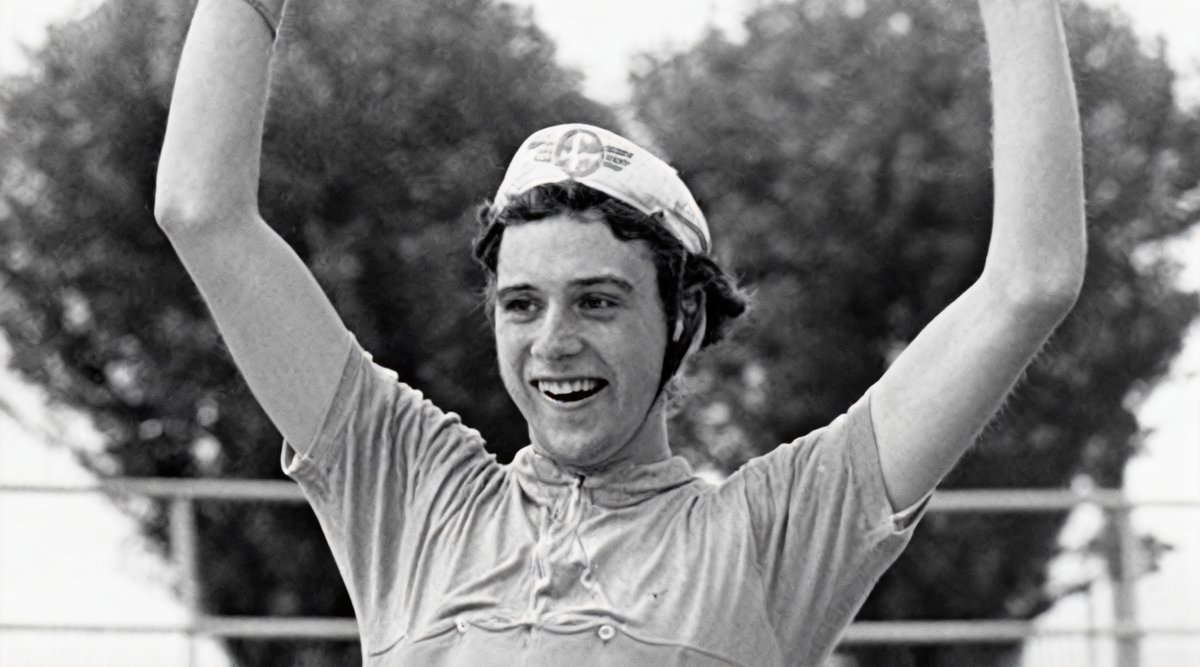
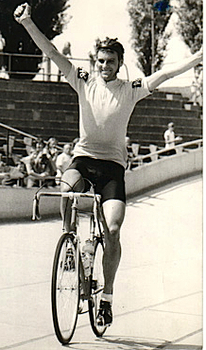
The crowning moment came in 1976. In the Olympic qualifying race — a single event that would determine who represented the GDR at the Montreal Games — Wolfgang Lötzsch, the factory club rider with no support system and no party membership, crossed the finish line first. He had beaten the entire cycling elite of East Germany.
The regime’s response was swift, bureaucratic, and absurd. They created a new regulation, unofficially known as “Lex Lötzsch” — a rule that formally prohibited BSG riders from competing against athletes from elite sports clubs. The qualifying race was retroactively nullified. He did not go to Montreal.
Lötzsch applied for an exit visa six times. Each was denied. His university place was revoked. In 1976, he was arrested, tried, and sentenced to ten months in prison for “Staatsverleumdung” — defamation of the state. Upon his release, he was banned from all competition until 1979.
The Vindication
When the ban expired, Lötzsch returned to racing. In 1983, he won Rund um Berlin, one of Germany’s classic one-day races. The state had done everything it could to erase him — demotion, a bespoke law, imprisonment, a multi-year ban — and still, when he was allowed on the road with other cyclists, he rode past them.
In 1985, after fifteen years of resistance, Lötzsch finally joined the SED. The decision was not conversion. It was exhaustion. He later described it simply as a decision to have peace. The Party that had punished him for staying out now accepted him without ceremony.
The Berlin Wall fell in 1989. East Germany dissolved. The system that had tried to break Wolfgang Lötzsch ceased to exist.
And then, in 1990, at age thirty-seven — an age when most cyclists have retired — he won the German national championship in the 100-kilometer team time trial. Twenty years after the regime tried to bury him, he was on top of his country’s podium, in a unified Germany that no longer had a Lex Lötzsch on its books.
In 1995, he received the Bundesverdienstkreuz — the Federal Cross of Merit — Germany’s highest civilian honor. A documentary, “Sportsfreund Lötzsch,” was made about his life in 2008. In 2012, he was inducted into the German Sports Hall of Fame. After his competitive career, he worked as a mechanic for professional cycling teams — a quiet man who fixed bikes for a living and carried a story that fewer than a dozen people knew in full.
Wolfgang Lötzsch is still alive. He fought the state openly, on a bicycle, over twenty years, and he won.
References
- German Sports Hall of Fame — Inductee profile: Wolfgang Lötzsch (2012)
- MDR Documentary — “Sportsfreund Lötzsch” (2008)
- Bundesverdienstkreuz records — Award to Wolfgang Lötzsch (1995)
- Der Tagesspiegel — “The Man Who Beat the Lex Lötzsch”
- Köster, Philipp. *Lötzsch: Der lange Weg eines Jahrhunderttalents*, 2004