
The Black Spider: How Lev Yashin Became the Only Goalkeeper to Win the Ballon d’Or

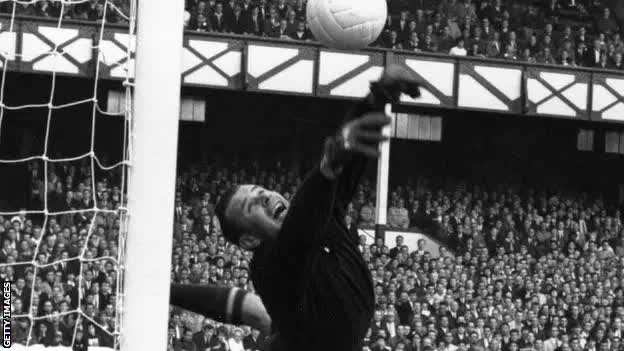
Goalkeepers rarely get the glory. Forwards score the goals, midfielders dictate the tempo, defenders are celebrated only in the quiet language of clean sheets. But once — just once — the football world paused and handed its most prestigious individual prize to a man in goal. His name was **Lev Ivanovich Yashin (Лев Яшин)**. They called him the Black Spider. He dressed in black from head to toe, wore a flat cap long after it went out of fashion, and saved over 150 penalty kicks across a career that spanned more than two decades. He is the only goalkeeper in history to win the Ballon d’Or, and no goalkeeper has won it since.
From Factory Floor to Goalmouth
Lev Ivanovich Yashin was born on October 22, 1929, in the working-class Moscow district of Bogorodskoye. His father was a factory worker, his mother a seamstress. The family lived in a communal apartment, and young Lev grew up surrounded by the noise and grit of Soviet industrial life. He left school at 16 to work at the Tushino aircraft factory, assembling military planes for the post-war Soviet military-industrial complex. It was hard, repetitive, joyless work.
But at the factory, Yashin also played. The Tushino factory had a sports club, and Yashin was a natural athlete. He was tall, long-limbed, and unusually coordinated. He played football as a forward and ice hockey as a goalkeeper. He was good at both, but a decision loomed. In 1949, he was invited to try out for Dynamo Moscow’s senior team. The coach took one look at his lanky frame and quick reflexes and told him: “You’re a goalkeeper.” Yashin was not convinced. He wanted to score goals, not prevent them. But he listened. It was the best decision he never made.
For his first two seasons at Dynamo Moscow, Yashin sat on the bench. He was the understudy to Alexei Khomich, a national hero known as “the Tiger.” Yashin learned by watching, absorbing, waiting. He made his senior debut in 1953, at age 23. He was immediately dropped after a poor performance. But Dynamo’s managers saw something in him — an unbreakable calm, a willingness to learn — and they kept him on. By 1954, he had claimed the starting spot. He would not relinquish it for 17 years.
The Style That Changed Goalkeeping
To understand Yashin’s impact, you have to understand what goalkeeping looked like before him. In the 1950s, goalkeepers were reactive. They stayed on their line, waited for shots, and did their best. There was no sweeping, no organizing the defense, no commanding the penalty area. Goalkeepers were expected to be the last line of defense, not the first line of attack.
Yashin changed that. He was the first goalkeeper to sweep — to rush off his line to intercept through-balls before attackers could reach them. He was the first to organize his defense, shouting instructions, pointing at markers, directing walls. He was the first to distribute with precision, throwing the ball to start counterattacks rather than just booting it downfield.
His agility was legendary. Despite his height (1.89 m / 6 ft 2 in), he moved across the goal line with the lateral quickness of a much smaller man. His reflexes were extraordinary — he once made a save with his foot while lying on the ground, a move that would later be imitated by goalkeepers around the world. He also had an uncanny ability to read the game, positioning himself before the shot was even taken.
And then there was the uniform. Yashin always wore black. All black — shorts, jersey, gloves, and his signature flat cap. The cap was practical (the Moscow sun could be harsh), but it became iconic. On the pitch, he was a silhouette, a shadow, a dark figure filling the goal. The Italian press nicknamed him “Il Ragno Nero” — the Black Spider. The name stuck.
The 1960 European Championship
Yashin’s first major international triumph came at the inaugural European Nations’ Cup in 1960. The Soviet Union defeated Yugoslavia 2–1 in a tense final in Paris. Yashin was named goalkeeper of the tournament. But it was the 1966 World Cup in England that cemented his global reputation. The Soviet Union finished fourth, their best-ever World Cup result. And Yashin was spectacular. He saved two penalties during the tournament and was widely considered the best goalkeeper on display.
His performances in England caught the attention of European journalists. In December 1963, just months before the 1964 European Championship, Yashin received the Ballon d’Or. The award was a shock to the football establishment. Goalkeepers were not supposed to win individual awards. They were the forgotten men of football, the ones who wore different colors and stood in different positions and were only noticed when they made mistakes. Yashin shattered that perception. “This is not just for me,” he said in his acceptance speech. “This is for every goalkeeper who has ever been overlooked.”
The 1966 World Cup and the End of an Era
The 1966 World Cup in England was Yashin’s last great tournament. At 37, he was the oldest player in the Soviet squad. He played every minute of every match, saving a penalty against Italy in the group stage and producing a man-of-the-match performance against Hungary in the quarterfinals. The Soviet Union lost to West Germany in the semifinals and finished fourth after losing to Portugal in the third-place match. But Yashin left England with his reputation enhanced. He was voted the best goalkeeper of the tournament a decade after his first World Cup appearance.
Yashin finally retired in 1971 at the age of 41. His farewell match was held at Moscow’s Lenin Stadium on May 27, 1971. The stadium was filled to its capacity of 102,000. The match was between Dynamo Moscow and a World XI that included legends like Pelé, Eusébio, and Garrincha. Pelé later called it one of the most emotional moments of his career. “I came to say goodbye to a man who was not just a goalkeeper,” Pelé said. “He was a symbol.”
Legacy
Lev Yashin passed away on March 20, 1990, at the age of 60, after a battle with stomach cancer. His death was mourned across the football world. FIFA awarded him a posthumous recognition, and Dynamo Moscow named their stadium after him.
Today, the Yashin Trophy (awarded by France Football since 2019) is given annually to the best goalkeeper in the world. It bears his name and his legacy. Every goalkeeper who lifts that trophy understands that they are walking in the shadow of the man in the flat cap.
Yashin’s story is not just about statistics or trophies. It is about a boy from the Moscow factories who refused to be ordinary. It is about a goalkeeper who turned his position from a necessary evil into an art form. It is about a man who wore black when everyone else wore color, who saved penalties with the calm of a librarian shelving books, and who proved, beyond any doubt, that goalkeepers belong in the pantheon of football’s immortals.

References
1. Wilson, Jonathan. The Outsider: A History of the Goalkeeper. Orion, 2012.
2. Edelman, Robert. Spartak Moscow: A History of the People’s Team in the Workers’ State. Cornell University Press, 2009.
3. Ballon d’Or Archive — France Football, 1963 edition profiles.
4. FIFA World Cup Technical Reports, 1958, 1962, 1966 editions.
5. UEFA. European Nations’ Cup 1960 — Tournament History and Match Reports.