
The Boy Who Ran Until He Couldn’t Anymore — The Life and Legacy of Steve Prefontaine

On the night of May 30, 1975, a burnt orange 1973 MGB convertible slammed into a stone wall on Skyline Boulevard in Eugene, Oregon. The driver was 24 years old. According to legend, he was wearing a t-shirt that read, “I’m going to run until I can’t run anymore.” His name was Steven Roland Prefontaine — Pre to everyone who loved him, and there were thousands. In his brief 24 years, he had set seven American records simultaneously, changed the way Americans thought about distance running, taken on the amateur sports establishment, and become the reason Nike exists today. This is his story.
Oregon Childhood
Steven Roland Prefontaine was born on January 25, 1951, in Coos Bay, a small logging and fishing town on the Oregon coast. He was not an obvious candidate for athletic greatness. He stood five feet nine inches and was stocky, built more like a wrestler than a runner. As a child, he was restless, competitive, and loud, always looking for a race he could win.
His father, Raymond, worked as a welder and carpenter. His mother, Elfriede, was a German immigrant. Money was not plentiful, but the family was tight-knit.
The landscape of Coos Bay shaped him. The foggy coastal mornings, the pine forests, the steep hills. He began running not because he loved it, but because he had energy to burn. He ran everywhere — to school, to the store, to the beach.
“The woods were my playground,” he once said. “I’d run through them for hours, just exploring. I never thought of it as training.”
Coos Bay High School Legend
By the time he reached Marshfield High School in Coos Bay, Prefontaine was already known as the kid who ran. But he was not yet a star. He did not make the track team until his sophomore year.
What changed Prefontaine was a single defeat. In a cross-country race against North Eugene High School, he was beaten badly. Prefontaine sat on the grass and cried. That night, he told his mother: “I’m going to beat that guy if it kills me.”
He began training with an intensity that shocked everyone. In his senior year, 1969, Prefontaine set the Oregon high school record in the mile at 4:06.9, and the national high school two-mile record at 8:41.5.
The University of Oregon and Bill Bowerman
Bill Bowerman was already a legend — the head coach of the Oregon Track and Field program, a former Olympian, an innovator who would later co-found Nike. He saw in Prefontaine something he had rarely seen in any athlete: a complete absence of fear.
Most runners race conservatively. Prefontaine did the opposite. He went to the front from the first lap and dared everyone to catch him.
Under Bowerman, Prefontaine’s VO2 max was tested at an astonishing 84.4 milliliters per kilogram per minute, one of the highest ever recorded. In his first NCAA outdoor championship in 1970, Prefontaine won the 3-mile and the 6-mile. He was undefeated in NCAA competition for his entire collegiate career.
Munich 1972
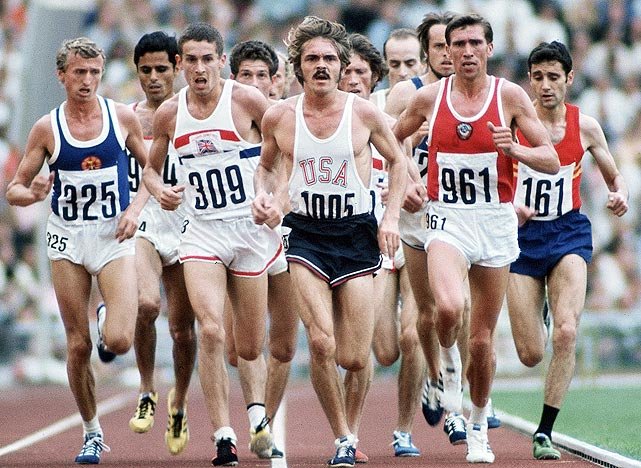
The 1972 Munich Olympics were the summit of Prefontaine’s career. He entered the 5,000 meters as the overwhelming favorite, holding the American record and a reputation for fearless front-running.
Prefontaine did what he always did. He went to the front. He led the race for most of the distance, setting a brutal pace. With 200 meters to go, he was still in the lead. But in the final stretch, three runners passed him. Prefontaine finished fourth, just two-tenths of a second away from a medal.
He was devastated. He sat on the track for a long time after the race, head in his hands.
But the fourth-place finish in Munich became part of his legend. He had not won a medal, but he had run the race his way — from the front, all the way, with no fear.
The Fight Against the AAU and the Birth of Nike
After Munich, Prefontaine became increasingly vocal about the state of amateur athletics in the United States. The Amateur Athletic Union (AAU) forbade athletes from earning money from their sport. Prefontaine was outraged. He began speaking out, giving interviews, and in 1973 testified before the United States Senate.
At the same time, Prefontaine was working with Bill Bowerman and Phil Knight on a small shoe company called Blue Ribbon Sports. They were designing running shoes in Bowerman’s kitchen, pouring rubber into a waffle iron. Prefontaine was their first sponsored athlete — the first person to wear a shoe that would one day be called Nike.
Death at 24
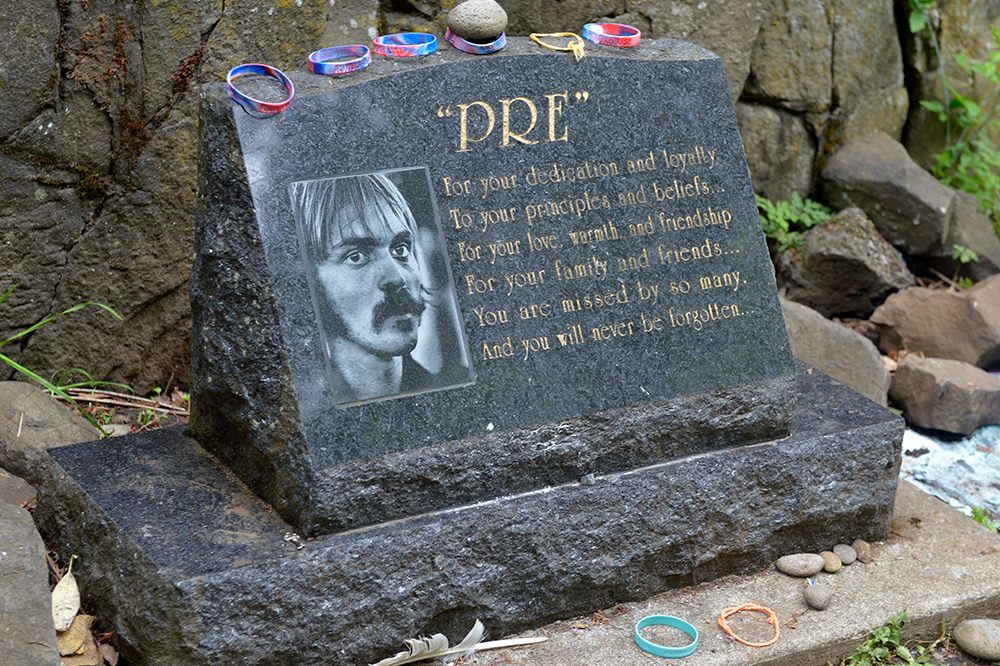
On the evening of May 29, 1975, Prefontaine attended a party near Eugene. He left late, driving his burnt orange 1973 MGB convertible along Skyline Boulevard. The road was dark, winding, and wet. About a mile from the party, the car left the road and struck a stone wall. Prefontaine died instantly. He was 24 years old.
The news hit Eugene like a shockwave. The flag at Hayward Field was lowered to half-staff. Bowerman was inconsolable. Phil Knight locked himself in his office.
His funeral was held in Coos Bay. Thousands attended. Bowerman gave the eulogy. “He was a throwback,” he said. “He ran like they did in the old days. He ran with his heart.”
Legacy — The Prefontaine Classic and Nike
In 1975, just months after his death, the University of Oregon renamed its annual track meet the “Prefontaine Classic.” It has since become one of the most prestigious track and field meets in the world.
Nike, the company Prefontaine helped launch, grew into the largest athletic footwear company on earth. Phil Knight has said repeatedly that Prefontaine was the soul of Nike.
His American records, his NCAA titles, his Olympic fourth-place finish — these are the statistics of his career. But his real legacy is harder to measure. He changed the way Americans ran. Before Prefontaine, distance running in the United States was a niche sport. After Prefontaine, Americans began to believe they could compete.
Steven Roland Prefontaine died at 24. But if you go to Hayward Field on a summer evening, when the track is quiet and the sun is setting, you can almost see him — stocky, fearless — running from the front, with nothing left to prove and no regrets at all.
References
1. Jordan, Tom. Pre: The Story of America’s Greatest Running Legend, Steve Prefontaine. Rodale Press, 1997.
2. Moore, Kenny. Bowerman and the Men of Oregon. Rodale Press, 2006.
3. Knight, Phil. Shoe Dog: A Memoir by the Creator of Nike. Scribner, 2016.
4. National Track and Field Hall of Fame: Steven Roland “Steve” Prefontaine — Biography and Career Records.
5. University of Oregon Athletics, Hayward Field History — The Origins of the Prefontaine Classic.