
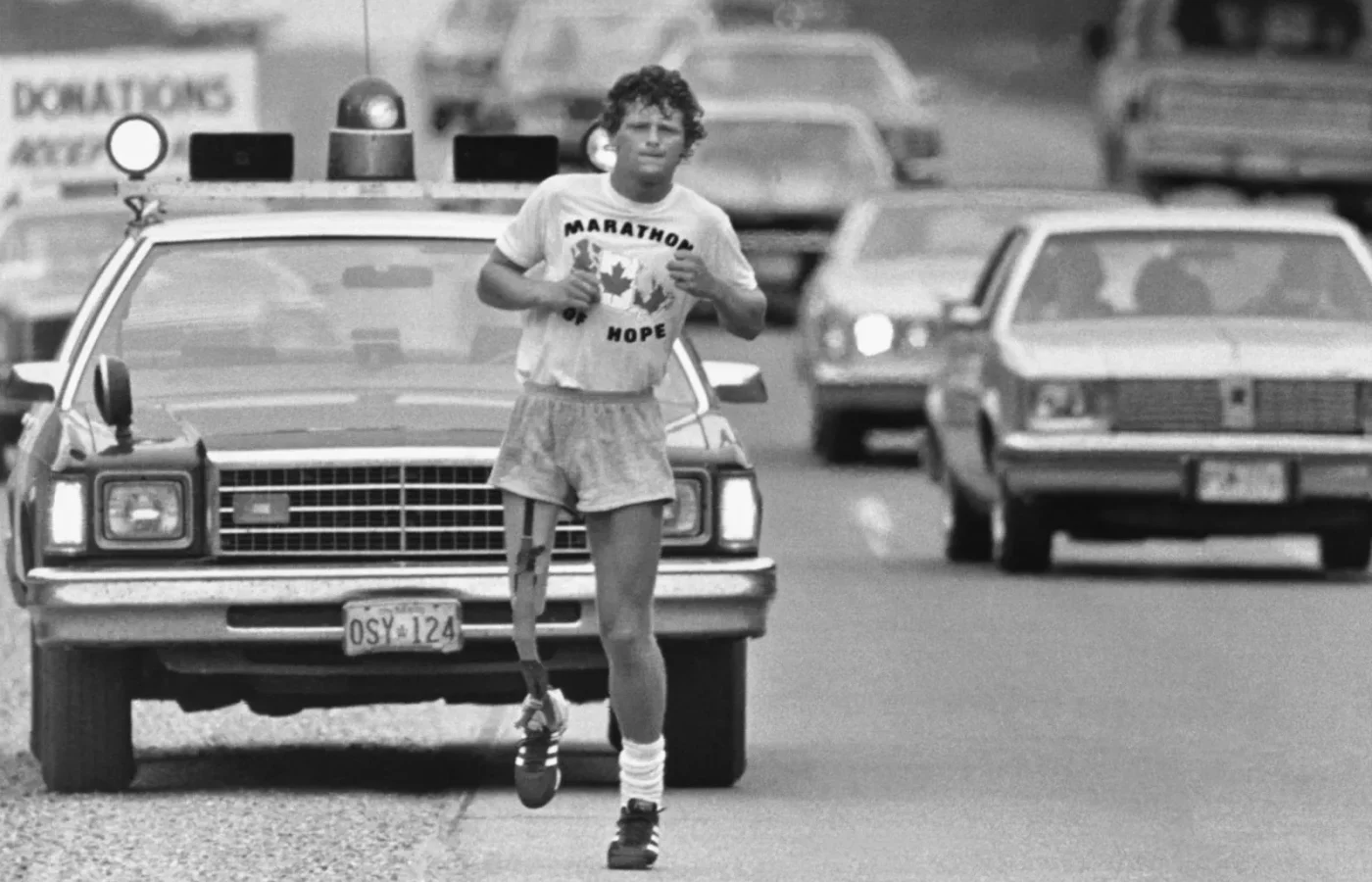
He Ran 5,373 Kilometers on One Leg. Then He Died at 22.

Terry Fox (July 28, 1958 – June 28, 1981) was a Canadian cancer research activist and long-distance runner who, after losing his right leg to osteosarcoma at 18, embarked on a cross-country run across Canada — the Marathon of Hope — covering 5,373 kilometers on a prosthetic leg over 143 days. His run ended when cancer spread to his lungs, and he died at age 22, but his annual Terry Fox Run now spans over 60 countries and has raised more than $850 million for cancer research.
The Diagnosis That Changed Everything
In 1977, Terry Fox was an active 18-year-old student at Simon Fraser University in British Columbia, passionate about basketball and distance running. He began feeling persistent pain in his right knee, which he initially dismissed as a sports injury. When the pain refused to subside, he visited a doctor — and received a devastating diagnosis: osteosarcoma, an aggressive form of bone cancer. To save his life, surgeons amputated his right leg 15 centimeters above the knee.
As Terry lay in the hospital bed recovering, he was struck by the suffering of the pediatric cancer patients around him — many of them far younger than himself. “Somewhere the hurting must stop,” he later wrote. That moment planted a seed: if he survived, he vowed to do something unforgettable for cancer research.
Building the Body, Planning the Run
The amputation did not slow Terry down. He was fitted with a prosthetic leg — a standard mechanical limb with a hinged knee and an artificial foot — and began the painful process of learning to walk again. Within months, he could walk. Within a year, he was running.
His goal was staggering: to run across Canada, from the Atlantic to the Pacific, covering a full marathon distance — 42 kilometers — every single day. No one had ever attempted such a feat, let alone an amputee with a prosthetic leg.
Terry began training in secret, running on back roads near his home in Port Coquitlam, British Columbia. His runs were brutal. The prosthetic leg was not designed for high-impact activity. It rubbed against his stump, causing bleeding and blisters that would never fully heal. He ran through pain, through exhaustion, through doubt. His companion, Doug Alward, drove a converted camper van behind him, carrying supplies and providing support.
The Marathon of Hope Begins
On April 12, 1980, Terry Fox dipped his artificial leg into the Atlantic Ocean at St. John’s, Newfoundland, and began to run west.
The first weeks were invisible. Few people knew what he was doing. He ran through rain, sleet, and freezing temperatures along the rugged Newfoundland coast. The prosthetic leg caused constant pain, but Terry refused to stop. He ran one marathon after another — day 10, day 20, day 30 — crossing into Nova Scotia, New Brunswick, Quebec, and Ontario.
As word spread, crowds began to gather. Small towns turned out to cheer. Donations poured in. By the time he reached Toronto, tens of thousands lined the streets. He had become a national symbol — a young man with one leg running for a cause greater than himself.
The Run That Ended Too Soon
By September 1980, Terry had covered 5,373 kilometers in 143 consecutive days. He was near Thunder Bay, Ontario, when he began coughing uncontrollably. A persistent pain in his chest would not go away. He visited a doctor, who delivered the news: the cancer had returned — this time in his lungs.
On September 1, 1980, after 143 days of running, Terry Fox stopped.
He was taken back to British Columbia for treatment. Canadians who had followed his journey were devastated. Donations, however, continued to pour in. Terry’s run had awakened a nation.
The Final Months
Chemotherapy could not stop the spread. Terry’s condition deteriorated through late 1980 and early 1981. His left lung collapsed. New tumors appeared. He spent his final months in the hospital, never reaching his 23rd birthday.
He died on June 28, 1981, at age 22, one month short of his 23rd birthday. The Canadian government ordered flags flown at half-mast — an honor usually reserved for heads of state. Tens of thousands attended his funeral, broadcast live on national television. Prime Minister Pierre Trudeau said in Parliament: “It occurs to me that Terry Fox’s body eventually gave out. But his spirit — that did not give out.”
Legacy: The Run That Never Stops
The Marathon of Hope ended in Thunder Bay, but the run that Terry started never stopped.
The first Terry Fox Run was held in 1981 — the year he died — attracting 300,000 participants across Canada. Today, the annual Terry Fox Run takes place in over 60 countries, with millions of participants. The Terry Fox Research Institute was established in 2007, carrying forward his mission to fund innovative cancer research.
To date, the Terry Fox Foundation has raised over $850 million for cancer research — the money Terry had hoped to collect himself, multiplied a hundredfold. Schools, hospitals, and research centers across Canada bear his name. In 1999, he was voted Canada’s greatest hero in a national poll.
Terry Fox ran 5,373 kilometers on one leg. He was 22 years old when he died. But before he left, he started something that the world refuses to let stop.
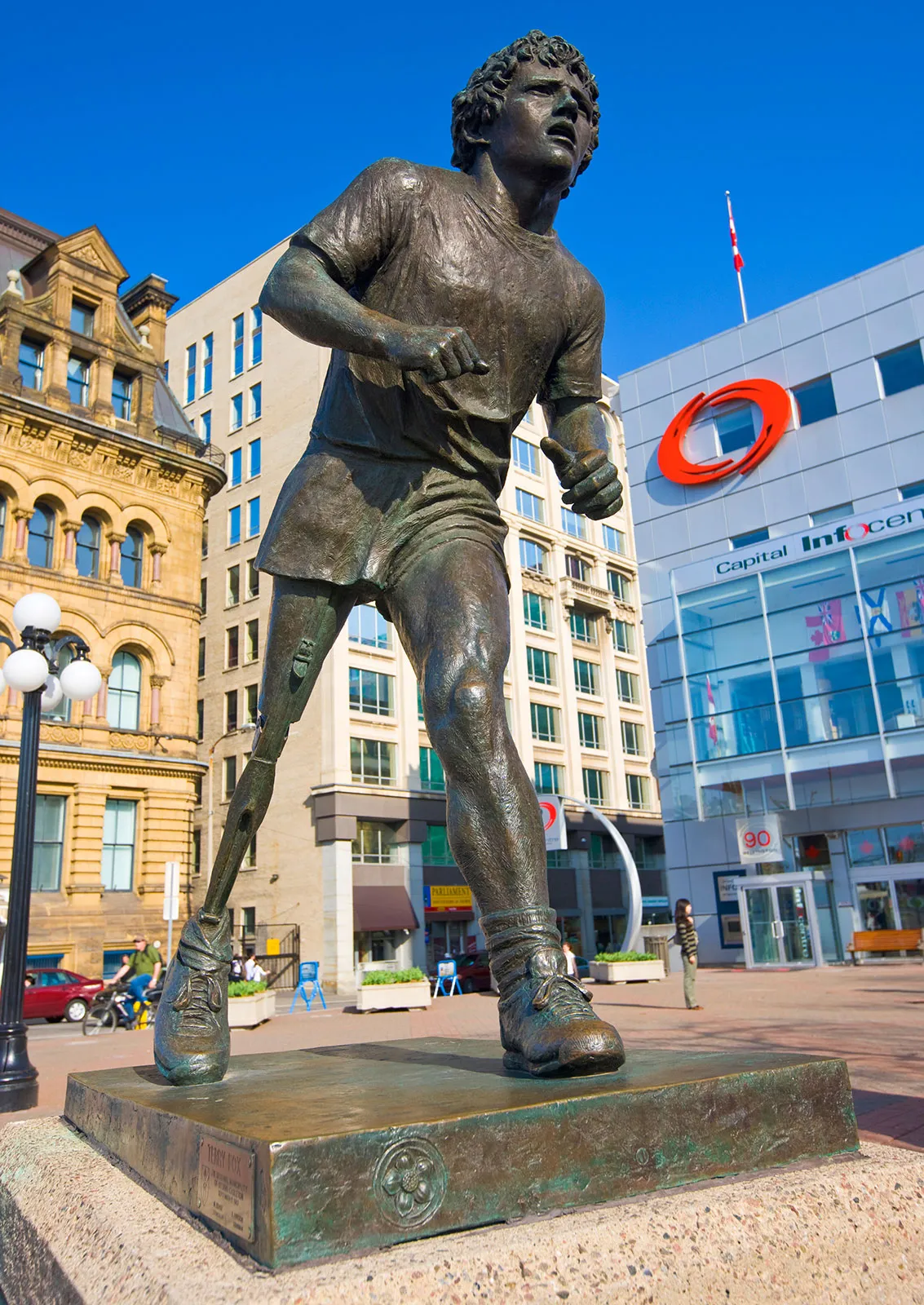
Terry Fox, statue in Ottawa, Ontario, Canada.
References
1. Terry Fox Foundation Official Website — Marathon of Hope Historical Records
2. Terry Fox: A Story of Hope by Maxine Trottier (2005, Scholastic Canada)
3. Canadian Encyclopedia — Biography of Terry Fox
4. Government of Canada — “Terry Fox: A Canadian Hero” biographical archive
5. The Terry Fox Research Institute — History and Impact Report