Two Fists Raised: The Silent Protest That Changed Sports Forever

The Making of Two Champions
Tommie Smith was born on June 6, 1944, in Clarksville, Texas, one of twelve children in a sharecropping family. His family moved to California when he was a child, and he discovered his sprinting talent at Lemoore High School. Smith attended San Jose State University, where he joined the famed Speed City track program under coach Bud Winter. By 1966, Smith was the dominant sprinter in the world. On May 7, 1967, at the NCAA championships, he ran 200 meters in 19.83 seconds — the first man to break 20 seconds legally (without wind assistance) — a world record that stood for eleven years. He also set a world record in the 400 meters (44.5 seconds) in 1967. Smith’s long, fluid stride and powerful finish made him virtually unbeatable over the final 100 meters.
John Carlos was born on June 5, 1945, in Harlem, New York City. He grew up in a rough neighborhood and was a gifted athlete from an early age. Carlos attended East Texas State University before transferring to San Jose State, where he trained alongside Smith. At 6-foot-3 and built like a middleweight boxer, Carlos possessed a rare combination of power and speed. In 1968, Carlos ran 200 meters in 19.92 seconds at the Olympic trials — though the mark was never ratified as a world record due to a shoe spike violation. He also ran 100 yards in 9.1 seconds, matching the world record. But in 1968, Carlos was still emerging as a world-class sprinter, largely in Smith’s shadow.
Both men were shaped by the civil rights movement that was sweeping America. At San Jose State, they joined the Olympic Project for Human Rights (OPHR), an organization founded by sociologist Harry Edwards that threatened a black athlete boycott of the 1968 Olympics to protest racial discrimination. Though the boycott never materialized, Smith and Carlos arrived in Mexico City determined to make a statement.
The Race: October 16, 1968
The men’s 200-meter final was one of the most anticipated events of the Games. Smith, the world-record holder, was the overwhelming favorite. Carlos, powerful and explosive, was a strong medal contender.
The race was over almost before it began. Smith exploded from the blocks and ran a flawless curve, entering the straightaway with a lead that only grew. He crossed the line in 19.83 seconds — equaling his own world record — and won the gold medal. Peter Norman of Australia took silver in 20.06 seconds. Carlos finished third in 20.10 seconds, winning bronze.
At the time, Smith’s victory was the headline. He had defended his title as the world’s fastest man over 200 meters, and the crowd at the Estadio Olimpico Universitario cheered accordingly. But the headlines would soon change.
The Salute: Three Men on a Podium
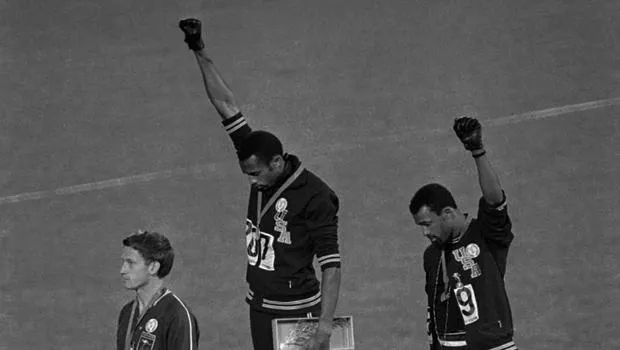
The medal ceremony took place later that evening. Smith and Carlos had planned their protest carefully. They would not shout. They would not disrupt the ceremony. They would stand silently and let the image speak.
As they walked onto the podium, Smith pinned an OPHR badge to his tracksuit. He wore a black scarf around his neck. Carlos wore a beaded necklace and left his tracksuit jacket unzipped. Both men stood barefoot — a protest against black poverty.
When the first notes of “The Star-Spangled Banner” began to play, Smith and Carlos bowed their heads. Then, at the same moment, each raised a single arm. Their hands were covered in black gloves — Smith’s right hand, Carlos’s left hand. The fist rose into the air and held there, motionless, until the anthem ended.
The third man on the podium, Australian silver medalist Peter Norman, also participated. He wore an OPHR badge on his chest, given to him by Carlos moments before the ceremony. Norman would pay a heavy price for that small act of solidarity.
The photograph, captured by multiple photographers, ricocheted around the world within hours. It was printed on front pages from New York to Tokyo. The image was electric, raw, and impossible to ignore.
The Reckoning
The International Olympic Committee acted swiftly. IOC President Avery Brundage, who had already threatened to ban the athletes if they protested, ordered Smith and Carlos suspended and expelled from the Games. They were forced to leave Mexico City within 48 hours.
The backlash was immediate and ferocious. Smith and Carlos returned to the United States to find themselves condemned as un-American. They received death threats. Their families were threatened. Smith’s mother received hate mail at her home. Carlos’s wife was subjected to harassment. Job offers vanished. Both men struggled to find work. Smith’s track career never fully recovered; he briefly played football for the Cincinnati Bengals but never regained his Olympic form. Carlos drifted through a series of jobs, battled personal demons, and watched his marriage fall apart under the strain.
Peter Norman, the Australian who stood with them, fared even worse. Australia banned him from the 1972 Olympics despite repeatedly qualifying. He was ostracized by the Australian track establishment and died in 2006, a largely forgotten figure. Smith and Carlos served as pallbearers at his funeral.
Vindication
Decades passed. Smith and Carlos never apologized for their protest. They never regretted it.
Smith was inducted into the U.S. Track and Field Hall of Fame in 1978. Carlos followed in 2003. The inductions were long overdue recognitions not only of their athletic achievements — Smith’s world records in the 200m and 400m, Carlos’s 200m speed — but of their courage.
The tipping point came in 2005. San Jose State University, their alma mater, unveiled a 22-foot-tall statue on campus depicting Smith and Carlos on the medal podium, fists raised. At the dedication ceremony, Smith and Carlos stood before a crowd of thousands and watched as a new generation honored the protest that had cost them everything.
The statue’s inscription reads: “Saluting the courage and conviction of Tommie Smith and John Carlos, who, in 1968, used the world stage of the Olympics to focus attention on the problems of racial and social injustice — a courageous act that stands as a symbol of hope and inspiration for all humanity.”
In 2016, the U.S. Olympic Committee officially apologized to Smith and Carlos for the treatment they had received in 1968. The committee acknowledged that the protest had been “a peaceful expression of beliefs about human rights” and that the punishment had been unjust.
Tommie Smith and John Carlos stood on a podium for three minutes. They raised their fists. They said nothing. And they changed the world.