
Under the Water, No One Sees Your Legs

—
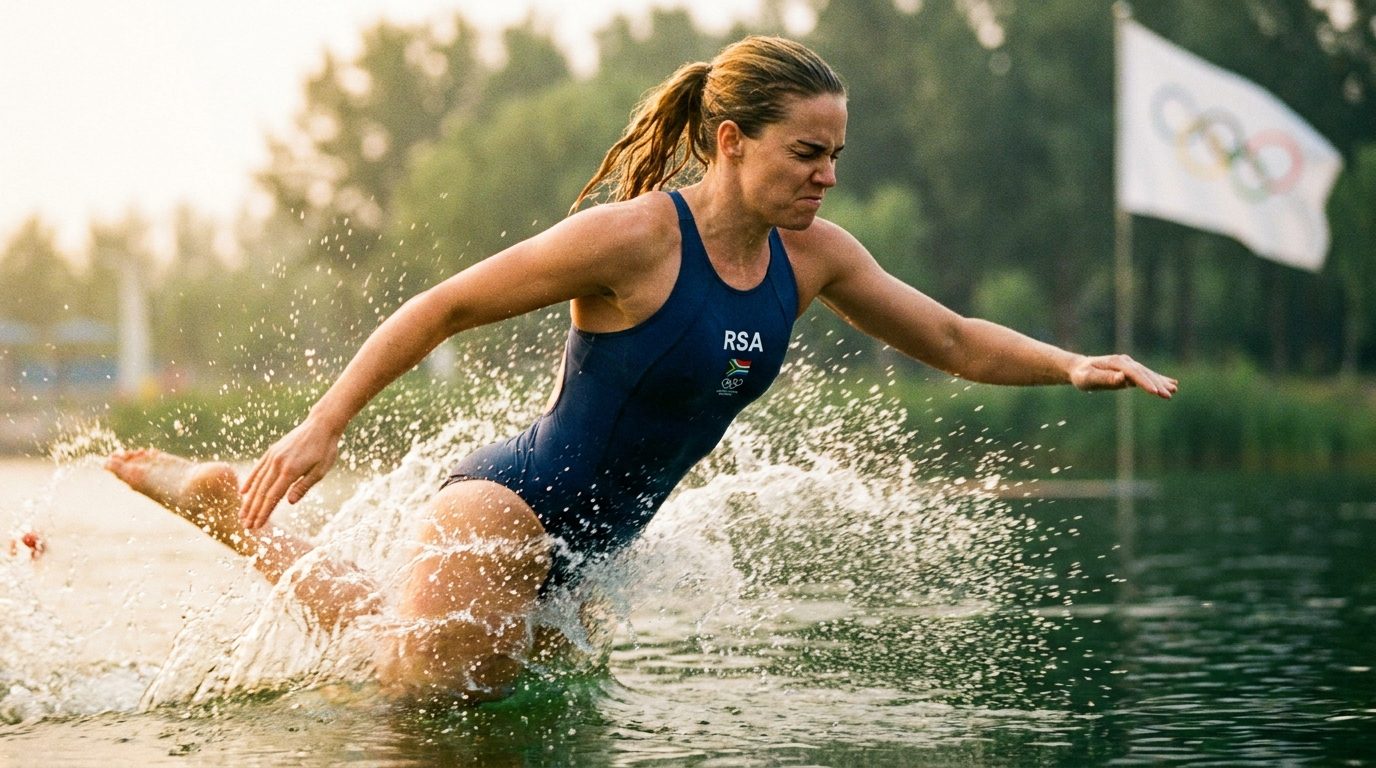
August 20, 2008. Beijing. Shunyi Olympic Rowing-Canoeing Park. The women’s 10-kilometer open-water marathon.
Twenty-five swimmers stood on the starting pontoon. Twenty-four of them had two legs. One of them had one. The rules did not permit her to wear a prosthetic in competition. She walked to the pontoon on crutches. When the crutches were taken away, she balanced on a single leg, waiting for the gun. The gun fired. She dove into the water. Then the surface closed.
This is open-water marathon swimming—the most forgotten event on the Olympic program. No lanes, no turns, no walls to push off from. The swimmers circle a two-kilometer lake course five times, nearly two hours in the water, forbidden to touch the boat, the coach, anything. Under the water, no one sees your legs. Everyone is arms, breath, forward.
Natalie du Toit did not come to overcome disability. She came to swim.
Cape Town, 2001. A seventeen-year-old du Toit was riding her motorcycle home from school. A car ran a red light and hit her. Five days later, her left leg was amputated below the knee. Before this, she was one of South Africa’s most promising young swimmers—selected for the national team at fourteen, a Commonwealth Games competitor in 1998. The day she woke up in the hospital bed, her first question was not “why me.” She asked the doctor: can I still swim?
The doctor said: yes. But you may not be able to beat people with two legs.
She said: watch.
During rehabilitation, she endured multiple surgeries. The residual limb became infected repeatedly. Pain persisted for nearly two years. She got in the water every day. Not because of willpower—in her own words, “I am more comfortable in the water than on land.” After the amputation, her center of gravity had shifted. Core strength had to be redistributed. Every kick angle had to be recalibrated. This was not like learning to swim. It was harder than learning to swim, because you have to unlearn everything you already knew. It took her three years. She failed to qualify for the 2004 Athens Olympics. Then she trained for four more years.
May 2008. Olympic qualifier. She earned her ticket to Beijing at the open-water world championships in Seville. In August, she stood on the starting pontoon in Beijing.
Before the Games, FINA officials discussed a question: was it fair to other competitors to allow a one-legged athlete into the Olympic field? The conclusion: in the water, she had no advantage, and no disadvantage that required accommodation. Like every other swimmer, she covered every meter.
She finished sixteenth. The winner beat her by nearly two minutes. Sixteenth means no podium, no flash of cameras in the mixed zone. After touching the pad, she swam to the dock, stood up on her crutches, wet hair plastered to her face, and smiled at the people waiting for her. Then she walked back to the changing room. No one thought the image was remarkable—an athlete finishing a race, going home. That was exactly what she wanted.
That same summer in Beijing, she also competed in the Paralympics and won five gold medals. But she has said that the Olympic sixteenth place is the most important result of her career. “Sixteenth.” She has repeated that number many times, never with false modesty. She says: “I was there. I started with the best open-water swimmers in the world, and I swam the entire course with them.”
Under the water, no one sees your legs. She chose this sport, perhaps, precisely because—in the water, numbers don’t count. The number of legs, the weight of a prosthesis, the stares you don’t want from people on land—all of it vanishes the moment you dive in. The surface closes. You are just a person, in the water, moving forward.

**Tags:** #NatalieDuToit #SouthAfricanSwimming #BeijingOlympics #OpenWater #Paralympics
**Sources:** 2008 Beijing Olympic Games official records; FINA open-water marathon documentation; international media coverage of du Toit’s career.