
The Barefoot King of Rome: Abebe Bikila and the Marathon That Changed Africa

The Barefoot Champion of Rome
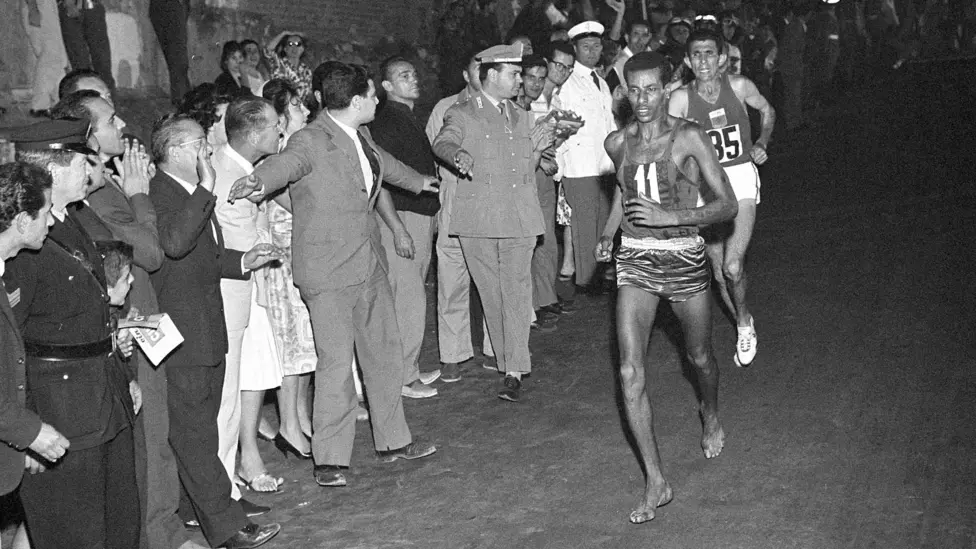
September 10, 1960. The marathon of the Rome Olympics started at 5:30 PM, timed so the runners would finish in the golden dusk along the Appian Way. Among the 69 starters was a lean Ethiopian soldier named Abebe Bikila. He was 28, from a small town in the Ethiopian highlands. He had no coach, no team, no sponsor.
Days before the race, Adidas provided shoes. They did not fit. Bikila tried a few practice strides, felt blisters forming, and made a decision. He walked to the starting line barefoot.
The course ran over Rome’s cobblestone streets and ancient ruins still radiating the day’s heat. Bikila’s bare feet struck stone laid two thousand years before. At the 30-kilometer mark, the lead pack fractured. Bikila did not accelerate. He simply maintained his rhythm and passed runners one by one. Spectators noticed the barefoot runner — not because he was fast, but because he was quiet. No spikes striking pavement.
He crossed the finish line in 2:15:16 — a world record, the first gold medal ever won by a sub-Saharan African.
The Miracle of Tokyo
Four years later, the world gathered in Tokyo. All eyes were on Bikila. Could he defend his title?
Six weeks before the Games, Bikila was rushed to hospital with acute abdominal pain. Doctors diagnosed appendicitis and performed emergency surgery. The incision had barely healed when he resumed training. Medical experts said recovery takes two to three months. Running a marathon within six weeks was unthinkable.
In Tokyo, he ran with medical tape still covering his fresh surgical scar. From the gun, he adopted an aggressive strategy: lead from the front, alone. Conventional wisdom said he would collapse.
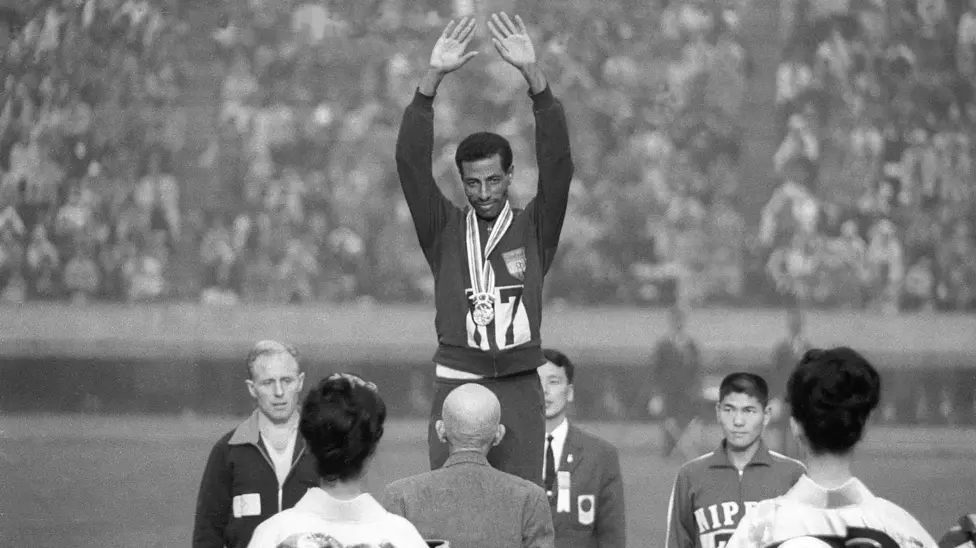
He crossed the finish line in 2:12:11 — another world record. He finished more than four minutes ahead of the silver medalist, one of the largest victory margins in Olympic marathon history. When he crossed the line, he did not collapse. He began doing pushups. A reporter asked how. Bikila said: “There are two men inside me. One wants to stop. The other does not let him.”
From Paralysis to Archery
A third Olympic gold was not meant to be. At Mexico City 1968, the high altitude took its toll and he dropped out with an injury. In 1969, a car accident near Addis Ababa crushed his cervical spine. He was paralyzed from the chest down.
He did not disappear. In 1970, just one year after his accident, Bikila competed in the Stoke Mandeville Games in England — the precursor to the Paralympic Games. He took up archery from a wheelchair. A man who had conquered the world with his feet found another way to compete.
A Legacy That Runs Through African Sport
Abebe Bikila died on October 25, 1973, in Addis Ababa, at age 41, from a cerebral hemorrhage. Ethiopia gave him a state funeral. Emperor Haile Selassie attended. Tens of thousands lined the streets.
His impact on African distance running is impossible to measure. Before Rome 1960, no black African had won an Olympic gold medal. His barefoot victory opened a door that generations of Ethiopian and Kenyan runners would walk through. Haile Gebrselassie, Kenenisa Bekele, Tirunesh Dibaba — they all stand on the shoulders of the man who ran shoeless through Rome.
Today, every September 10, runners in Addis Ababa take off their shoes and run barefoot through the highland roads — remembering a race that began at dusk in Rome and changed African sport forever.
References
- Olympedia — Abebe Bikila profile
- Official Report of the 1960 Rome Olympic Games
- World Athletics — Abebe Bikila profile
- IOC — “Abebe Bikila: The First African Gold Medalist”