
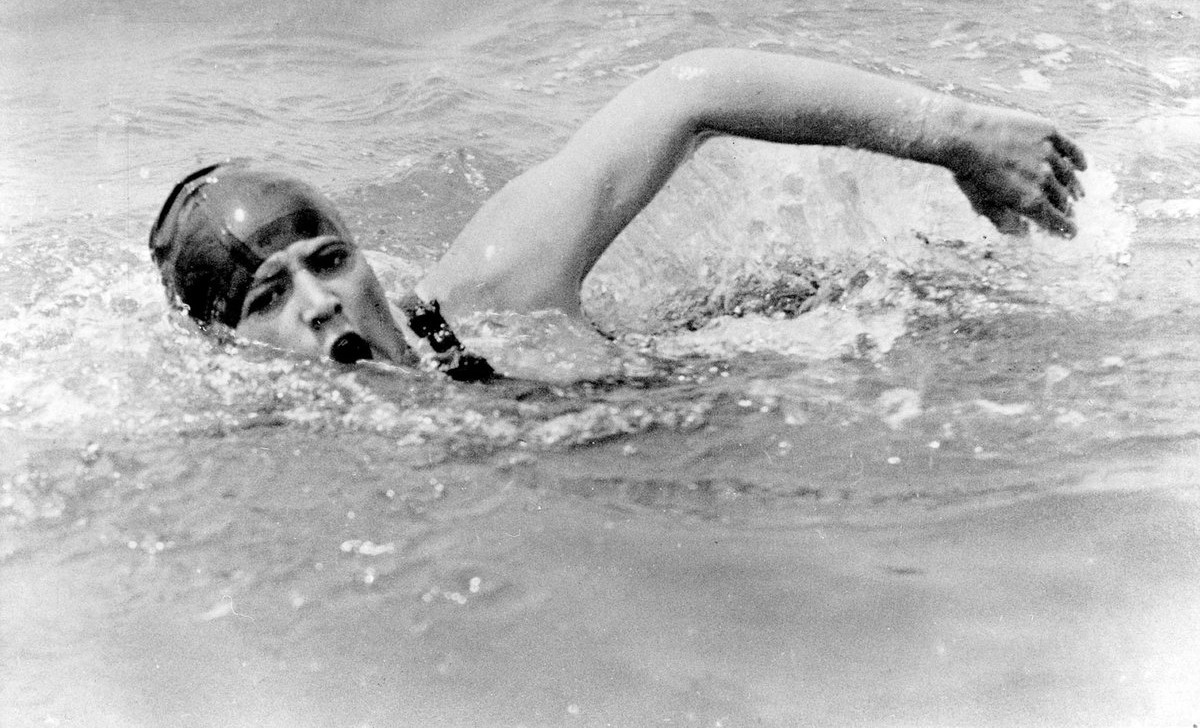
The Girl Who Swam Through Impossible: Gertrude Ederle

The Girl Who Refused to Be Quiet
Gertrude Ederle — called “Trudy” by those who knew her — was born on October 23, 1905, in Hell’s Kitchen, New York City. Her father was a German-born butcher who taught her to swim in the cold surf of the Jersey Shore. She caught the water like a fever.
At 15, she dropped out of school to join the Women’s Swimming Association. In an era when doctors warned that competitive swimming could damage a woman’s reproductive organs, Trudy just swam. At the 1924 Paris Olympics, she won gold in the 4×100m freestyle relay and bronze in the 100m and 400m freestyle. Impressive — but not enough.
21 Miles of Riptide and Ice
The English Channel had been swum successfully by only five men. The fastest took 16 hours and 33 minutes. Every doctor warned that the Channel swim could rupture her eardrums. She was already partially deaf from childhood measles. She went anyway.
On her first attempt in 1925, she was pulled from the water after nine hours — disqualified because her own coach touched her. She was furious. She went back to training, harder.
On August 6, 1926, she stepped into the water at 7:08 a.m., coated in lanolin and petroleum jelly. Her support crew included her father, her sister, and two trainers in a rowboat. The weather turned ugly. Waves as high as ten feet crashed over her. Her crew called for her to give up. She shouted back: “What for?”
When her father grew seasick and could no longer follow, she sang “Let Me Call You Sweetheart” to steady her nerves. At 9:12 p.m., she staggered onto Kingsdown, England. Time: 14 hours, 31 minutes. Two hours faster than any man who had ever swum the Channel.
Two Million People, One Blizzard of Paper
When Trudy returned to New York, the city shut down. On August 27, 1926, an estimated two million people lined Broadway for a ticker-tape parade — the largest crowd New York had ever seen.
President Calvin Coolidge called her “America’s best girl.” Hollywood wanted to make her a star. But the Channel swim had permanently damaged her hearing. Within a few years, she was nearly completely deaf. The fame evaporated. She never capitalized on it. She simply disappeared from public view.
The Quietest Victory
In the 1930s, Trudy moved to Queens and began a new career: teaching deaf children to swim. At the Lexington School for the Deaf, she spent three decades in the pool with children who lived in the same silence she knew. She understood their isolation, their determination, their need to feel strong.
She never sought attention for this work. When reporters tracked her down, she declined interviews.
In 1950, the Associated Press voted her the greatest woman athlete of the first half of the 20th century. In 1965, she was inducted into the International Swimming Hall of Fame. She never made a fuss.
Gertrude Ederle died on November 30, 2003, at age 98. Her record — the way she redefined what a woman’s body could endure — has not aged a day.
References
- Stout, Glenn. *Young Woman and the Sea: How Trudy Ederle Conquered the English Channel*, 2009
- International Swimming Hall of Fame — Gertrude Ederle
- The New York Times — “Ticker-Tape Parade for Gertrude Ederle” (August 27, 1926)
- Dahlberg, Tim. *America’s Girl: The Incredible Story of Gertrude Ederle*, 2004