
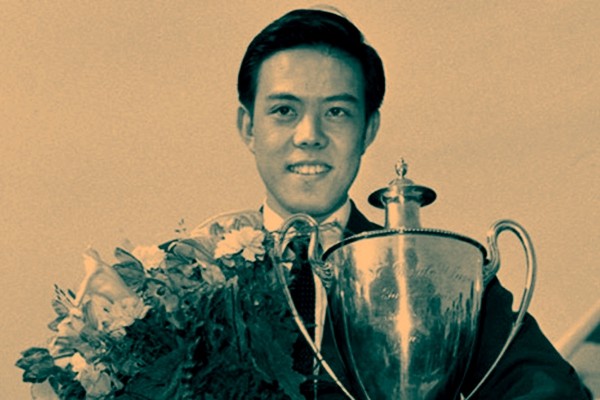
He Won China’s First World Championship at 21. By 31, He Was Erased from History.

The Boy from Hennessy Road
Rong Guotuan was born in 1937 in Hong Kong, then a British crown colony, into a family that knew hardship intimately. His father, Rong Mianzhi (容勉之), was a seaman who spent months at sea. The family lived in a modest tenement on Hennessy Road on Hong Kong Island.
He learned table tennis not in a training hall but on concrete tables in the street. The net was a wooden plank set across the middle. The paddle was whatever he could afford. There was no coach, no system, no path to professional play. But Rong had something that could not be taught: a feel for the ball that seemed intuitive, almost supernatural. His playing style was forged in the chaos of street play — fast, unpredictable, unorthodox.
In 1957, at twenty years old, he crossed the border into mainland China. He represented Guangdong Province in national competition, and his talent was immediately recognized. He was selected for the national team. Two years later, he was world champion.
Dortmund 1959: The Night China Arrived
April 1959. The 25th World Table Tennis Championships in Dortmund, West Germany. The men’s singles final.
Across the table stood Ferenc Sidó of Hungary — a legend who had already won nine world titles. Rong was twenty-one, competing in his first world championship. No Chinese player had ever won a world title. No one expected the boy from Hong Kong to change that.
Rong lost the first game. Then he adjusted. He changed his grip slightly, shortened his backswing, began reading Sidó’s serves with a precision that surprised even himself. He took the second game. Then the third. In the fourth, Sidó’s return clipped the net and bounced out. The match was over.
Rong did not throw his paddle. He did not jump or scream. He stood at the table, lowered his head, and let out a long breath. He had just done what no Chinese athlete had ever done — and his only visible reaction was stillness.
The People’s Republic of China had its first world champion. Radio broadcasts carried the news across the country. In factories, in schools, in villages, people stopped and listened. A young man from Hong Kong had inscribed the word China into the world champion’s ledger for the first time.
Beijing 1961: The Dynasty Begins
In 1961, the 26th World Championships came to Beijing — the first world-class sporting event ever hosted by the People’s Republic. Rong was a core member of the Chinese men’s team. Playing in front of a home crowd for the first time in his international career, he won his match in the team final. China won the team title.
That tournament marked the beginning of Chinese table tennis’s global dominance. Over the decades that followed, the sport became China’s national game — and it all began with Rong Guotuan, on a night in Dortmund in 1959.
The Fall
Then came the Cultural Revolution. Starting in 1966, the sports system was swept into the political storm. A world champion’s title was no longer a shield. It became evidence.
Rong was targeted for his “overseas connections” — the fact that he had grown up in Hong Kong. He had stood at the top of the world. Now he was beaten to the ground. Public struggle sessions. Constant interrogation. The same country that had celebrated him as a national hero now treated him as an enemy.
On June 20, 1968, after months of persecution, Rong Guotuan took his own life. He was thirty-one. He left a note. Chinese media later reported its contents: “I love my reputation more than life.” The exact words have never been officially confirmed. His death received no news coverage. The man who won China’s first world championship vanished into silence.
The Name That Survived
After the Cultural Revolution ended, Rong Guotuan was posthumously rehabilitated on June 23, 1978. His trophy — the men’s singles cup from the 1959 Dortmund World Championships, his name engraved on it — is now on display at the China Table Tennis Museum. A statue of him stands in Zhuhai. His name appears first in Chinese sports history textbooks.
But a person’s fate is not measured by trophies. Rong Guotuan appears in the textbooks as China’s first world champion. Usually that is the only line. 1959, won the title. 1968, died. What happened in between is not always told.
But it should be.
References
- ITTF Museum — Rong Guotuan
- China Table Tennis Museum Archives
- Baidu Baike — Rong Guotuan (容国团)
- 1959 World Table Tennis Championships Official Report
- Table Tennis Legends: The Story of Chinese Table Tennis, People’s Sports Publishing, 2009