
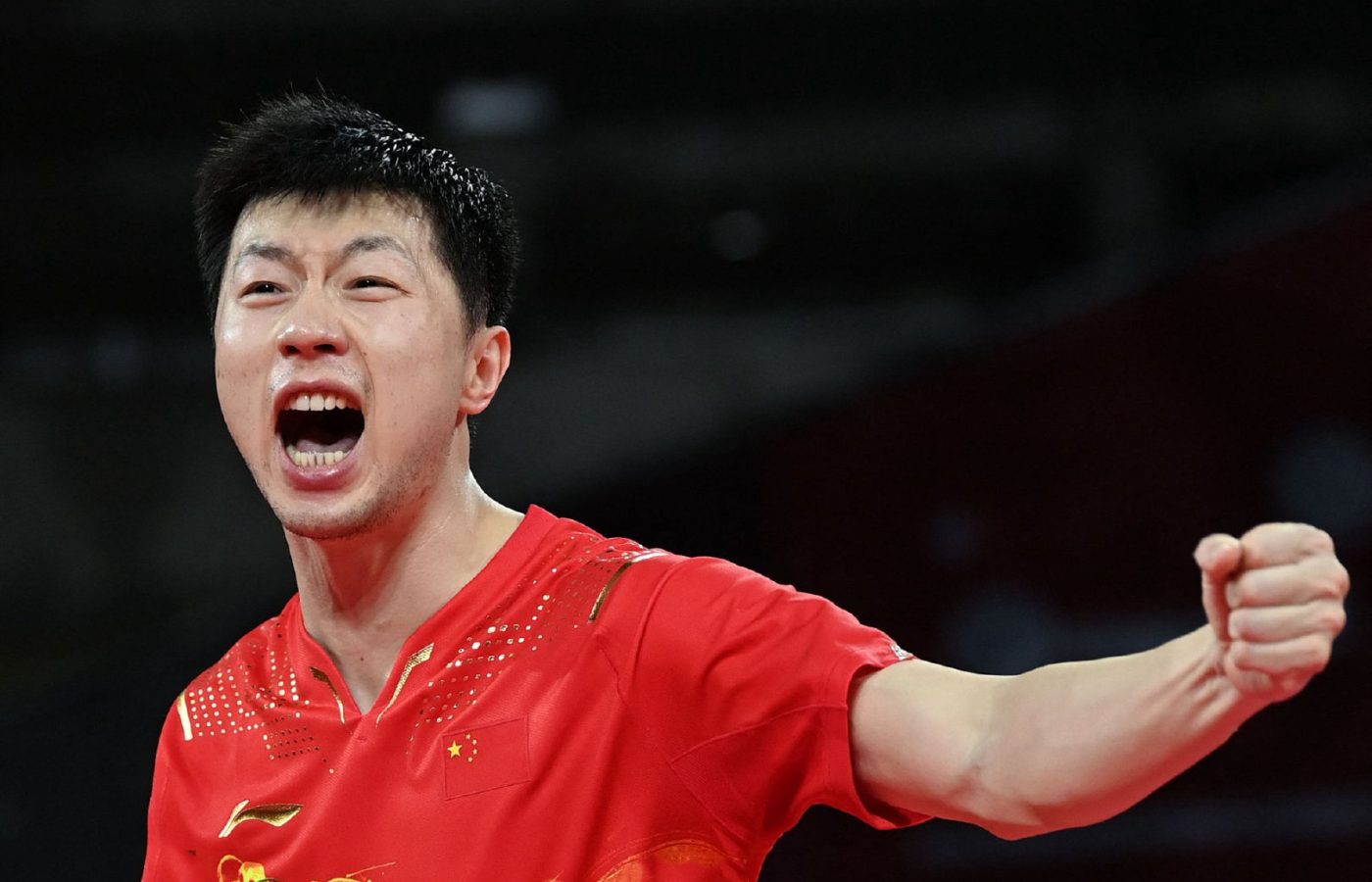
The Only Man to Win Everything Twice: Ma Long, the Greatest Table Tennis Player Who Ever Lived
Ma Long (马龙) (born October 20, 1988) is a Chinese table tennis player widely regarded as the greatest male player in history. He is the only man to complete the “Double Grand Slam” — winning Olympic singles gold at both Rio 2016 and Tokyo 2020, plus three consecutive World Championship titles. Known as “The Dragon” and “The Dictator,” his complete game, relentless consistency, and unmatched longevity have defined an era of table tennis.
The Making of a Champion
Ma Long was born on October 20, 1988, in Anshan, Liaoning Province, a city in northeastern China known for its steel industry and, increasingly, for producing world-class table tennis players. His father, a factory worker, introduced him to the sport at age 5 as a way to build physical confidence. Ma Long was a shy, quiet child — not the typical profile of a future champion.
But his talent was unmistakable. By age 8, he had already caught the attention of local coaches. By 10, he was accepted into the provincial team. By 13, he was training at the national youth center in Beijing. Every coach who worked with him noted the same thing: his technique was already nearly flawless. He did not need to be taught how to play — he needed to be taught how to win.
The defining relationship of his early career was with his coach, Ma Wenge, a former world champion who recognized that Ma Long’s technical perfectionism could become a psychological handicap. “He wanted every shot to be perfect,” Ma Wenge later recalled. “But in competition, there is no perfect. There is only winning.”
The Breakthrough: World Champion at Last
Ma Long’s senior breakthrough came in the late 2000s. He won his first World Championship medal — a bronze — in 2009, but it was clear to those watching that his technical foundation was being built into something extraordinary. In February 2010, the ITTF rankings showed him at world number one for the first time.
At the 2012 London Olympics, Ma Long watched from the team bench as his teammate Zhang Jike won men’s singles gold. Zhang Jike completed a career Grand Slam in just 445 days — flashy, explosive, and marketable. Ma Long, by contrast, was methodical. He won team gold in London, but the singles gold eluded him.
Those questions were answered emphatically in 2015 at the World Championships in Suzhou. Ma Long defeated his compatriot Fang Bo in the final, dropping only one game. The performance was a statement: technically flawless, tactically perfect, and emotionally unbreakable. He had arrived, not as a challenger, but as the new king.
Rio 2016: Olympic Gold at Last
The 2016 Rio Olympics were Ma Long’s coronation. In the men’s singles final, he faced his longtime rival Zhang Jike — the defending Olympic champion. The match was billed as a clash of styles: Zhang Jike’s explosive aggression versus Ma Long’s comprehensive control.
Ma Long won in straight games — 4-0 — a result that stunned the table tennis world. Zhang Jike had never lost to anyone in straight games at a major tournament. After the final point, Ma Long made a heart gesture with his hands — a quiet, personal celebration that became his signature image. He had finally won Olympic gold.
He added a team gold to complete his first Olympic campaign, but it was the singles gold that mattered. The “nearly man” label was gone forever.
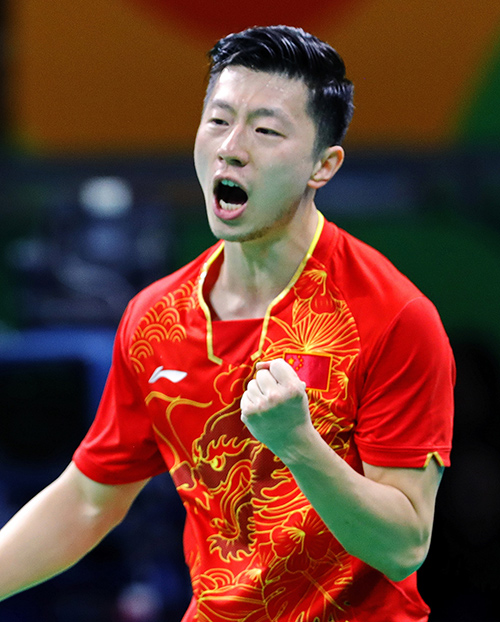
Ma Long pumps himself up during the men’s singles table tennis final at the Rio 2016 Olympic Games
The Comeback: Knee Surgery and Tokyo 2020
After Rio, Ma Long continued to dominate. He defended his World Championship titles in 2017 and 2019, becoming the first male player in 54 years to win three consecutive world singles titles. But in 2019, during a training session, his left knee gave way. The diagnosis was a calcified tendon and a bone spur — the result of two decades of punishing training.
The surgery was serious. Many athletes never return to full form after such a procedure. At 30, with nothing left to prove, retirement would have been understandable.
Ma Long chose surgery and rehabilitation. For months, he could not walk properly, let alone train. He missed tournaments. His world ranking dropped. Young players like Fan Zhendong rose to take his place at number one.
The Tokyo 2020 Olympics, delayed to 2021 by the COVID-19 pandemic, represented the ultimate test of his resilience. At 32, he was the oldest male singles gold medalist in Olympic table tennis history. The final pitted him against Fan Zhendong, the man who had supplanted him at world number one and represented the new generation.
In a riveting six-game final, Ma Long defeated Fan Zhendong 4-2. The quality was extraordinary: rallies of breathtaking speed and spin, tactical adjustments on every point, two players operating at the absolute ceiling of the sport. When Ma Long won the final point, he did not celebrate with the heart gesture of Rio. He simply knelt, then stood up with a quiet, exhausted smile. The Double Grand Slam was complete. No male player had ever won two Olympic singles gold medals. No male player had ever won three consecutive World Championship singles titles. Ma Long had done both.
Legacy: The GOAT of Table Tennis
Quantifying Ma Long’s greatness is almost absurd in its numerical density: 3 World Championship singles titles (2015, 2017, 2019), 2 Olympic singles gold medals, 7 World Cup titles (including 2 singles), 64+ months ranked world number one (the all-time record for men), and over 30 ITTF World Tour titles. But the numbers, however staggering, do not capture what Ma Long represents.
He represents the triumph of craft over flash, of sustained excellence over fleeting brilliance. In a sport where the Chinese national system produces an endless conveyor belt of talent — each new generation faster and more powerful than the last — Ma Long survived at the top for over a decade. He outlasted Zhang Jike. He outlasted Wang Hao. He outlasted the first wave of Fan Zhendong’s prime. He came back from an injury that should have ended him and won Olympic gold at an age when most of his peers had retired.
His nickname in Chinese media is “The Dictator” — a reference to his absolute, uncompromising control over the game. Opponents often describe playing against Ma Long as suffocating: every shot is returned, every angle is covered, every weakness is exploited. There are no easy points against Ma Long.
Ma Long did not just dominate table tennis. He redefined what dominance looks like. He proved that perfection — or something close to it — could be sustained across injuries, across generations, and across decades. The Dragon’s reign is the longest in table tennis history, and it may never be matched.
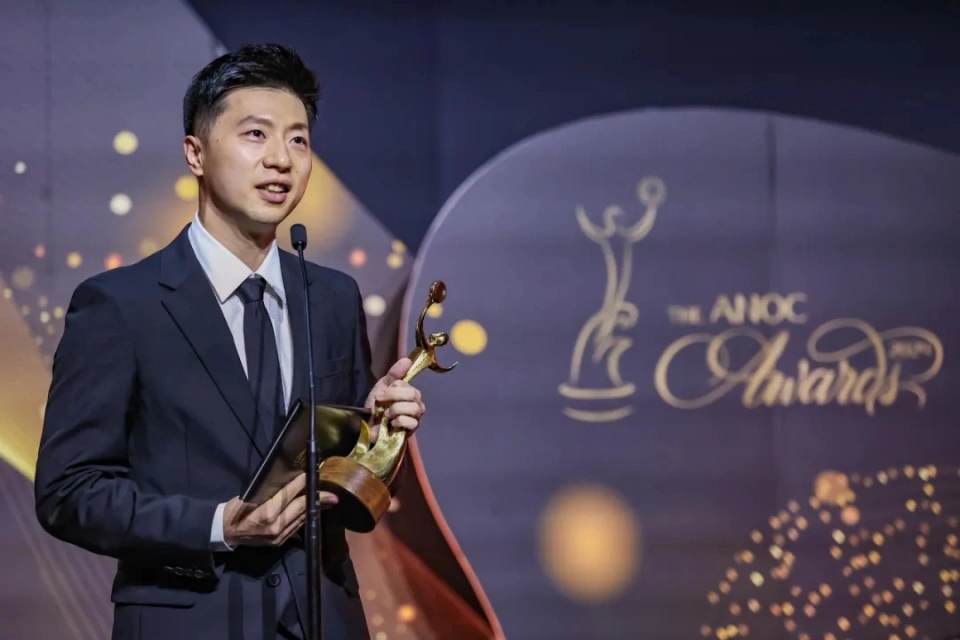
Ma Long receiving the Outstanding Sports Career Award at the 27th ANOC General Assembly in Cascais, Portugal on October 30, 2024
References
- ITTF (International Table Tennis Federation) — Ma Long Career Statistics and Rankings
- Olympics.com — Ma Long Profile, Rio 2016 and Tokyo 2020
- Chinese Table Tennis Association — Ma Long Career Achievements
- Sports Illustrated — “Ma Long: The Unrivaled Champion of Table Tennis” (2021)
- BBC Sport — “Ma Long: From Nearly Man to the Greatest of All Time” (2021)