
他知道自己不是最快的,所以他当了别人的腿

引言:胡安·安东尼奥·塞拉诺(Juan Antonio Serrano),西班牙一名成绩平平的中距离跑者。他发现自己跑不过别人后,决定让盲人运动员跑得更快。此后二十年,他给七位盲人运动员当过引导员,自己的名字只出现在残奥会官方记录中一次。
1976年,巴塞罗那。残奥会选拔赛。
Juan Antonio Serrano 站在跑道边,看着一位盲人运动员在引导员的搀扶下试跑。引导员和运动员之间绑着一根30厘米的短绳,两个人靠它传递方向、速度和节奏。Serrano 当时23岁,是加泰罗尼亚地区一名成绩平平的中距离跑者——他的1500米个人最好成绩是3分52秒,在全国排名进不了前五十。他在一家体育用品店做销售,周末去田径场训练,没有什么人注意到他。
那天他在跑道边看了很久。
“他在跑的时候,我比自己跑还紧张,”Serrano 后来回忆那个下午。”我看见他的脚步犹豫,每一步都在等绳子告诉他是否安全。我当时想的是——我能帮他跑得更快。”
他没有念过体育学院。没有教学经验。他走过去,问那位盲人运动员的教练:引导员和运动员是怎么配对的?引导员自己要不要跑完同样的距离?如果引导员比运动员快,是好事还是坏事?
那一年,西班牙对残疾人体育还没有系统的引导员培训制度。盲人运动员的引导员通常是他们的朋友、家属,或者体育老师——任何愿意在操场上陪跑的人。Serrano 提出申请,通过了体能测试,成为了西班牙残奥田径队的引导员候补。
没有人把这当作一个职业选择。他的朋友问他:你又不残疾,去残奥会干什么?
他说:”跑。”
他的第一任搭档叫 Carlos——一名全盲的800米运动员,40岁,早年因青光眼失明,右腿曾有旧伤。Serrano 需要把自己的步幅精确地调整到和 Carlos 一致——不能比 Carlos 快,否则绳子会绷紧,拉着对方失去平衡;不能比 Carlos 慢,否则绳子松了,失去方向感。他花了三个月,跑坏了两双鞋,找到了那个节奏。
1980年阿纳姆残奥会,他们进了决赛。没有奖牌。但 Carlos 跑出了个人最好成绩——比一年前快了将近四秒。
赛后 Carlos 对 Serrano 说了一句他记了一辈子的话:”你让我忘了自己看不见。”
Serrano 没有因此出名。残奥会引导员的名字很少被记入正式成绩单。他回到了巴塞罗那的体育用品店,继续卖跑鞋。但他没有停下来。在接下来的二十年里,他先后给七位盲人运动员当过引导员——有人跑400米,有人跑1500米,有人跑5000米。最短的合作是两年,最长的合作持续了十一年。他从不挑搭档,教练安排谁就是谁。他不是队里最快的引导员——比他快的人有的是。但他是队里最稳定的。教练的评价是:Serrano 永远不会让他的搭档受伤。
1996年,他的搭档 Miguel 在亚特兰大残奥会 T11 级1500米比赛中获得了一枚铜牌。赛后的官方报道里,Miguel 的名字被写在前面,后面跟着”引导员:Juan Antonio Serrano(西班牙)”。那是 Serrano 的名字唯一一次出现在残奥会的官方记录中。
2000年,47岁的 Serrano 因膝盖磨损被迫退役。他的右膝软骨几乎磨光了——不是因为他自己跑步,而是因为他用二十年时间把自己的步幅调整到别人的节奏。他的左膝是正常的。”左膝是我自己的节奏,”他说。”右膝是他们的。”
退役后他在巴塞罗那的一所特殊教育学校教体育,教盲人孩子跑步。
2019年,加泰罗尼亚体育记者协会给他颁了一个小奖——”体育奉献奖”。颁奖词里有一句话:”他用别人的腿,跑了自己的马拉松。”
他没有把这当成职业生涯的总结。他七十多岁,膝盖不好,走路微跛。偶尔有以前合作过的运动员来看他。他们一起吃饭,聊起某一次比赛、某一次训练、某一段绳子绷紧的瞬间。
他从不认为自己是故事的主角。”主角是那些看不见的人,”他说。”我只是帮他们找到方向。”
但那些和他绑在同一根绳子上跑过几千公里的人知道:在盲人运动员的世界里,视觉消失了,剩下的只有耳朵、双脚、和绳子那头的节奏。那根绳子的另一头,Serrano 从来没有松过手。
—
**标签:** #JuanAntonioSerrano #残奥会 #引导员 #西班牙 #跑步
**信息来源:** 加泰罗尼亚体育记者协会2019年颁奖报道;西班牙残奥委员会历史档案;Serrano 本人接受《先锋报》采访(2001年)。
—
—
## English Version
# He Knew He Wasn’t the Fastest, So He Became Someone Else’s Legs
Barcelona, 1976. Paralympic qualifying trials.
Juan Antonio Serrano stood at the edge of the track, watching a blind athlete run with a guide. A short rope—no more than thirty centimeters—connected them. Direction, speed, rhythm—everything passed through that rope.
Serrano was twenty-three, an average middle-distance runner from Catalonia. His 1500m personal best was 3:52, nowhere near national level. He worked at a sports store, trained on weekends, and no one paid attention to him.
But that afternoon, he couldn’t look away.
“He was running, and I was more nervous than when I run myself,” Serrano later recalled. “I could see the hesitation in his steps, waiting for the rope to tell him it was safe. I thought—I can help him run faster.”
He had no coaching degree, no teaching experience. He walked over and asked the blind athlete’s coach: How do guides and runners pair up? Does the guide have to run the same distance? Is it better if the guide is faster?
That year, Spain had no formal training system for Paralympic guides. Guides were usually friends, family members, or PE teachers—anyone willing to run around a track. Serrano applied, passed the fitness test, and became a reserve guide for Spain’s Paralympic track team.
No one saw this as a career choice. His friends asked him: You’re not disabled, why are you going to the Paralympics?
He said: “To run.”
His first partner was Carlos—a completely blind 800m runner, forty years old, who had lost his sight to glaucoma. Serrano spent three months adjusting his stride to match Carlos’s—not faster, or the rope would pull and throw Carlos off balance; not slower, or the rope would slacken and he’d lose direction. He wore out two pairs of shoes finding the rhythm.
At the 1980 Arnhem Paralympics, they reached the final. No medal. But Carlos ran a personal best—nearly four seconds faster than the year before.
After the race, Carlos said something Serrano carried for the rest of his life: “You made me forget I was blind.”
Serrano never became famous. Paralympic guides are rarely listed in official results. He returned to his sports store in Barcelona, selling running shoes. But he didn’t stop. Over the next twenty years, he guided seven blind athletes—some ran 400m, some 1500m, some 5000m. The shortest partnership lasted two years, the longest eleven. He never chose his partners—whoever the coach assigned, he took. He wasn’t the fastest guide on the team—there were faster men. But he was the steadiest. The coach’s assessment: Serrano would never let his partner get hurt.
In 1996, his partner Miguel won a bronze medal in the T11 1500m at the Atlanta Paralympics. The official report read: “Miguel, with guide Juan Antonio Serrano (Spain).” That was the only time Serrano’s name appeared in Paralympic records.
In 2000, at forty-seven, Serrano retired due to wear and tear on his knees. His right knee cartilage was almost gone—not from his own running, but from two decades of adjusting his stride to someone else’s rhythm. His left knee was fine. “The left is my rhythm,” he said. “The right is theirs.”
After retiring, he taught physical education at a special education school in Barcelona, teaching blind children to run.
In 2019, the Catalan Sports Journalists Association gave him a small award—”Dedication to Sport.” The citation read: “He ran his own marathon using someone else’s legs.”
He never saw himself as the main character. “The main characters are the ones who can’t see,” he said. “I just helped them find direction.”
But the ones who ran those thousands of kilometers tied to the other end of the rope knew: when the world goes dark, all that’s left are your ears, your feet, and the rhythm coming through the rope. At the other end of that rope, Serrano never let go.
—
**Tags:** #JuanAntonioSerrano #Paralympics #GuideRunner #Spain #Running
**Sources:** Catalan Sports Journalists Association 2019 award report; Spanish Paralympic Committee historical archives; Serrano interview with La Vanguardia (2001).
—
—
—
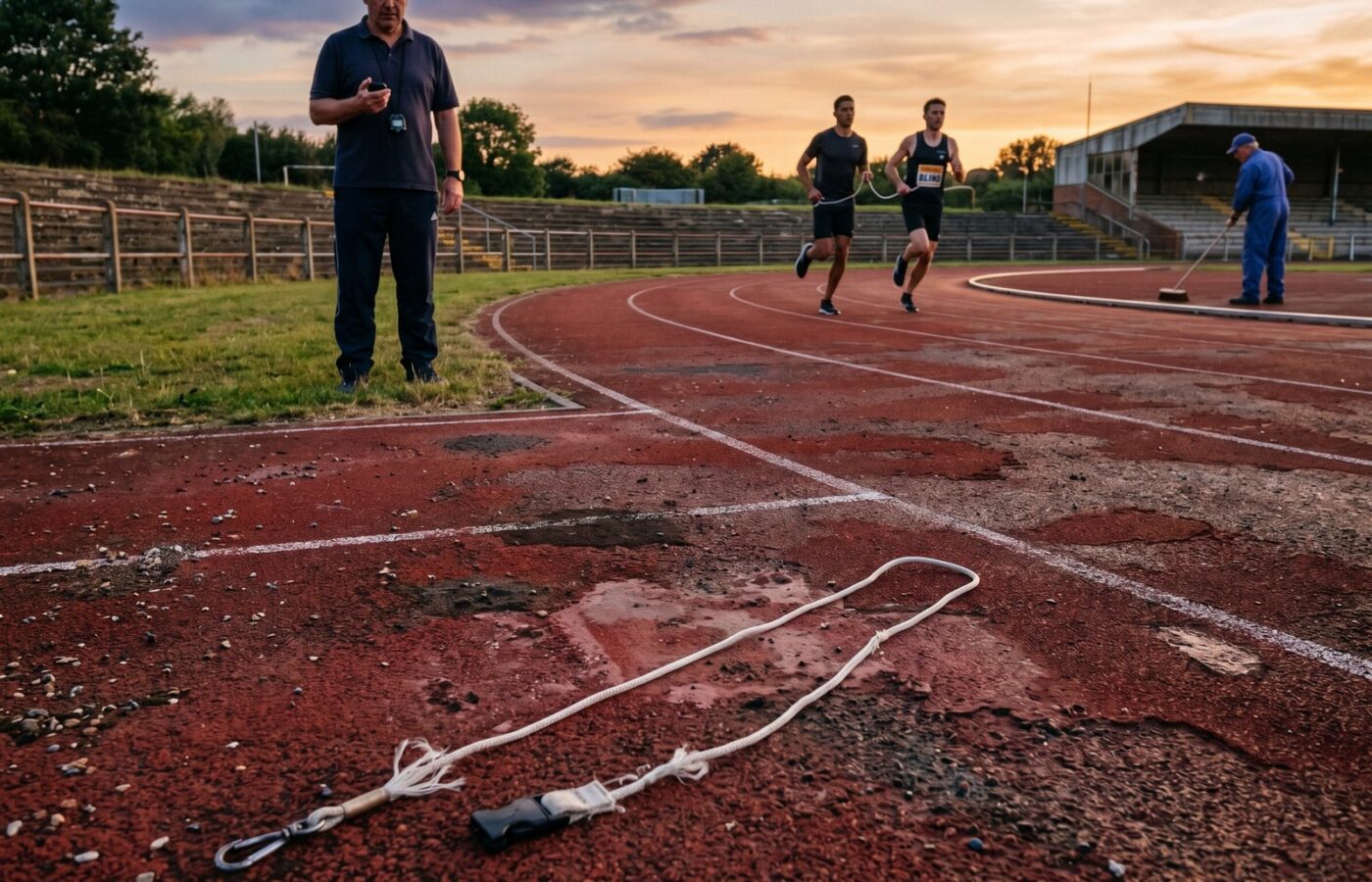
In the middle distance, two athletes — one sighted, one blind — are running together on lane 3, connected by a short tether. The blind runner’s arm is slightly raised, trusting the rhythm. They are slightly out of focus, motion-blurred, captured mid-stride.
Further back on the infield, a coach in a polo shirt leans against a railing holding a stopwatch. Near the far curve, a groundskeeper in a faded blue uniform is raking the edge of the track. A few scattered leaves. Warm golden sunlight from the left, long shadows. The stadium walls are weathered, paint peeling. The scene is alive — people are doing their jobs, training, maintaining. Nobody is posing. Photorealistic, slightly grainy, like a moment caught during an ordinary training session.
—
## 配图提示词(两个版本)
**版本A:绳子的视角**
黄昏时分的旧跑道。前景是一条细白色尼龙引导绳——约5mm粗,两端各有一个小腕带/手环扣(wrist strap),中间绳长约30cm——搁在磨损的红色塔当跑道上,两端的手环扣自然散开。跑道有明显的使用痕迹:褪色的标线、积过水的深色斑块、几颗嵌入的小石子。绳子后方略微虚化,一个穿polo衫的男教练站在内场草地上掐着秒表,望着远处弯道上两个正在跑动的男性运动员——一个明眼引导员和一个盲人运动员。两人之间连着一根同样的白色短绳,引导员右手腕上的手环连着绳的一端,盲人运动员左手腕上的手环连着绳的另一端,绳在两人之间微松呈弧形,不拉紧。两人步伐一致,正在过弯。夕阳低垂,在跑道拉出长长的斜影。远处看台边,一个穿褪色蓝制服的场地工人在扫跑道边。暖琥珀色光线,轻微胶片颗粒感。真实,不精致。横版,1k。
**版本B:人和绳一起**
下午的训练场。略高的视角俯视第三道。两名男性运动员——一个明眼引导员和一个盲人运动员——正在跑近,两人靠得很近(间距约30cm)。一根白色短绳(约30cm长)连接着引导员右手腕带和盲人运动员左手腕带,绳在两人身体之间微松下垂呈U形,不拉紧,不绷直。盲人运动员目光微散,手臂放松,信任节奏。引导员微微侧头,检查间距。两人都穿着旧训练服,非比赛装备。他们的影子斜斜拉过跑道。前景地上,一条同样的引导绳卷好放在地上,两端腕带清晰可见,旁边放着一个水壶和一副墨镜。深远背景处,一个教练和一个场地工人在看台附近。阳光中有浮尘。运动员腿部轻微动态模糊。自然、抓拍、纪录片质感。横版,1k。