
She Held the Marathon World Record for 16 Years. The Olympics Broke Her Heart.

Paula Radcliffe (December 17, 1973) is a British long-distance runner who holds the women’s marathon world record of 2:15:25, a mark that stood for 16 years. Despite her dominance on the road, the Olympics brought her nothing but heartbreak — three Games, three devastating outcomes.
Early Life and Running Career
Paula Jane Radcliffe was born in Davenham, Cheshire, England, on December 17, 1973. Her parents were both avid runners, and her father introduced her to the sport at an early age. She ran her first cross-country race at just seven years old — and finished dead last. It didn’t matter. She was hooked.
As a teenager, Radcliffe was diagnosed with asthma and exercise-induced asthma, a condition that would shape her training and racing for the rest of her career. She quickly learned to manage it, but the challenges it posed forged a resilience that would become her signature trait.
Radcliffe’s talent emerged early. She won the world junior cross-country title in 1992 and made her Olympic debut at Atlanta 1996, where she finished 5th in the 5000 metres. That result was a promising start for a runner still in her early twenties. Few could have predicted then that she would become the greatest female marathoner in history — nor that the Olympics would remain unfinished business for the rest of her career.
She transitioned to longer distances in the late 1990s and early 2000s, winning the European 10,000 metres title in 2002 and the Commonwealth 5000 metres gold the same year. Her form was building toward something extraordinary.
The Perfect Race: London 2003 Marathon (2:15:25)
On April 13, 2003, Paula Radcliffe lined up for the London Marathon. She had already run the fastest women’s marathon debut in history the year before (2:18:56 in London 2002) and had broken the world record in Chicago later that same year (2:17:18). But what happened next was not just a world record — it was a rewriting of what people believed possible.
Radcliffe ran 2:15:25, shattering her own world record by nearly two minutes. To put that in perspective: she ran each of the 26.2 miles at an average pace of roughly 5 minutes 10 seconds per mile (3:13 per kilometre). She crossed the finish line looking fresh, as if she could have kept going.
The record was so far ahead of its time that it stood for 16 years — the longest-held women’s marathon world record in the modern era. It was not broken until Brigid Kosgei ran 2:14:04 at the 2019 Chicago Marathon. Even today, Radcliffe’s mark remains the second-fastest women’s marathon in history and the fastest ever run on a mixed-gender course.
Radcliffe’s running style was famously unconventional — a high-stepping, slightly forward-leaning gait with an unusually short stride. Biomechanically, it looked inefficient. Yet it worked. Her body, she once explained, simply found a rhythm that allowed her to sustain punishing paces for over two hours.
Olympic Heartbreaks: Three Games, Three Tragedies
Athens 2004 — The Favourite Who Broke Down
Radcliffe arrived at the 2004 Athens Olympics as the overwhelming favourite for gold. She was the world record holder, the most dominant marathoner on the planet, and in the shape of her life. The British press had already written the story: Radcliffe, Olympic champion at last.
It was not to be.
The Athens course was notoriously tough — steep hills, cobblestones, and a relentless Greek sun. But it was not the course that broke her. Around the 36-kilometre mark, Radcliffe was running in the lead pack when she suddenly stopped, doubled over, and stepped off the course. She had been suffering from severe stomach cramps and dehydration. Unable to continue, she sat down on the kerb, buried her face in her hands, and wept. She did not finish the race — a DNF, officially.
Beijing 2008 — Collapse at the Wall
Four years later, Radcliffe returned for the 2008 Beijing Olympics. By now she was 34, with a growing list of injuries, but still driven by the one hole in her resume. She had been battling a stress fracture in her leg in the months before the Games. It was not fully healed.
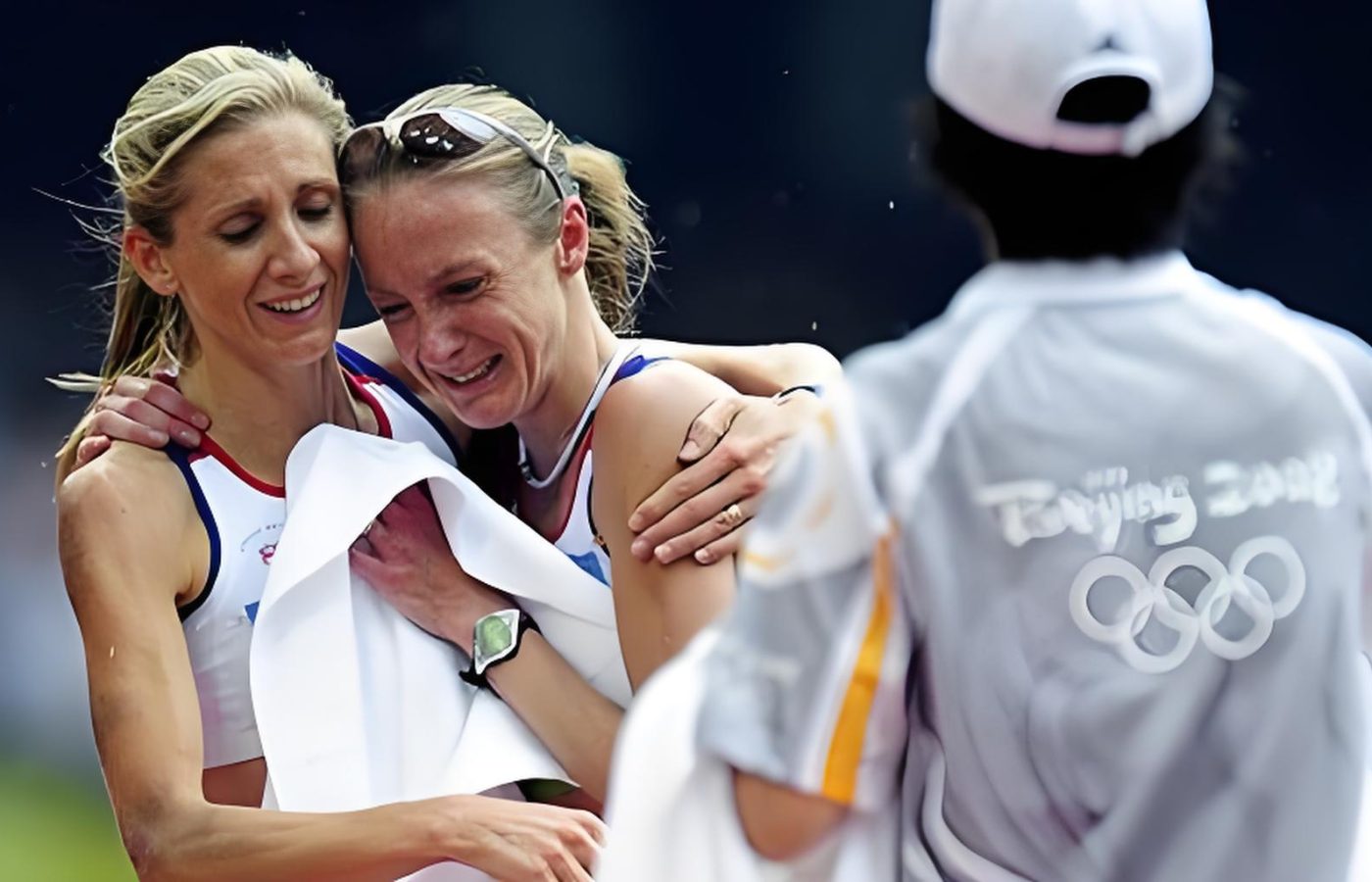
Despite the pain, she started the race. For the first half, she ran with the leaders. But as the kilometres ticked by and the Beijing smog thickened, her body began to shut down. Near the 30-kilometre mark, with her leg screaming and her form crumbling, she slowed to a jog. And then she collapsed.
Television cameras captured the image: Paula Radcliffe, the world’s greatest marathoner, slumped on the roadside, unable to stand. She eventually got up, but the race was over. She staggered across the finish line in 23rd place, her Olympic dream in ruins once more. The British public watched in agony. She vowed, through tears, to try again.
London 2012 — The Heartbreak That Finally Ended Her Olympic Quest
By 2012, Radcliffe was 38 years old. She had been battling foot injuries, had undergone surgery, and had missed months of training. Despite her determination, the injury proved too much. Weeks before the London 2012 marathon, Radcliffe was forced to withdraw from the race.
She was invited to carry the Olympic torch through her hometown instead — a poignant honor that served as a farewell of sorts. Her Olympic journey, which had begun with such promise in Atlanta 1996, ended not on the finish line but on the sidelines, watching her teammates compete without her.
“I have given it everything,” she said at the time. “But my body just won’t let me do it anymore.”
Other Achievements: World Champion, European and Commonwealth Glory
Radcliffe’s Olympic story was defined by heartbreak, but the rest of her career is a catalogue of dominance.
– World Champion — She won the marathon gold at the 2005 World Championships in Helsinki, cementing her status as the best in the world.
– European Champion — She won gold in the 10,000 metres at the 2002 European Championships in Munich.
– Commonwealth Champion — She won gold in the 5000 metres at the 2002 Commonwealth Games in Manchester.
– London Marathon — She won the London Marathon three times (2002, 2003, 2005), setting world records in two of those victories.
– New York City Marathon — She won three times (2004, 2007, 2008).
– Chicago Marathon — She won in 2002, setting a world record at the time.
She also set world records in the 10 kilometres (30:21 in 2003) and the half marathon (1:05:40 in 2003). Her range — from 1500 metres to the marathon — was extraordinary, a testament to her endurance and versatility.
Legacy
Paula Radcliffe retired from competitive running in 2015. Her world record of 2:15:25 stood as a benchmark for an entire generation of female distance runners, inspiring athletes like Brigid Kosgei, Eliud Kipchoge, and countless others to push the boundaries of the marathon.
She was appointed Officer of the Order of the British Empire (OBE) in 2026 for services to athletics. She had earlier been made an MBE in 2002. She has worked as a commentator and pundit for the BBC, offering sharp, insightful analysis of the sport she dominated.
Beyond the statistics, Radcliffe’s legacy is one of vulnerability and courage. She was never afraid to show the cost of ambition — the tears, the collapses, the public failures. In a sport that often celebrates only perfection, she made room for the messy, human truth of elite competition.
As she said after London 2012: “I wish it could have been different. But I gave absolutely everything. And in the end, I think that’s all anyone can ask.”
References
1. Radcliffe, P. (2004). Paula: My Story So Far. Simon & Schuster UK.
2. IAAF (2003). “Radcliffe breaks women’s marathon world record in London.” International Association of Athletics Federations.
3. BBC Sport (2012). “Paula Radcliffe withdraws from London 2012 marathon.” BBC.
4. The Guardian (2008). “Paula Radcliffe collapses in Beijing marathon heat.” Guardian Media Group.
5. World Athletics (2019). “Kosgei breaks Radcliffe’s marathon world record in Chicago.” World Athletics.