
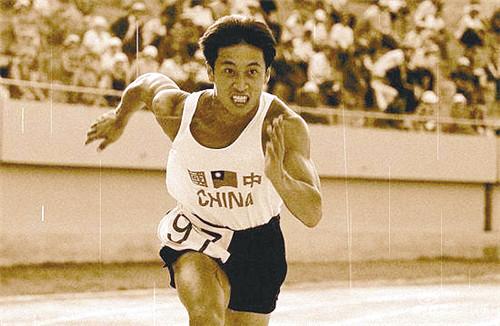
Three Weeks at Sea, One Man for a Nation: Liu Changchun (刘长春), China’s First Olympian

The Boy Who Outran the Wind
Liu Changchun (刘长春) was born on October 13, 1909, in Wafangdian, a small city in Liaoning Province, Northeast China. In an era when China was fractured by warlords, foreign concessions, and economic hardship, young Liu found his gift on the track.
His breakthrough came in 1929 at the North China Games, a premier regional athletics meet. Liu swept the men’s sprints — winning the 100 meters, 200 meters, and 400 meters — and in doing so set three national records. His 100-meter time of 10.7 seconds and 200-meter time of 22.0 seconds (the latter clocked in 1933) would stand as Chinese records for more than twenty years. At a time when world-class sprinters like Eddie Tolan and Ralph Metcalfe were pushing the 100m toward 10.3 seconds, Liu was competitive — not with the world’s best yet, but within striking distance.
But Liu’s speed on the track was matched only by the political storm brewing off it.
The Puppet State That Tried to Claim Him
In 1931, Japan invaded Manchuria (Northeast China) and established the puppet state of Manchukuo. The regime needed legitimacy — and what better way than to field an “Olympic team” at the 1932 Los Angeles Games?
Manchukuo officials approached Liu Changchun (刘长春). They offered him a place on their delegation. They pressured his family. They tried to print propaganda declaring that Manchukuo’s star sprinter would represent the puppet state on the world’s biggest stage.
Liu’s response was unequivocal. In a public statement published in Tianjin’s Dagong Bao (L’Impartial), one of China’s most influential newspapers at the time, he declared: “As long as my conscience still exists and my blood still flows, how could I forget my motherland and become a beast of burden for a puppet state?” It was an act of extraordinary courage. His family was still in Japanese-occupied Liaoning. Refusing Manchukuo meant putting them at risk — and putting himself in the crosshairs of a regime that did not tolerate dissent. But Liu never wavered.
A General’s Silver, a Steamer, and the Pacific
With Manchukuo’s claim refused and China needing an Olympic presence, someone had to act. That someone was General Zhang Xueliang — the Young Marshal of Manchuria, who had been ousted by the Japanese and was now based in Beijing.
Zhang personally donated 8,000 silver dollars to fund Liu’s Olympic journey. It was a princely sum at the time, and it covered Liu’s passage, accommodation, and expenses in Los Angeles. On July 8, 1932, Liu Changchun (刘长春) boarded the SS President Wilson in Shanghai and set sail for America.
The voyage lasted three weeks. Liu had no coach, no training partner, no medical staff. He was alone.
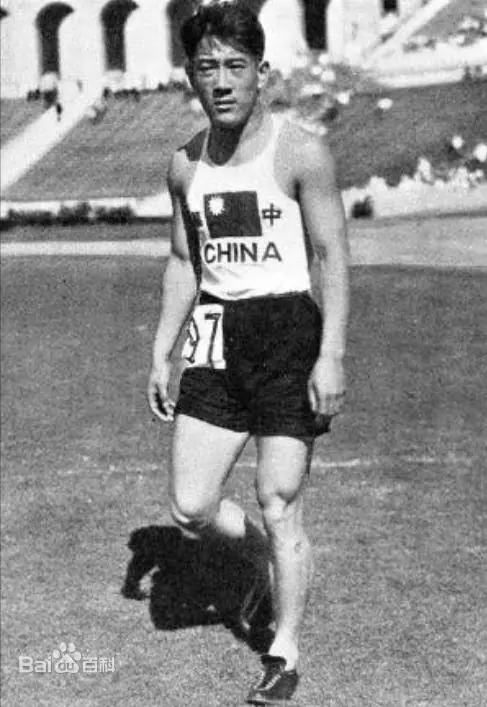
The ship crossed the Pacific, stopping in Kobe, Japan — a nerve-wracking port of call where Japanese journalists mobbed him, demanding to know why he had refused Manchukuo. Liu held his ground. As the ship pushed on across the open ocean, Liu trained on deck, sprinting along the rolling planks, fighting seasickness and the equatorial heat. He was 22 years old, 167 cm tall, carrying the weight of 400 million Chinese people on his shoulders.
He arrived in Los Angeles on July 29, 1932 — one day before the opening ceremony.
Los Angeles 1932: The Sole Flagbearer
The 1932 Los Angeles Olympics opened on July 30 at the Memorial Coliseum. As the nations marched in, China entered sixth. Behind the placard was a single figure: Liu Changchun (刘长春), holding the flag of the Republic of China. No teammates. No delegation. Just one man under a banner that the world barely recognized.
The next day, July 31, Liu stepped onto the track for the 100-meter heats. He ran 11.5 seconds — a credible time for a man who had spent three weeks recovering from a trans-Pacific voyage — but finished fifth in his heat. He did not advance.
On August 2, he ran the 200-meter heats. Again, elimination.
The results disappoint on paper. But they tell only half the story. Liu had arrived in America exhausted and utterly alone. He had not slept on land for 23 days before his first race. He had no warm-up facilities, no proper nutrition, no support staff. The journey alone had robbed him of the peak form he had shown in 1929 and 1933.
What matters is not that he lost. What matters is that he showed up.
Coach, Teacher, Survivor
Liu Changchun (刘长春) returned to China and continued competing. He qualified for the 1936 Berlin Olympics, where he again represented his country — this time with a slightly larger delegation, though still with meager resources.
After retiring from competition, Liu devoted his life to coaching and teaching. He became a physical education professor, training generations of Chinese athletes. But his life took a dark turn during the Cultural Revolution (1966–1976). Like countless intellectuals and pre-revolutionary figures, Liu was persecuted. He was forced to leave his teaching post and work on a farm near Dalian, stripped of the status he had earned through a lifetime in sport. The man who had defied the Japanese and carried China’s flag at the Olympics was treated as an outcast by his own country.
He survived.
In his later years, Liu Changchun (刘长春) was rehabilitated and appointed Vice Chairman of the Chinese Olympic Committee — a symbolic but deeply meaningful role that acknowledged his foundational contribution to China’s Olympic story.
He passed away on March 21, 1983, at the age of 73. His legacy was not yet fully recognized — that would come later.
The Gymnasium That Bears His Name
In 2008, as Beijing prepared to host the Summer Olympics — the first time China would ever stand as Olympic host — the country looked back at its Olympic origins. They found Liu Changchun (刘长春).
A gymnasium at Northeastern University in Shenyang was renamed Liu Changchun Gymnasium in his honor. A statue was erected in front of it. The building stands as a permanent reminder: China’s Olympic journey did not begin with 51 gold medals in 2008. It began with one man, on a steamship, in 1932.
Liu Changchun (刘长春) never won an Olympic medal. But he is arguably China’s most important Olympian — because he was the first. He proved that China could be present. That a Chinese athlete could compete on equal terms with the world. That no puppet state, no political regime, and no ocean could stop one man from running for his country.
Every Chinese athlete who has since stood on an Olympic podium — from Xu Haifeng’s gold in 1984 to Liu Xiang’s 110m hurdles triumph in Athens — stands on the shoulders of Liu Changchun (刘长春), the boy from Liaoning who outran the wind.
References
- Olympedia — Liu Changchun athlete profile
- Olympics.com — Liu Changchun profile
- Official Report of the 1932 Los Angeles Olympic Games
- Chinese Olympic Committee Archives — Liu Changchun
- Brownell, Susan. Beijing’s Games: What the Olympics Mean to China, Rowman & Littlefield, 2008