
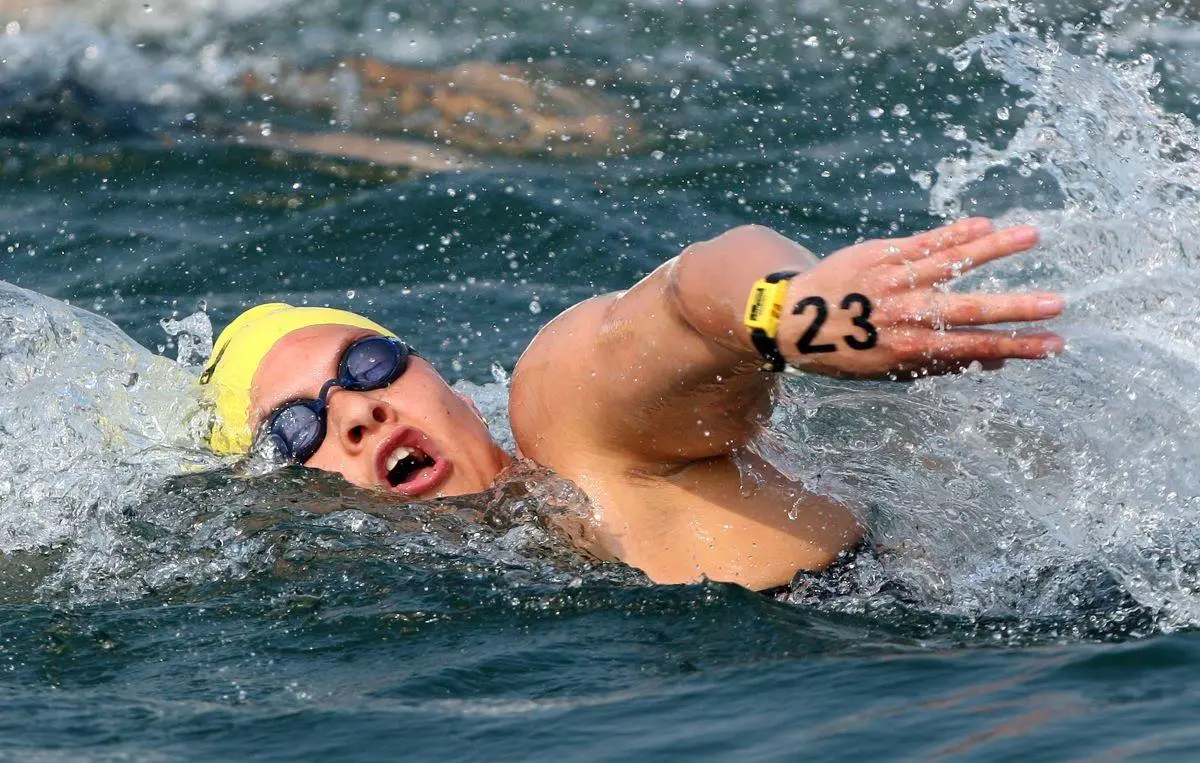
One Leg. One Olympic Pontoon. Sixteenth in the World: The Natalie du Toit Story

The Swimmer Before the Crash
Long before the accident defined her public story, Natalie du Toit was simply a swimmer — and a gifted one. Growing up in Cape Town, she was in the water before she could properly walk. By age fourteen, she had earned a place on South Africa’s national swimming team. In 1998, she traveled to Kuala Lumpur to represent her country at the Commonwealth Games, competing against the best swimmers in the Commonwealth at just fourteen years old.
She specialized in open water, the grueling discipline of long-distance swimming in natural bodies of water. Unlike pool swimming, open water has no lane ropes, no walls to push off, no clean black line at the bottom of the pool to follow. It is raw and unpredictable — currents shift, water temperature fluctuates, other swimmers bump and kick you without apology. Natalie du Toit loved it. The longer the race, the better she performed. By 2000, at sixteen, she was already being talked about as a future Olympian. Coaches described her as relentless in training — the kind of athlete who finished every set, who pushed herself when no one was watching.
Then, in February 2001, everything changed.
The Accident and the Question
Natalie du Toit was riding her scooter home from school after swimming practice when a car ran a red light and struck her. The impact was severe. Her left leg was crushed beyond repair. Five days later, surgeons amputated below the knee.
She was seventeen years old.
In the hospital bed, groggy from surgery, she asked the doctor a single question: “Can I still swim?” The doctor paused. He told her yes, she could swim — but she would probably never compete at the level she had before. She would most likely not beat swimmers with two legs again.
Natalie du Toit looked at him and said: “Watch.”
That single word became the thesis of her next seven years. She did not spend time asking why this had happened to her. She did not dwell on the unfairness. She simply wanted to know whether the pool was still an option. The answer, even a hesitant one, was enough.
Learning to Swim for the First Time, Again
Returning to the water after an amputation is not simply a matter of “getting back in the pool.” Natalie du Toit had to relearn every aspect of her stroke. With her left leg missing below the knee, her center of gravity had shifted. The balance she had developed over a decade of swimming was suddenly useless. Every kick angle had to be recalibrated. Her core strength had to be redistributed to compensate for the missing limb. It was harder than learning to swim the first time, because she had to unlearn everything her body already knew.
She got in the water every single day.
The rehabilitation was brutal. She endured multiple surgeries and recurrent infections in the residual limb. Pain followed her for nearly two years. On land, she needed crutches to walk. In the water, she found something different — a kind of freedom. “I am more comfortable in the water than on land,” she later said. In the pool, no one could see the difference. Under the surface, all bodies look the same.
She set her sights on the 2004 Athens Olympics. She trained harder than she had ever trained before. She failed to qualify. The cutoff time slipped beyond her reach. She was nineteen years old, one year post-amputation, and not yet fast enough. Many athletes would have taken that as a sign to stop. Natalie du Toit took it as a reason to train four more years.
Seville, May 2008: The Race That Changed Everything
On May 3, 2008, at the FINA Open Water World Championships in Seville, Spain, Natalie du Toit lined up for the women’s 10-kilometer race. The top finishers would earn qualification for the 2008 Beijing Olympics. She needed to finish in the top ten. She finished fourth.
The moment she touched the timing pad, she knew. She had done it. She became the first female amputee in history to qualify for the Olympic Games. Only two male amputees had done it before her — and no woman, ever.
When the news spread, FINA officials briefly discussed whether it was fair to allow a one-legged athlete into the Olympic field. Their conclusion was decisive: in the water, she had no advantage that required restriction, and no disadvantage that required accommodation. She would swim the same course, the same distance, under the same rules, as every other athlete. That was all she had ever asked for.
Beijing: The Olympic Pontoon and Five Gold Medals
On August 20, 2008, at the Shunyi Olympic Rowing-Canoeing Park in Beijing, twenty-five swimmers stood on the starting pontoon for the women’s Olympic 10-kilometer open-water marathon. The rules did not permit Natalie du Toit to wear her prosthetic during the race. She walked to the pontoon on crutches. She balanced on one leg as the crutches were taken away. Then the starting gun fired, and she dove into the water.
For two hours, forty-nine seconds, and nine-tenths of a second — 2:00:49.9 — she swam. No lane. No wall. No rest. Just arms pulling, lungs burning, and the cold dark water of the lake. She finished sixteenth — twenty-five starters, sixteenth place. The winner beat her by just over a minute and a half. But sixteenth place at the Olympic Games means you finished ahead of nine of the best open-water swimmers on the planet. It means you belong.
After touching the pad, she swam to the dock, pulled herself up, and stood on her crutches with water streaming down her face. She smiled. Then she walked back to the changing room, an Olympian who had done exactly what she set out to do.
But she was not done.
That same summer, at the Beijing Paralympics, Natalie du Toit won five gold medals — in the 50m freestyle, 100m freestyle, 100m butterfly, 200m individual medley, and 400m freestyle. Five races, five wins. Yet when reporters asked her which achievement meant more, she did not hesitate. The Olympic sixteenth place, she said, was the most important result of her career. “I was there,” she said simply. “I started with the best open-water swimmers in the world, and I swam the entire course with them.”
What She Left Behind
Natalie du Toit retired from competitive swimming in 2012, after competing at the London Paralympics, but her legacy has only grown. She proved that the boundary between disability and ability in sport is not as rigid as the world assumes. She did not ask for sympathy, or for special rules, or for the bar to be lowered. She asked only for a place on the starting line.
Today, her name appears in Olympic record books not under a separate category, but alongside every other athlete who competed in Beijing. That is precisely how she wanted it. She was not a symbol. She was a swimmer. And for one summer in Beijing, she was exactly where she belonged — in the water, moving forward, indistinguishable from everyone else.

References
- Olympics.com — Natalie du Toit profile
- Encyclopaedia Britannica — Natalie du Toit
- 2008 Beijing Olympic Games Official Report
- FINA Open Water Marathon Documentation
- Commonwealth Games Federation — Athlete Profile: Natalie du Toit
- #BeyondSport #NatalieDuToit #SouthAfrica #Beijing2008 #OpenWaterSwimming #Paralympics