
Sergei Belov: The Soviet Basketball Legend Who Lit the Moscow 1980 Olympic Cauldron

The Siberian Who Conquered Soviet Basketball
Sergei Belov was born on January 23, 1944, in the remote village of Nashchokovo, deep in the Tomsk Oblast of Siberia. Nothing about his beginnings suggested a path to global fame. Basketball in the Soviet Union of the 1950s was still a developing sport, and Siberia was hardly its cradle. But Belov possessed something that coaches noticed early: a relentless work ethic and a jump shot that seemed to arc progressively higher the tighter the defense.
Standing 191 centimeters — about 6-foot-3 — Belov was not exceptionally tall by international basketball standards. What set him apart was his elevation on the jumper, his ice-cold composure, and an almost mechanical consistency. American players who later faced him would compare his shooting form to that of Jerry West: high release, impossible to block, and devastatingly accurate.
After brief stints with Uralmash Sverdlovsk, Belov joined CSKA Moscow in 1968. It was the beginning of a dynasty. Over the next twelve years, he would lead CSKA to eleven Soviet league championships and two EuroLeague titles. On the international stage, he was equally dominant, helping the Soviet national team win two FIBA World Championships and four European Championships. By the late 1960s, the soft-spoken Siberian guard was the most feared scorer on the continent.
Munich 1972: The Shot That Shook America
No single game defines Sergei Belov’s legacy more than the 1972 Olympic men’s basketball final in Munich. The matchup carried more than sporting weight: it was the Cold War on a hardwood court. The United States had never lost an Olympic basketball game. They had won seven consecutive gold medals. Everyone expected number eight.
What they got instead was chaos.
With three seconds on the clock and the Americans leading 50–49, American guard Doug Collins sank two free throws to put the USA up by one. The Soviet Union called a timeout they technically did not have. The officials reset the clock. The Soviets inbounded the ball but could not get a shot off before the buzzer. The Americans celebrated.
But the game was not over. FIBA secretary-general William Jones ruled that three seconds should remain on the clock — not one, not zero. The officials ordered the teams back onto the floor. The Americans protested. The Soviets inbounded again.
This time it worked. A long pass found Soviet center Alexander Belov (no relation) under the basket, who scored as time expired. Final score: Soviet Union 51, United States 50. The Americans filed a formal protest. It was denied. To this day, the U.S. players have refused to accept their silver medals.
And through it all, Sergei Belov was the steady hand. He scored a game-high 20 points — the only player on either side to reach double figures. In the crucible of the most controversial final in Olympic history, while teammates faltered, while the officials argued, while thousands of fans roared in confusion, Belov kept shooting and kept scoring. Doug Collins, who played against him that night and later became an NBA head coach, remembered Belov not with bitterness but with deep respect, calling his death in 2013 “a sad day for Russia and the world of basketball.”
The Textbook Jumper and the Hall of Fame
FIBA named Belov the best player in its history in 1991, a year before he became the first international player ever enshrined in the Naismith Memorial Basketball Hall of Fame. The honor was unprecedented: an athlete who had never played a single game in the NBA, whose entire career unfolded behind the Iron Curtain, was now immortalized alongside the titans of American basketball.
What the Hall of Fame voters recognized was not just statistics but style. Belov’s jump shot became a teaching tool across Europe and Asia. Coaches would freeze-frame footage of his release point — the high arc, the perfect wrist snap, the soft follow-through — and tell young players, “Shoot like Belov.” His game was pure mechanics and pure artistry at the same time.
He won four Olympic medals: gold in 1972, bronze in 1968, 1976, and 1980. He captured eleven national titles, two EuroLeague crowns, two World Championships, and four European Championships. But his real legacy was paving the way for every European player who would later make the leap to the NBA. Before Dirk Nowitzki, before Toni Kukoc, before Giannis Antetokounmpo, there was Sergei Belov — proof that greatness in basketball had no geographic boundaries.
1980: Lighting the Flame at the Games Nobody Came To
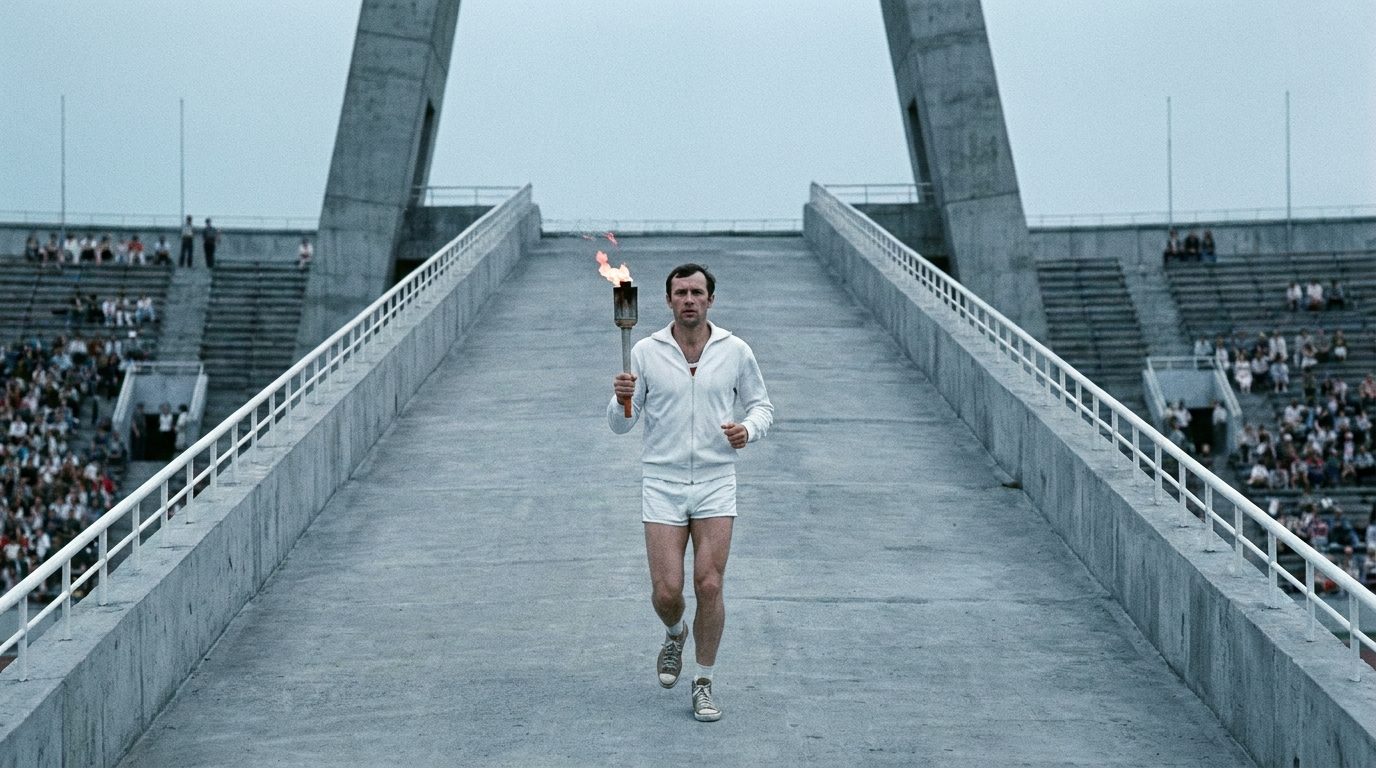
The 1980 Moscow Olympics were unlike any Games before or since. In response to the Soviet invasion of Afghanistan, U.S. President Jimmy Carter led a boycott of 65 nations. The Americans did not come. Neither did Japan, West Germany, or dozens of other countries. The Opening Ceremony at Lenin Stadium was attended by empty seats and a palpable sense of what might have been.
And yet, for the Soviet Union, the ceremony was a moment of immense national pride. The organizers needed a symbol — someone who embodied the excellence of Soviet sport, someone whose story transcended politics. They chose Sergei Belov.
On the evening of July 19, 1980, Belov jogged into Lenin Stadium carrying the Olympic flame. He was 36 years old, competing in his fourth and final Olympics. The crowd roared as he climbed the steps toward the cauldron. With a single motion, he ignited the fire that would burn for sixteen days, becoming the first — and still the only — basketball player ever to light the Olympic cauldron.
It was a moment weighted with irony. The boy from Siberia, raised in obscurity, now stood at the center of the world’s attention — at a Games that half the world had chosen to ignore. He later said little about it. That was Belov: he let his actions speak. But the image of a basketball player holding the Olympic flame aloft remains one of the most powerful symbols in Olympic history.
After the Final Whistle
Belov retired as a player after the 1980 Olympics and moved into coaching. He led CSKA Moscow back to Soviet league titles, coached the Russian national team to silver medals at the 1994 and 1998 FIBA World Championships, and spent years developing young talent in the city of Perm, in the Ural Mountains. He also served as president of the Russian Basketball Federation from 1993 to 1998.
His later years were marked by health struggles. On October 3, 2013, Sergei Belov died in Perm at the age of 69. The basketball world mourned. NBA Commissioner David Stern issued a statement calling Belov’s contributions “extraordinary.” Doug Collins, his opponent in that 1972 final, called him “a treasure.” Andrei Kirilenko, the Russian NBA star who was once cut from the national team by Belov himself, remembered the man who demanded the ball in the most difficult moments and delivered every time.
In 2018, a small asteroid discovered nine years earlier was officially named 296638 Sergeibelov — a fitting tribute for a man whose light burned bright enough to outlast nations and ideologies.
References
- Olympedia — Sergei Belov profile
- Naismith Memorial Basketball Hall of Fame — Sergei Belov
- FIBA Hall of Fame — Sergei Belov
- Official Report of the 1980 Moscow Olympic Games
- Sputnik International — “Soviet Basketball Legend Belov Mourned in US” (2013)