
From a Simple Parade to a $100 Million Spectacle: How the Opening Ceremony Became the World’s Most Expensive Show
The Olympic opening ceremony has evolved from a modest parade of athletes into the most-watched live show on earth, with production costs exceeding $100 million. The transformation began in 1984 when Los Angeles turned the ceremony into a Hollywood spectacular — and every host city since has tried to outdo it.
The Early Years: A Simple Parade
For the first eight decades of the modern Olympic Games, the opening ceremony was a straightforward, dignified affair. Athletes marched into the stadium behind their national flags. The host nation’s head of state declared the Games open. The Olympic flag was raised. The cauldron was lit. Then the competition began.
This template held for decades. Through London 1908, Berlin 1936 (where the torch relay was invented), and Helsinki 1952, the core structure remained the same: the parade of nations, the release of doves, the torch lighting, and the declaration of opening by the host nation’s head of state. The doves were real. The production budget was negligible. The entire event, from first march to final flame, rarely exceeded 90 minutes.
No one thought of the opening ceremony as entertainment. It was a ceremony — formal, respectful, and deliberately understated.
1984 Los Angeles: The Birth of Spectacle
The modern opening ceremony was born in Los Angeles on July 28, 1984. That was the night producer David L. Wolper — a Hollywood veteran who had produced “Roots” and “The Thorn Birds” — decided that the opening ceremony needed to be a show.
Wolper treated the Los Angeles Memorial Coliseum as a soundstage. The show opened with a man flying into the stadium strapped to a jetpack — a stunt that stunned the 90,000 live spectators and the 2.5 billion television viewers watching at home. The Coliseum floor was crammed with 84 grand pianos — a nod to the year 1984 itself. The pianists played Gershwin’s “Rhapsody in Blue,” and 1,000 dancers in neon costumes created a living map of the United States.
Wolper’s calculation was simple: television was now the Olympics’ primary audience, and television demanded spectacle. Every visual element was designed for the camera — the wide shots, the synchronized movement, the color contrast. The jetpack man was pure Hollywood; the 84 pianos were pure excess. The world loved it.
The 1984 ceremony was also the first to feature a fully choreographed artistic segment before the parade of nations. This was a structural revolution: the show now came before the sport. The template Wolper established — a narrative-driven, television-optimized, celebrity-directed spectacle — has been followed by every host city since.
1988 Seoul: The Day the Doves Burned
If 1984 was the birth of spectacle, 1988 was the year the ceremony learned the limits of tradition. During the opening ceremony in Seoul, a group of doves were released as a symbol of peace — a modern Olympic tradition dating back to 1896. The doves flew around the stadium and settled on the rim of the Olympic cauldron.
When the cauldron was lit, the doves were caught in the flame. Hundreds of millions of viewers watched as the birds were burned alive on live television. The footage was horrifying. The International Olympic Committee received a flood of complaints from animal rights groups and horrified viewers worldwide.
Seoul 1988 became the last Olympics to use real doves in the opening ceremony. From 1992 onward, the IOC banned the practice. The doves were replaced by symbolic substitutes — dancers in white costumes, light projections, paper doves, and performers forming dove shapes.
The dove burn incident is a grim footnote in Olympic history, but it marks a critical moment in the ceremony’s evolution: it demonstrated that tradition, no matter how cherished, could be sacrificed in the name of ethics — and that television audiences had the power to force change.
1992–2008: The Ceremony Becomes Art
The Barcelona 1992 opening ceremony set a new standard for artistic ambition. Director Manuel Huerga created a Mediterranean-themed spectacle that included flamenco dancers, opera singers, and a dramatic moment when archer Antonio Rebollo lit the cauldron by shooting a flaming arrow over it. The arrow did not actually ignite the flame — the cauldron was lit by a concealed mechanism at the same moment — but the visual illusion was perfect.
Sydney 2000 raised the emotional temperature. Aboriginal athlete Cathy Freeman, a symbol of reconciliation between Indigenous and non-Indigenous Australians, lit the cauldron while standing in a pool of water. The image of fire on water became one of the most memorable in Olympic history.
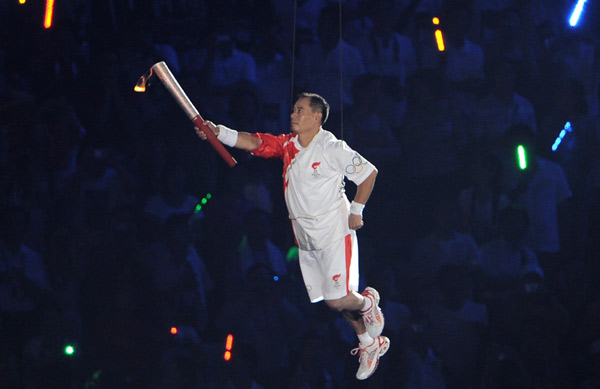
Then came Beijing 2008. Directed by Zhang Yimou, the ceremony was a $100 million production that remains the most expensive and ambitious opening ceremony ever staged. It featured 15,000 performers, a scroll-shaped floor made of LED screens, a five-story-high globe, and the spectacle of gymnast Li Ning running through the air around the roof of the Bird’s Nest stadium before lighting the cauldron. The world watched in awe. China had announced itself on the global stage with a display of cultural ambition that no host city has since matched.
2012 London: Storytelling Takes Center Stage
London 2012, directed by Danny Boyle, took a radically different approach. Instead of grand scale, Boyle chose narrative. His ceremony, titled “Isles of Wonder,” told the story of Britain through a series of theatrical scenes: the Industrial Revolution, the creation of the National Health Service, and the rise of British popular culture.
The most iconic moment was a short film starring Daniel Craig as James Bond and Queen Elizabeth II herself. In the film, Bond and the Queen appeared to parachute from a helicopter into the Olympic Stadium. The Queen’s participation was a closely guarded secret and became one of the most discussed moments in Olympic television history.
Boyle’s ceremony proved that spectacle did not require the largest budget or the most performers. A clear story, a sense of humor, and a few surprises could be just as powerful as a thousand dancers.
2020 Tokyo: The Empty Stadium
The 2020 Tokyo Olympics, postponed to 2021 due to COVID-19, presented a challenge no host city had faced: how do you stage a celebration of global unity when the world is in isolation?
The Tokyo ceremony was held in an almost empty stadium. The parade of nations continued, but athletes wore masks and kept their distance. The performances were elegant but subdued. There were no roar of the crowd, no spontaneous applause, no shared breath of 80,000 people in a single moment.
It was the quietest opening ceremony in modern Olympic history. And in its quietness, it became a different kind of spectacle — a testament to the human spirit’s determination to gather, even when the world told us not to.
Legacy: The Ceremony as Global Currency
The Olympic opening ceremony has become the most-watched recurring live event on the planet, with global audiences regularly exceeding two billion. It is the only event on earth where the entire world watches the same broadcast at the same time.
For host cities, the ceremony is the first impression they make on the world. It is a four-hour infomercial for national identity, cultural heritage, and economic ambition. The pressure to deliver is immense — and the cost of failure is even greater.
The opening ceremony has come a long way from the simple parade in Athens 1896. It is now a global art form, a diplomatic tool, and a $100 million gamble. And every two years, the world watches to see what the next host city will do to top it.
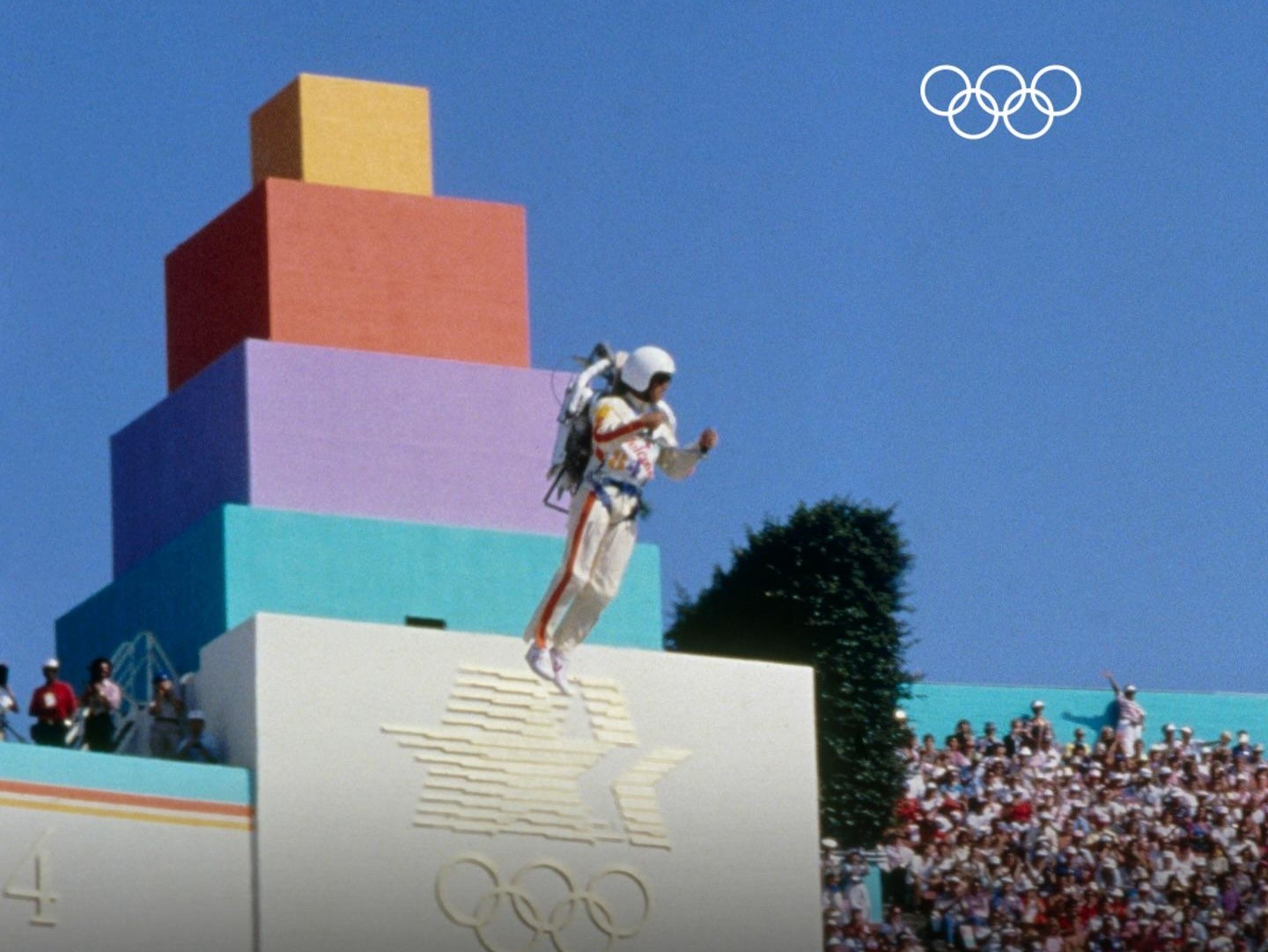
Jetpack man flying into the stadium at the 1984 Los Angeles Opening Ceremony
References
- IOC Official Report — Los Angeles 1984 Opening Ceremony (Vol. 1).
- Wolper, David L. The Inside Story of the 1984 Olympic Opening Ceremony. Los Angeles Olympic Organizing Committee, 1985.
- International Olympic Committee. Official Reports of the Olympic Games: Seoul 1988, Barcelona 1992, Sydney 2000, Beijing 2008, London 2012, Tokyo 2020.
- Zhang Yimou. The Beijing 2008 Olympic Opening Ceremony: A Director’s Account. China Intercontinental Press, 2009.
- Boyle, Danny. London 2012: Isles of Wonder — The Official Film. BBC / London Organising Committee, 2013.