
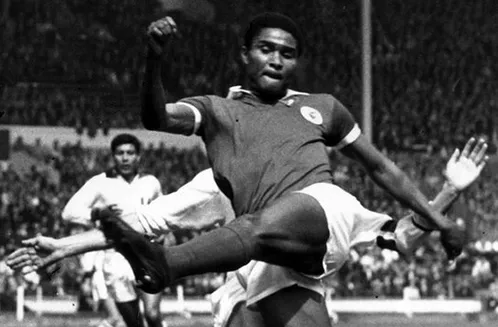
The Black Panther Who Conquered Europe: Eusebio’s Story of Goals, Glory and the 1966 World Cup

From the Streets of Mafalala to Benfica’s Secret Operation
Eusebio grew up in Mafalala, one of the poorest neighborhoods in Lourenco Marques (now Maputo). His father, a railroad worker, died of tetanus when the boy was just eight years old. His mother, Elisa, raised four children alone on a meager income.
But poverty could not touch what Eusebio had on the football field. He played barefoot with a makeshift ball – a bundle of rags tied together with string – on a dusty patch of dirt that locals called the football field. It was there that his raw talent first caught the eye of scouts.
Strangely enough, the local feeder club for Benfica turned him away. So he joined their rivals – Sporting Clube de Lourenco Marques, the Mozambican arm of Sporting Lisbon. By age 15, Juventus had already spotted him. His mother refused to let him move to Italy. Two years later, Sao Paulo FC had the chance to sign him but balked at the price.
Benfica did not make that mistake.
But getting Eusebio to Lisbon required something like a spy operation. Because he belonged to Sporting’s system, Benfica smuggled him out of Mozambique under the code name “Ruth Malosso.” He arrived in Lisbon on December 15, 1960. For days, the club kept him hidden in the Algarve town of Lagos, waiting for the legal dust to settle.
When he finally played his first friendly for Benfica – against Atletico Clube de Portugal – he scored a hat-trick in a 4-2 win. In his first official match, the day after Benfica had won their first European Cup, he scored again.
The Black Panther had arrived.
The 1962 European Cup Final: A 20-Year-Old Who Beat Real Madrid
On May 2, 1962, a 20-year-old Eusebio walked onto the pitch at the Olympic Stadium in Amsterdam. Across from him stood Real Madrid – the undisputed kings of European football, winners of six European Cups in seven years, led by the great Ferenc Puskas.
Puskas scored a hat-trick in the first 40 minutes. Real Madrid led 3-2 at halftime. The script seemed written.
Then Eusebio rewrote it.
He scored the equalizer in the 58th minute, powering a shot past the Madrid goalkeeper. Five minutes later, he scored again – a thunderous strike with his right foot, the foot that would become legendary. Benfica won 5-3. Eusebio had scored two goals and assisted another. A twenty-year-old had just beaten Puskas’s Real Madrid in a European Cup final.
That night changed everything. The boy from Mafalala was now a continental champion. Over the next 13 years with Benfica, he would win 11 Portuguese league titles and five Portuguese Cups, establishing himself as the most devastating striker in Europe.
In 1965, he was awarded the Ballon d’Or – the first Portuguese player ever to win it, a distinction only later matched by Cristiano Ronaldo’s five triumphs.
The 1966 World Cup: Four Goals in a Quarterfinal That Shook the World
Portugal arrived at the 1966 World Cup in England as an unknown quantity. They had never won a major tournament. They were making only their second World Cup appearance.
They left as one of the most exciting teams the tournament had ever seen.
Eusebio scored in every group-stage match. He torched Hungary with a hat-trick. Brazil, the defending champions, were dispatched 3-1. Portugal swept through the group stage with a perfect record.
Then came the quarterfinal against North Korea – a match that still stands as one of the most astonishing in World Cup history.
Twenty-five minutes in, Portugal trailed 3-0. North Korea, the tournament’s surprise package, had torn through Portugal’s defense. The stadium at Goodison Park was stunned into silence.
What happened next is pure folklore.
Eusebio scored in the 27th minute. Then again in the 43rd. The halftime score was 3-2. He scored his third in the 56th minute – a penalty, cool and precise. His fourth came in the 59th minute. Four goals. One man had single-handedly turned a 3-0 deficit into a 4-3 lead. Portugal would go on to win 5-3.
After the match, photographs show Eusebio weeping on the shoulder of a teammate, overcome with emotion. North Korean players later said they understood, through gestures and tears, that he was not celebrating – he was releasing something deeper.
Portugal fell to England in the semifinal, a controversial 2-1 loss remembered in Portugal as the “Jogo das Lagrimas” (Game of Tears). Eusebio scored a penalty in the 82nd minute – his ninth goal of the tournament – and Portugal beat the Soviet Union 2-1 in the third-place playoff to claim bronze.
He finished as the tournament’s top scorer with nine goals – a mark that has only been surpassed once in a single World Cup (Gerd Muller’s 10 for West Germany in 1970). More than half a century later, it remains among the highest totals the tournament has ever seen.
The Numbers Behind the Legend
Eusebio’s career statistics are almost impossible to process. For Benfica alone, across all competitions including friendlies, he scored over 700 goals in over 700 appearances. His record across all club football: 580 goals in 575 competitive matches. For Portugal, he scored 41 goals in 64 caps – a rate that would be world-class in any era.
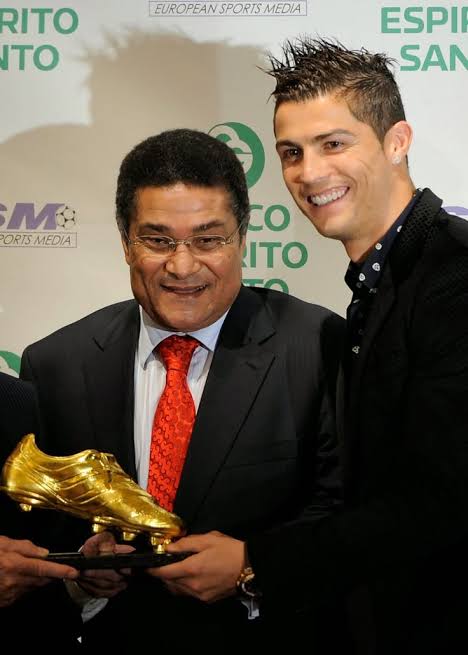
He was the Portuguese league’s top scorer seven times. He won the European Golden Boot in 1968 and 1973 – the first and one of only a handful of players to win it twice. He was named to the World Cup All-Star Team in 1966. At his physical peak, he could run 100 meters in under 11 seconds – extraordinary for a footballer in the 1960s.
His playing style was a fusion of raw power and technical elegance. His right-footed shots were so fierce that goalkeepers learned to get out of the way rather than try to catch them. He could accelerate past defenders as if they were standing still.
When he left Benfica in 1975, he continued playing in North America and Mexico for five more seasons, finally retiring at 38.
A Nation’s Farewell
Eusebio passed away on January 5, 2014, in Lisbon, at the age of 71. The Portuguese government declared three days of national mourning. His funeral procession through the streets of Lisbon drew hundreds of thousands of mourners.
In July 2015, Eusebio’s remains were transferred to the National Pantheon in Lisbon – a final resting place reserved for the most important figures in Portuguese history. He was the first footballer and the first black person to be buried there. A boy from the dirt fields of Mafalala, laid to rest alongside presidents, poets, and national heroes.
References
- Eusebio da Silva Ferreira – Encyclopaedia Britannica
- 1966 FIFA World Cup Official Report – FIFA.com
- 1965 Ballon d’Or – UEFA.com / France Football
- Eusebio – FootballHistory.org
- SL Benfica Official History Records