
5 Minutes, 44 Seconds: Gabriela Andersen-Schiess and the Finish That Defined the First Women’s Olympic Marathon

From the Snows of Switzerland to the Heat of Los Angeles
Gabriela Andersen-Schiess grew up in Switzerland, where she competed as a cross-country skier before switching to marathon running. She moved to the United States and settled in Sun Valley, Idaho, where she worked as a ski instructor and ran the mountain trails.
In 1984, at age 39, she qualified for the Los Angeles Olympics – the first Games to include a women’s marathon. The distance had been denied to women for decades. The IOC had argued that women were physically incapable of running 42 kilometers. In 1984, that argument was finally put to rest.
A Historic First Under a Cruel Sun
August 5, 1984. The starting gun fired for the first women’s Olympic marathon. The temperature was over 30 C (86 F), with high humidity. The course offered little shade. The marathon had only five water stations – a dangerously low number for such conditions, a rule designed for a men’s race in cooler weather.
Joan Benoit of the United States won in 2:24:52, pulling away early and never looking back. The race for the medals was decided. Most of the field had finished. The stadium began to empty.
Then Gabriela Andersen-Schiess appeared in the tunnel.
The 400 Meters That Lasted Nearly Six Minutes
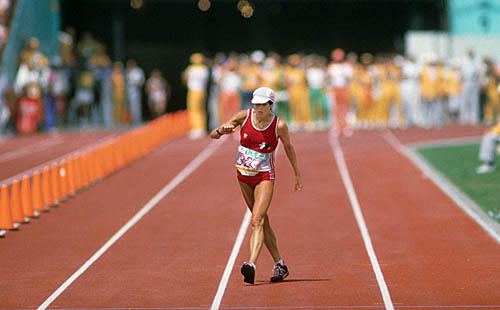
She entered the Los Angeles Memorial Coliseum alone. The stadium announcer called her name. The few thousand remaining spectators turned to watch.
She was not running. She was lurching. Her right arm hung limp at her side – a classic sign of severe heat stroke. Her left leg dragged. Her head rolled back. She staggered toward the track, listing to one side, barely staying upright.
Medical staff rushed to her side. She waved them away. She was determined to finish.
What followed was the longest single lap in Olympic history. Andersen-Schiess took 5 minutes and 44 seconds to cover 400 meters. She stopped. She swayed. She nearly fell. The crowd held its breath. She pushed forward. She collapsed onto the track. She stood up. She kept moving.
Finally, she crossed the finish line. Time: 2:48:42. 37th place. She collapsed into the arms of waiting medical staff. Her body temperature was 41.7 C (107 F). It took over an hour to stabilize her.
Aftermath and Legacy
The images of Andersen-Schiess staggering around the track were broadcast around the world. Some criticized the medical staff for not intervening sooner. Others called her a symbol of the human spirit. She herself said later that she did not remember the final lap – her mind had shut down.
The 1984 women’s marathon led to reforms. The IOC and IAAF increased the number of water stations and improved medical protocols for endurance events. Andersen-Schiess returned to Idaho and lived quietly. She never ran another competitive marathon.
But her final lap is remembered not as a failure of safety, but as a testament to the determination that the first women marathoners had to carry – a determination that had been denied for too long, and that finally, on an August afternoon in Los Angeles, the whole world got to see.
References
- Olympedia – Gabriela Andersen-Schiess
- The New York Times – “Marathon’s Grueling Final Lap” (August 6, 1984)
- IOC – Los Angeles 1984 Official Report
- World Athletics – Gabriela Andersen-Schiess profile