
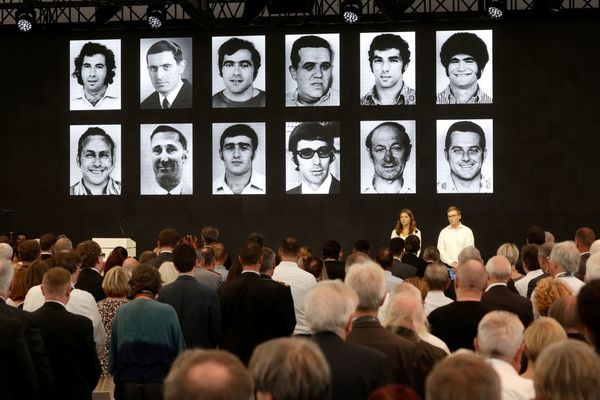
21 Hours, 11 Dead: The Night Terror Shattered the Olympic Dream
The 1972 Munich Olympics were meant to present a peaceful, modern Germany to the world — instead, they became the site of the darkest day in Olympic history. On September 5, Palestinian terrorists infiltrated the Olympic Village, taking 11 Israeli athletes hostage. The failed rescue attempt left all 11 dead and changed the Olympics forever.
The “Peaceful Games” — And the Shadow They Couldn’t Escape
When Munich won the bid to host the 1972 Summer Olympics, West Germany saw it as a once-in-a-generation opportunity. The world still remembered Berlin 1936 — the Nazi Olympics. Munich wanted to present a new Germany: democratic, open, peaceful.
The organizing committee made deliberate choices to project this image. Security was intentionally low-key. Guards wore light blue uniforms and carried pistols — not rifles. There were no barbed-wire fences around the Olympic Village. Athletes came and went freely, often climbing the fences to avoid showing credentials.
The message was clear: this was not the Germany of 1936.
But the relaxed security created a vulnerability that would be exploited with devastating precision.
The Infiltration: September 5, 1972
At 4:10 a.m. on September 5, eight men in tracksuits climbed the six-foot chain-link fence surrounding the Olympic Village. They carried duffel bags containing AK-47 assault rifles, grenades, and pistols. Several athletes saw them climbing the fence and assumed they were fellow Olympians sneaking back in after a late night.
The terrorists were members of Black September, a Palestinian militant group named after the 1970 Jordanian civil war. Their target was the Israeli team, housed at 31 Connollystrasse — a modest two-story building at the edge of the Village.
Inside the building, the 21-member Israeli delegation slept. At 4:30 a.m., the terrorists broke through the front door. Wrestling coach Moshe Weinberg heard the noise and confronted them. He shouted a warning to his teammates — “Run! Hide!” — before being shot dead. Weightlifter Yossef Romano also tried to fight the attackers and was killed. Nine other Israelis were taken hostage.
One athlete, Shaul Ladany, escaped by jumping through a window and running barefoot to safety.
By sunrise, the world knew: the Olympic Games were under terrorist attack.
Nearly 21 Hours of Failed Negotiation
The German authorities were completely unprepared. In 1972, Germany had no specialized counter-terrorism unit — GSG9 would be created only after this disaster. The Munich police were trained for traffic control and crowd management, not hostage crises.
For nearly 21 hours, negotiators attempted to secure the hostages’ release. The terrorists demanded the release of 234 Palestinian prisoners held in Israel, plus two German left-wing militants. Israeli Prime Minister Golda Meir refused to negotiate.
As the standoff dragged on, the terrorists grew increasingly agitated. They issued an ultimatum: if their demands were not met by midday, they would execute one hostage per hour.
The German authorities agreed to transport the terrorists and hostages by helicopter to Fürstenfeldbruck Airbase, where they claimed a plane was waiting to fly them to Cairo. It was a trap.
The Failed Rescue at Fürstenfeldbruck
The rescue plan was poorly conceived and poorly executed. Five German police snipers were positioned at the airbase — too few to handle eight heavily armed terrorists. There was no backup plan. Communication between the snipers was inadequate.
When the helicopters landed at 10:30 p.m., the terrorists realized they had been tricked. The snipers opened fire prematurely. What followed was 90 minutes of chaos.
Two terrorists were killed in the initial exchange. But the remaining six fought back. One terrorist threw a grenade into a helicopter carrying five hostages. The explosion killed all five instantly. Another terrorist machine-gunned the occupants of the second helicopter.
By the time the firefight ended, all nine hostages were dead. Five of the eight terrorists had been killed. One German police officer had been fatally shot. Three surviving terrorists were captured (they would be released later that year in a hostage exchange).
The Olympic Games had been suspended for 34 hours — the first interruption in Olympic history. At 10:00 a.m. on September 6, the world gathered in the main stadium to mourn.
“The Games Must Go On”
A memorial ceremony was held before 80,000 spectators and a global television audience estimated at nearly one billion. The Olympic flag was lowered to half-mast. The Israeli flag was draped over empty caskets. The names of the eleven dead were read aloud.
Then came the speech that would remain one of the most controversial moments in Olympic history. IOC President Avery Brundage delivered remarks that many present found shockingly cold. In a short address, he mourned the loss of life but then declared: “The Games must go on.”
Brundage had a particular motivation. The 1972 Games had been plagued by an earlier crisis: the expulsion of Rhodesia over apartheid. Brundage, a staunch defender of keeping politics out of sport, had been furious about that decision. Many historians believe his “must go on” declaration was as much a political statement against government interference in sport as it was about the massacre itself.
Brundage’s words — “The Games must go on” — would follow him to the grave as perhaps the most infamous quote in Olympic history.
Aftermath: Security Forever Changed
The Munich Massacre transformed the Olympics. Every subsequent Games has been secured with military-level security. The relaxed, open atmosphere of Munich 1972 — athletes strolling through the Village without credentials — has never returned. Today’s Olympic Games are surrounded by armed police, metal detectors, and no-fly zones.
Germany created GSG9, its elite counter-terrorism unit, directly in response to the failed rescue. Israel launched Operation Wrath of God, a covert campaign to assassinate the Black September operatives responsible for the attack.
The families of the victims have long criticized the IOC for what they see as inadequate acknowledgment of the tragedy. For years, no official memorial was placed at Olympic sites. A memorial plaque was finally installed at the Munich Olympic Village in 1995.
The 1972 Munich Olympics were supposed to show the world a new Germany. Instead, they showed the world that the Olympic dream — peace, unity, international friendship — could be shattered in a single night by men with guns.
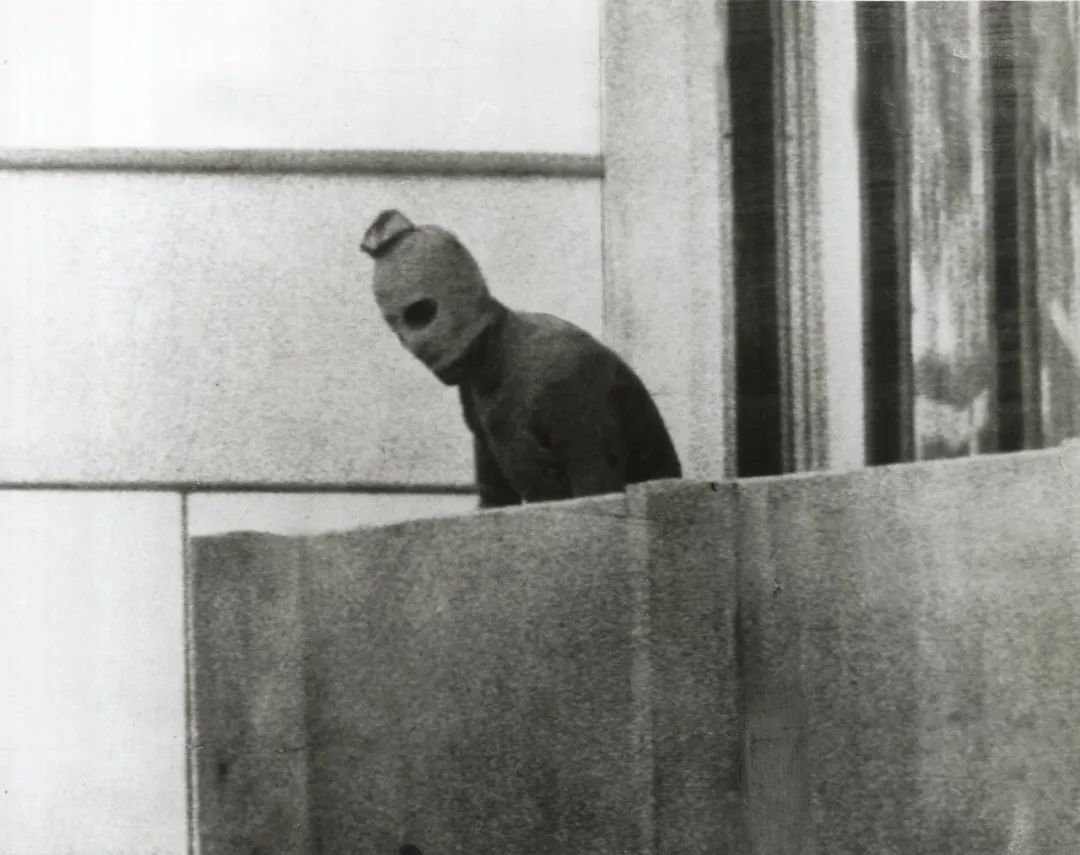
Armed terrorist on the Munich Olympic Village balcony
References
- Reeve, Simon. One Day in September: The Full Story of the 1972 Munich Olympics Massacre. Arcade Publishing, 2000.
- IOC Official Report — 1972 Munich Games, Vol. 2: The Crisis.
- BBC Archives — “Munich 1972: The 21-Hour Hostage Crisis.” BBC News, September 2002.
- Encyclopedia Britannica — “Munich Massacre” Historical Entry.
- Klein, Aaron J. Striking Back: The 1972 Munich Olympics Massacre and Israel’s Deadly Response. Random House, 2005.