
The Time He Lost Was Greater Than the Time He Won

—
He was twenty-five years old.
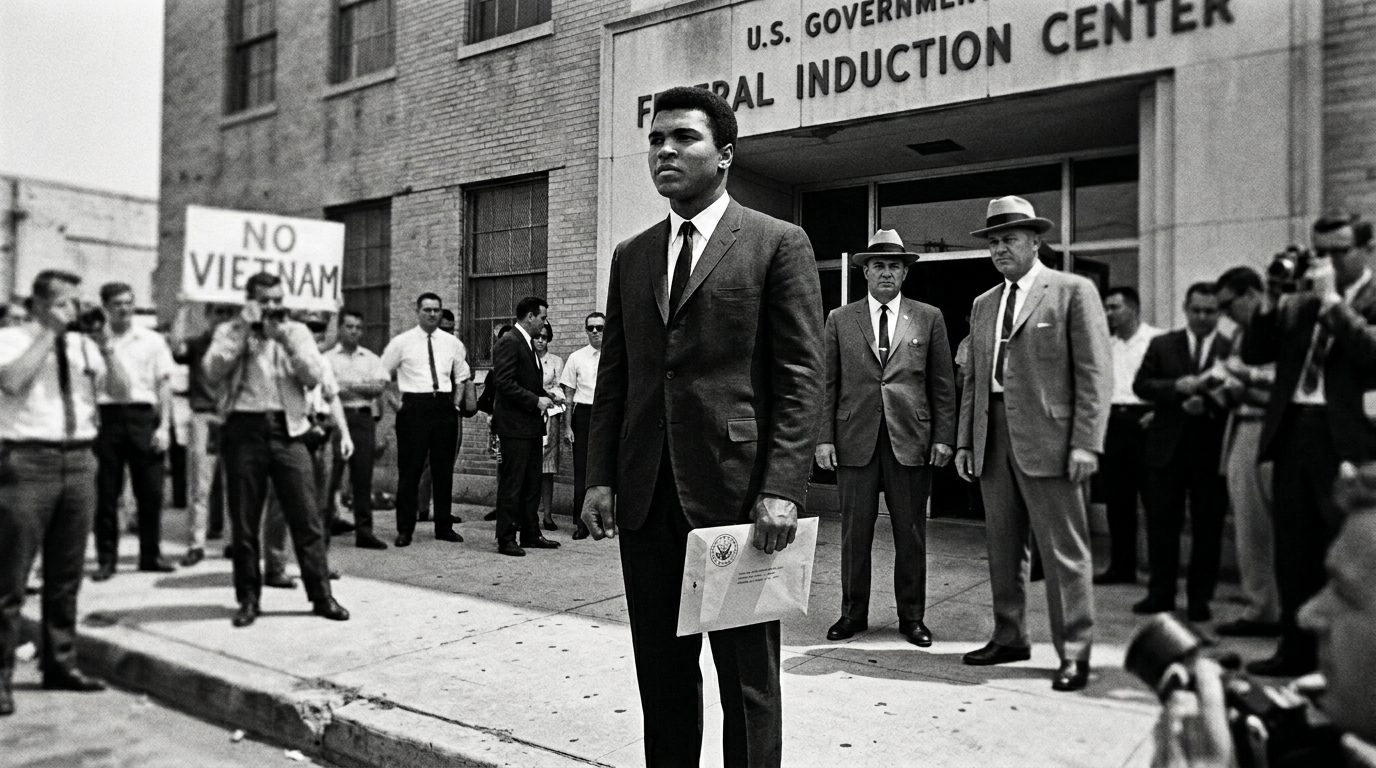
Ali had defeated Sonny Liston in 1964 to become the youngest heavyweight champion since Floyd Patterson. He was twenty-two. By 1967, he had defended his title nine times. He was fast, loud, and unbeatable. Then they asked him to put on a uniform and go kill people he had never met in a country he had never seen.
“I ain’t got no quarrel with them Viet Cong,” he said.
That sentence cost him everything.
The five minutes he stood at that induction center, he later said, were the longest of his life. Not because he was afraid. Because in those five minutes, he ran through every possible outcome. He knew the commission would take his license. He knew the authorities would take his title. He knew he could go to prison. He knew that by the time he got out — if he ever got out — the heavyweight division might have moved on without him. He knew all of this. And when he finished thinking it through, he still did not step forward.
From June 1967 to October 1970, Ali did not fight a single professional bout. He lost what should have been the peak years of his career — ages twenty-five to twenty-eight. A boxer’s prime is measured in fights, not years, and three and a half years in a heavyweight’s career is an eternity.
But Ali did not disappear. He spoke. He went to college campuses and Black churches and community centers. He gave over two hundred speeches during his exile. Some audiences were tiny; some filled entire auditoriums. He talked about Vietnam, but he also talked about race, about poverty, about what it means to stand alone. He talked about how a man keeps himself from breaking when the whole system is trying to break him.
On October 26, 1970, Ali stepped back into the ring. His opponent was Jerry Quarry, a top-five heavyweight. The talk before the fight was that Ali would be rusty. And he was — for the first three rounds. His footwork was slower. His timing was off. But from the fourth round onward, you saw a different fighter. He was no longer just dancing and jabbing. There was something else in the ring with him. It was not technique. It was three and a half years of rage, compressed and released.
Ali stopped Quarry in the third round.
Then came March 8, 1971. Madison Square Garden. The Fight of the Century against Joe Frazier. Ali lost — a unanimous fifteen-round decision, his first professional defeat. But consider this: three months earlier, people were still asking whether he could even fight again. And here he was, going fifteen rounds with the undefeated heavyweight champion of the world. From exile to the brink of reclaiming his throne, it took him five months.
What followed is well-known: the Rumble in the Jungle in 1974, when he stopped George Foreman in Kinshasa. The third title in 1978, making him the first heavy-weight champion to win the belt three times. The Olympics in Atlanta. The tremor. The torch. The goodbye.
But beneath all those moments of glory, I keep returning to the three years and seven months. The interval when a twenty-five-year-old champion did not know if he would ever fight again. When no one knew — including him. That lost time, in the end, was the most important fight he ever won.
**Tags:** #MuhammadAli #boxing #VietnamWar #sportsandpolitics #FightOfTheCentury
**Sources:** FBI archives on Ali’s draft refusal; Muhammad Ali, *The Soul of a Butterfly*; HBO documentary *Ali: The People’s Champion*; Sports Illustrated and The Ring magazine coverage of the exile period (1967-1970)