
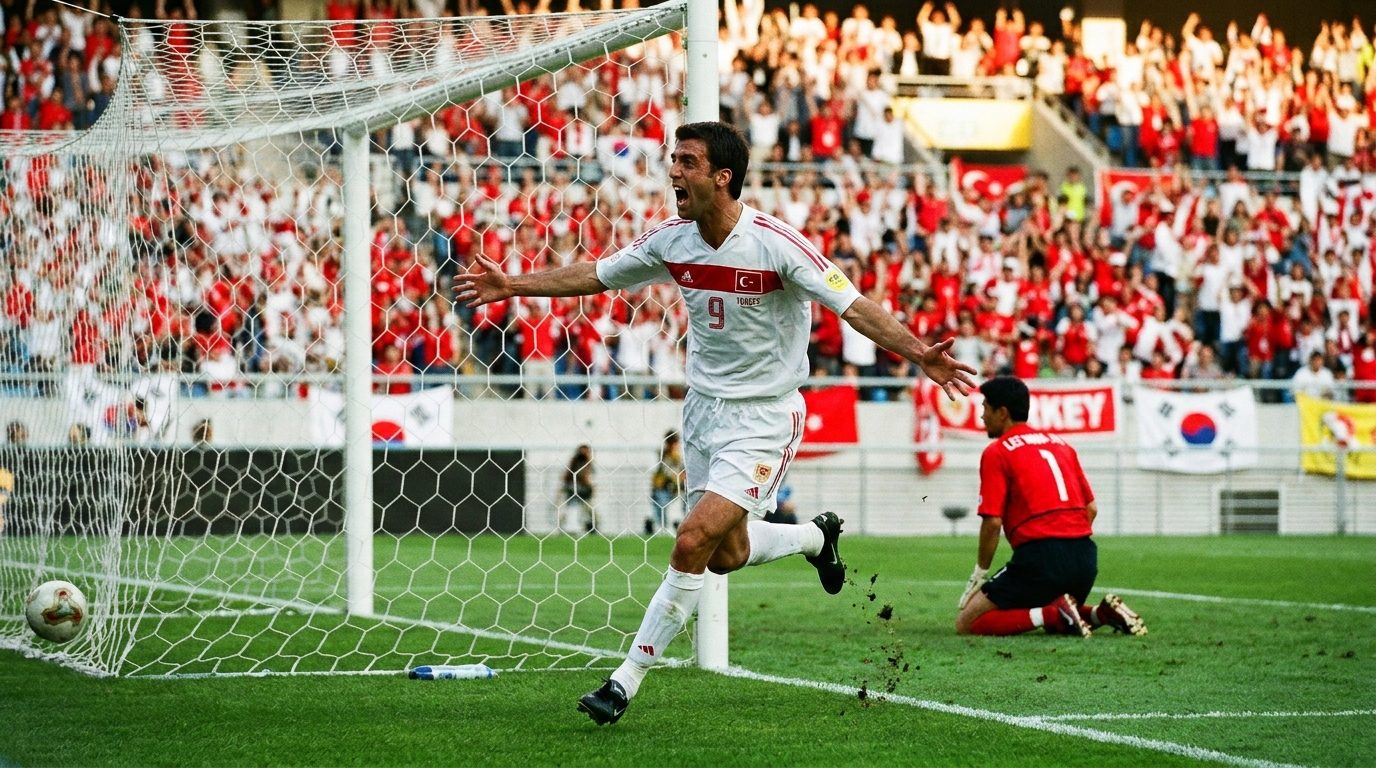
The Man Who Scored After 11 Seconds Now Drives an Uber in San Francisco

—
June 29, 2002. Daegu, South Korea. World Cup third-place match. Turkey versus the host nation.
The referee blew the opening whistle. Turkey kicked off. A sideways pass, a backward pass, then a long ball arcing toward the Korean penalty area. The Korean defender waited for the ball to bounce. He never got there. Hakan Şükür materialized behind him, got his right foot to the ball before it touched the ground, and swept it into the net. The clock stopped at eleven seconds. The fastest goal in World Cup history.
The man who scored it is the all-time leading goalscorer for the Turkish national team. He scored 51 international goals, a record no one has come close to breaking. He helped Turkey win the World Cup bronze medal—the best result in Turkish football history. He won nine Süper Lig titles with Galatasaray, plus a UEFA Cup. On the streets of Istanbul, his face once occupied every other billboard. They called him the Bull of the Bosphorus.
In 2020, someone recognized him in San Francisco. He was sitting behind the wheel of a Toyota Camry, a phone mount on the dashboard, an air freshener hanging from the rearview mirror. He was driving for Uber.
Hakan Şükür was born in 1971 in Sapanca, a small town in northern Turkey. His father was a construction worker. Six children, he was the fifth. He started playing professional football at seventeen, made the national team at twenty-one. His physique did not fit the traditional center-forward mold—he was tall but not powerful, quick but not explosively so. What he had was a rarer gift: the ability to be in the right place at the right time. Football calls people like him “opportunists,” but that word is sometimes an insult. Real opportunists rely on luck. Şükür relied on judgment. He knew where the ball was going before the ball did.
After the 2002 World Cup, his name belonged to the entire nation—not in a footballing sense. In the sense of something beyond sport, something called national pride. After retiring, he went into politics. In 2011, he was elected to parliament as a member of the Justice and Development Party. Erdogan’s party. He sat on the parliamentary benches in a suit, the picture of a dignified man who had found a second act after the pitch. Then came the coup attempt of July 2016. It failed. In the purges that followed, Şükür was accused of ties to the Gülen movement. He denied it. The state did not wait for his denial. A warrant was issued. His assets were frozen. And his goals—all of them—were removed from the official records. Not his political career. His football goals. Fifty-one international strikes, erased. He took his family and left Turkey.
He chose San Francisco. Of all the cities in the world, San Francisco may be the one least like Istanbul—no Bosphorus, no Galatasaray chants echoing through side streets, no tea houses where men argue about last night’s match until the early hours. This city has Silicon Valley, the Golden Gate Bridge, streets that climb at absurd angles. Şükür is not the Bull of the Bosphorus here. He is an immigrant. He needed income.
He drives for Uber. Someone asked him why not coaching, why not punditry, why not any of the standard transition jobs from politician-in-exile to something resembling a normal life. His answer was simple: his coaching license is in Turkey, and it cannot travel. Sports commentary requires Turkish, and San Francisco does not need Turkish-language pundits. Uber does not require a license, does not require a language, only requires that you know how to drive.
Knowing how to drive has never been an issue for Hakan Şükür. He was one of the best forwards in Europe. The rhythm in his feet does not leave a person. Now that rhythm finds its use on the roads of San Francisco—in the gridlock of Market Street, in the morning fog of the Golden Gate Bridge, at the tourist pickup point outside Fisherman’s Wharf. Someone recognized him. A Turkish immigrant passenger got into his car, glanced at the rearview mirror, and said: You are Hakan Şükür. Şükür said yes. The two of them sat in silence for a moment. The passenger did not know what to say. Şükür pressed the accelerator and pulled away from the curb. You can assume he watched the road. You can assume he did not look back.

**Tags:** #HakanŞükür #TurkishFootball #2002WorldCup #Exile #SportsAndPolitics
**Sources:** 2002 World Cup third-place match official records; international media coverage of Şükür’s life in exile (BBC, The Guardian, The New York Times); Şükür’s public social media content.