
She Fought Five Pro Bouts to Pay for Football Training

—
In Lusaka, the capital of Zambia, a teenage girl who wants to play football has to learn how to take a punch first.
That is not a metaphor. By the time Barbra Banda was fourteen, she was already known in Lusaka’s street football circles—blistering pace, a shot that stung, and a reputation that made boys reluctant to let her join because whichever side got her usually won. But street football does not pay bills. Zambia had no professional women’s league. Girls played for nothing. Her family lived in a working-class neighborhood of Lusaka, and she needed money—not for boots, but for the bus fare to get to training.
She found a boxing gym.
Zambia has deep boxing roots—the country has produced plenty of professional fighters. When Banda walked into the gym, no one stopped her for being a girl. In Zambian boxing circles, a poor kid looking for a way out is not a story. It is the everyday. After her first training session, the coach asked if she had ever been in a fight before. She said she used to scrap with boys during street football matches. The coach nodded. That made things simpler.
In the ring, Banda learned something more valuable than speed: how to keep moving after being hit. In football, this skill has a more formal name—holding the ball under pressure. But she did not know she was training for football at the time. She only knew she needed to win fights. A professional bout came with a purse. That purse could buy a lot of bus rides.
Her professional boxing record: five fights, five wins. Not exhibition matches against a heavy bag—real professional bouts, with a referee, a crowd, and an opponent trying to knock her down. No one knocked her down. She was fast with her hands, tight with her defense, and she had a rare sense of distance—when to step in, when to step out, when to end things with one heavy shot. Every one of those skills later found a home on the football pitch. The penalty box is a ring. The defenders are opponents. The goal is the knockout.
In 2018, she made her choice. Full-time football.
She walked away from an undefeated boxing career. She walked away from a professional identity that was already earning money. She became a beginner again—an African women’s footballer who had never played for a European club. But the Zambian women’s national team was rising, and they needed a forward who could score. She knew it should be her.
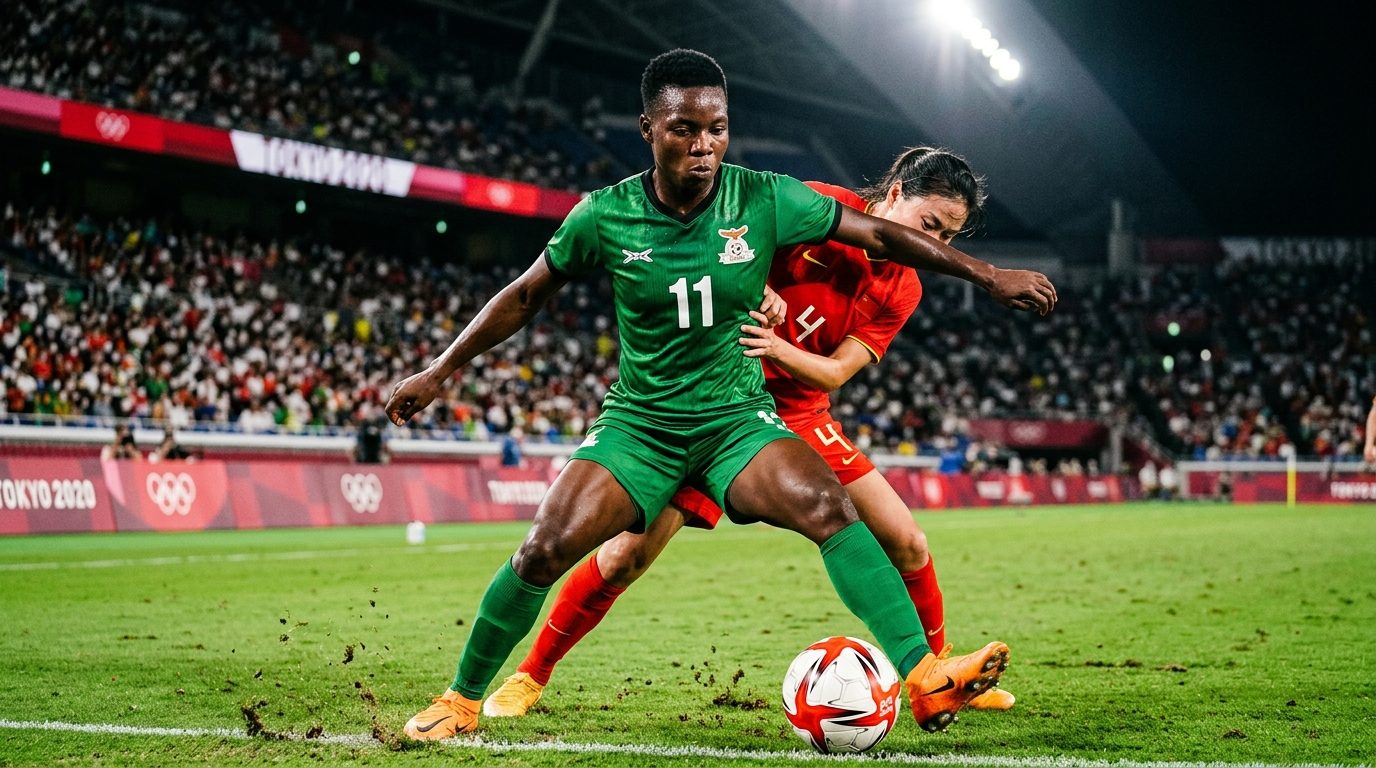
Tokyo 2020 Olympics. Zambia versus China. The first Olympic women’s football match in Zambian history—this country had never sent a women’s team to the Games. Banda scored three goals. A hat-trick. The match ended 4–4. Zambia did not win, but they earned their first Olympic point. Banda’s name was written into the record—the first Zambian woman to score at an Olympic football tournament, the second, the third. All three were the same person.
After that match, FIFA’s official social media posted: Barbra Banda. Someone commented underneath: *She used to be a boxer.* They added a boxing glove emoji. No one needed to explain why that background made her more terrifying. A forward holding off a defender in the box, shielding the ball, hunting for a shooting lane—these movements overlap completely with a boxer’s sense of distance, ability to absorb pressure, and instinct to stay calm when someone is trying to knock you over. Banda was not playing football on talent. She was playing on everything the ring had taught her.
She now plays for a European club, earning many multiples of what boxing ever paid her. But when a BBC Africa journalist once asked whether, at fourteen, she would still walk into that boxing gym, she answered without hesitation: of course. Otherwise, I wouldn’t have had the bus fare.
Those five professional bouts—she never lost one. But the thing that really got knocked out was the old rule that said an African girl had no path in football. She took her purses from five fights and bought herself a road to Tokyo.
**Tags:** #BarbraBanda #ZambiaWomensFootball #TokyoOlympics #BoxingAndFootball #AfricanSports
**Sources:** Tokyo 2020 Olympic women’s football official records; FIFA official database; BBC Africa long-form interview with Barbra Banda.