
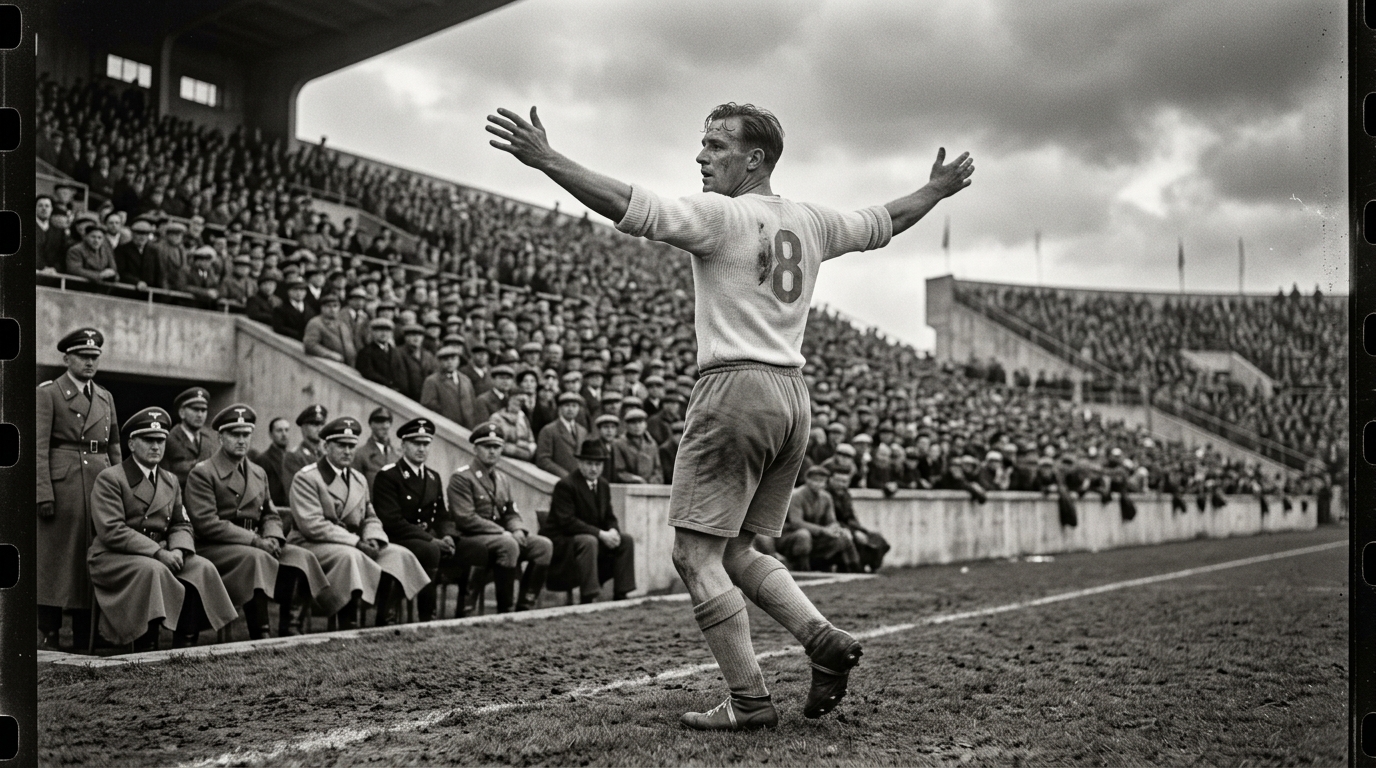
He Danced a Waltz in Front of the Nazis

Matthias Sindelar, Austria’s greatest footballer, soul of the 1930s “Wunderteam.” After the Anschluss in 1938, the Nazis demanded he play for Germany. In the “unification friendly,” he scored a goal, then danced a Viennese waltz in front of the Hitler Youth stands. Months later, he was found dead in his apartment. Cause: gas leak.
April 3, 1938. Vienna’s Prater Stadium. Sixty thousand people. This was not an ordinary match. The Nazis had swallowed Austria, and this “friendly” was the ritual they had scripted: Austria versus Germany. The plot was clear—Germany wins, the scoreline polite, the whole affair a gentle wedding ceremony. Then a slender Austrian ruined the wedding.
Matthias Sindelar did three things in that game that he was not supposed to do. The first: he received the ball in the box, flicked it past a German defender with the outside of his foot. The second: one-on-one with the goalkeeper, he did not shoot immediately. He paused for half a beat—long enough for the entire stadium to see—then slotted the ball into the net. The third: he ran toward the stands. The section where the Nazi dignitaries sat, the block of Hitler Youth in uniform. He stopped, turned to his teammates, and danced a waltz.
In front of the Nazis. In front of sixty thousand people. In the occupied capital of a country that no longer existed.
Sindelar was not celebrating a goal. He was writing the name of a dead nation onto the pitch with his feet. The script for that match required Austria to lose. The Nazis wanted the game to become “the friendly reunion of two Germanic peoples.” Instead, Sindelar put Austria 1–0 up, and when he celebrated, he refused to give the Nazi salute. By then, the raised arm had become an unwritten rule for German and Austrian players after a goal. He did not raise his arm. He danced a Viennese waltz.
Austria won 2–0. The Nazi match reports fudged the scoreline. Some papers simply omitted it. Others called it an “unofficial exhibition.” But sixty thousand Viennese saw it. Inside that stadium, under the gaze of Nazi officials, they made a sound somewhere between a roar and a sob. It was the last time they would ever make a sound for their own country. Not long after, Austria vanished from the map, renamed a province of the German Reich.
Sindelar never played for the national team again. The Nazis demanded he join the German squad. He refused. He gave the excuse of age and injury—thirty-four, a bad knee from years of wear. No one believed him. He was still playing for his club, still in form. He simply would not put on a jersey bearing Nazi insignia.
January 23, 1939. Vienna. Sindelar and his girlfriend were found dead in his apartment. The cause was carbon monoxide poisoning. The police ruled it an accident—a faulty gas pipe. He was thirty-five. The argument about how he died has never settled, eight decades later. Some say suicide—a man who had lost his country chose to leave. Some say murder—the Nazis could not tolerate a national idol who refused to cooperate, still alive, still visible. Some say it really was a gas leak. The truth belongs to no one now. But in Vienna, at his funeral, more than twenty thousand people took to the streets. It was 1939. Nazi territory. Twenty thousand people, walking behind the coffin of a footballer who died of a “gas leak.” That procession was its own silent waltz.
Matthias Sindelar stood five-foot-nine and weighed under seventy kilos. On the pitch he was thin as paper—his nickname was der Papierene, the Paper Man. But his technique was considered the finest in Europe. He was not a forward who scored with his body. He scored with movement, timing, a sense of space that made defenders look half a step late wherever he went. Between 1931 and 1934, he led Austria’s Wunderteam on a rampage across Europe. If the 1934 World Cup had had fair refereeing—that tournament saw Italy, under Mussolini’s pressure, eliminate Austria with a series of dubious calls—he might well have been a world champion.
But the heaviest match the Wunderteam ever played was not a victory in any tournament. It was that “friendly” on April 3, 1938. From any rational angle, the match should not have been won. Winning changed nothing. Winning would not reverse the annexation. Winning would not put Austria back on the map. But Sindelar won it anyway. He played an entire match in his own style—elusive, cunning, unpredictable—right in front of the Nazis. Then he danced a waltz.
That was not resistance. Resistance requires organization, a manifesto, a program. Sindelar had none of those. He had a pitch, a ball, and a dance step he had learned on the streets of Vienna. He put the three together in a single moment. It was not enough to topple anything. But it was enough to let sixty thousand people, in the capital of a swallowed country, make a sound for the last time.
Tags: #MatthiasSindelar #AustrianFootball #Anschluss1938 #Wunderteam #FootballAndPolitics
Sources: Austrian Football Association historical archives; April 3, 1938 match records and photographs; German-language documentary and scholarly sources on the Wunderteam; contemporary press coverage of Sindelar’s funeral.