
The German Long Jumper Who Walked Beside Jesse Owens in Front of Hitler

The Best in Europe
Luz Long was born on April 27, 1913, in Leipzig, Germany. From his teenage years, he was unmistakable on the track: tall, powerfully built, with a graceful stride that coaches called effortless. By his early twenties, Long dominated the European long jump scene. He set the German national record, then broke it again. He set five European records between 1933 and 1937, culminating in a personal best of 7.90 meters. He arrived at the Berlin Olympics as Germany’s brightest hope for gold in the horizontal jumps.
The Nazi regime understood the propaganda value of an athlete like Long. Here was a man who matched the ideal plastered across Party posters: blond hair, blue eyes, a classical sculpture in athletic form. The state press built him up as proof of German athletic superiority. Long himself never played along. He refused to make political statements. He trained hard, jumped far, and kept quiet about everything else. His focus was singular: the Olympic long jump gold.
But there was another man who wanted that same gold. Jesse Owens of the United States had already shattered world records with a string of performances that seemed almost superhuman. In May 1935, at the Big Ten meet in Ann Arbor, Owens broke three world records and tied a fourth in the span of 45 minutes. By the time he stepped onto the Berlin track in August 1936, he was the most famous athlete on the planet — and a direct challenge to the Nazi theory of racial hierarchy.
The Qualifying Round That Changed Everything
August 4, 1936. Berlin Olympic Stadium. One hundred thousand spectators packed the stands. Hitler sat in his box, surrounded by Party officials and a battery of cameras. The long jump qualifying round was a formality for the favorites — get a legal jump, advance to the final, then fight for medals. But sports have a way of ignoring scripts.
According to Owens’ later account, he struggled in the qualifying round. He had already used two attempts without a clean jump. One more foul would eliminate the world’s greatest athlete before the final even began. The German crowd, encouraged by the regime’s anti-American and anti-Black propaganda, did not hide its satisfaction.
Then Luz Long stood up.
He walked from the German team area across the infield grass and approached Owens near the pit. The two had never spoken before. Long introduced himself. What happened next has been recounted many times — by Owens himself in his memoir, by reporters who witnessed the scene, and by Long’s teammates. Owens recalled that Long offered a simple piece of practical advice: place a marker a few inches behind the takeoff board, so the margin for error would open up.
It is worth noting that some details of this story have been questioned over the years. Sports journalist Tom Ecker reported that when he asked Owens about the encounter in 1965, Owens dismissed it as “just a good story.” Whether the advice was literal or symbolic, what is documented by multiple eyewitnesses is this: the two athletes spoke at the pit, Owens qualified, and the final that followed produced one of the most enduring images in Olympic history.
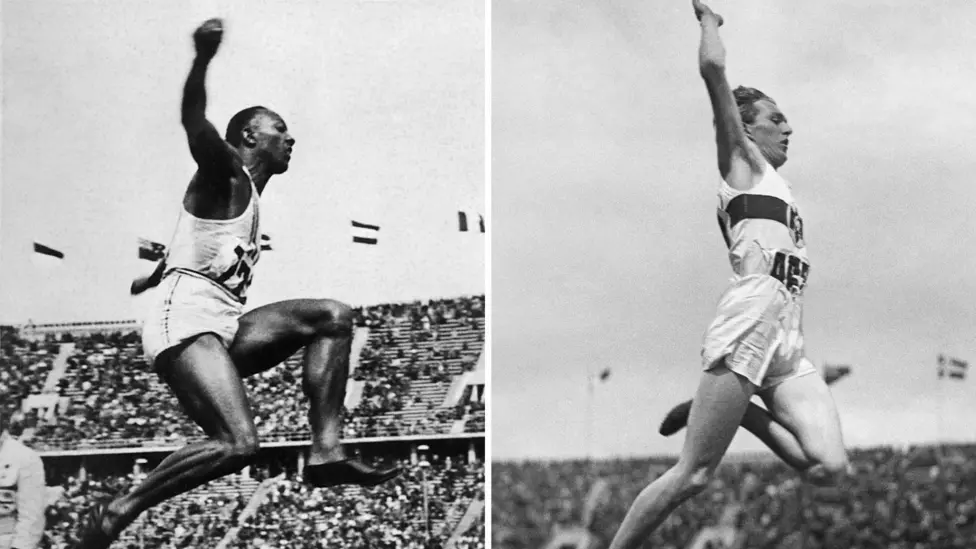
In the final, Owens jumped 8.06 meters — an Olympic record that would stand for twenty-four years. Long jumped 7.87 meters, his personal best in competition. The silver medal was his.
But neither man left the stadium thinking about the distance on the board.
An Embrace the World Could See
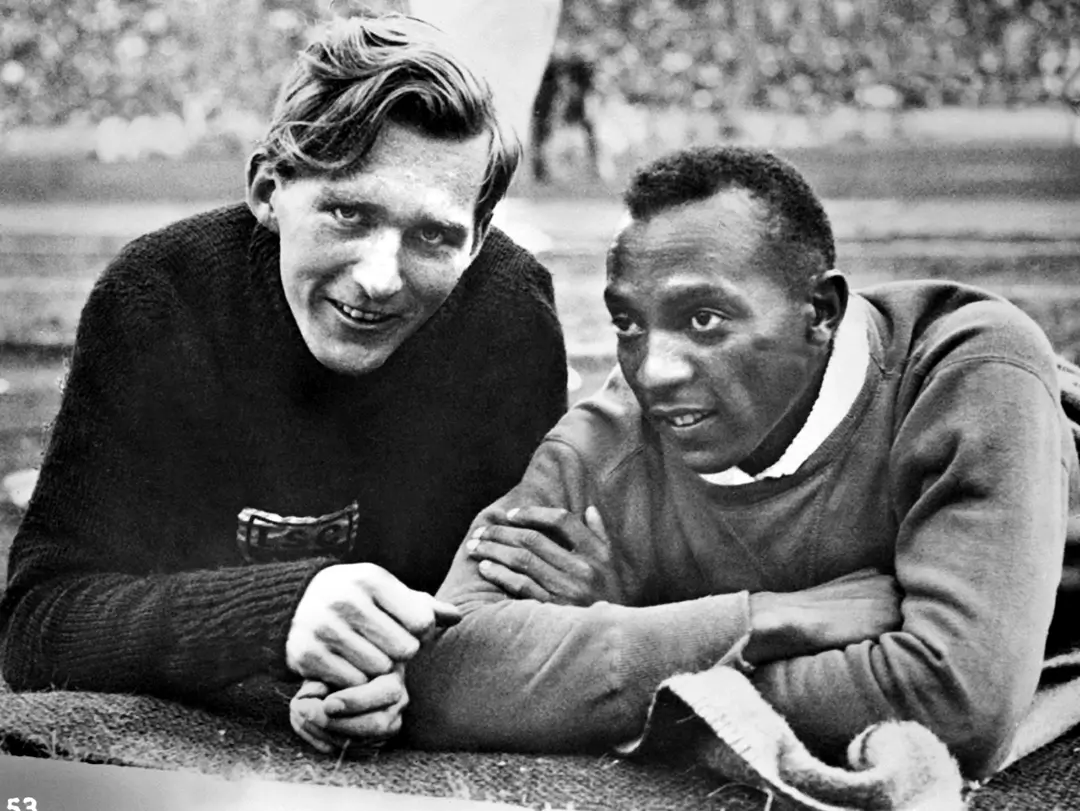
After Owens’s winning jump, Long did not retreat to the German side. He walked across the pit, past the photographers, past the officials, past the gaze of a hundred thousand spectators and the man who ruled Germany. He grasped Owens by the arm. They stood together in the sand, talking and smiling, as cameras captured the image that the Nazi propaganda machine could never quite suppress.
Owens later wrote: “It took a lot of courage for him to befriend me in front of Hitler. You can melt down all the medals and cups I have, and they wouldn’t be a plating on the twenty-four-karat friendship I felt for Luz Long at that moment.”
They walked off the field together, arms around each other’s shoulders. That walk — from the long jump pit to the locker room, under the eyes of the regime — may have been the single most public act of human decency performed at the 1936 Olympics.
Long and Owens are believed to have exchanged letters after the Games, though no physical correspondence survives for independent verification. In the years that followed, Long’s name would appear in every Owens interview and every retelling of the Berlin Olympics — always as the man who chose friendship over ideology in the moment that mattered most.
A Death in Sicily, a Promise Kept
When war broke out, Long was conscripted into the German army. He served in the Wehrmacht as a soldier — not by choice, but by circumstance, as millions of German men were. In July 1943, during the Allied invasion of Sicily, Long was hit by machine-gun fire near the town of Acate. He was evacuated to a field hospital, where he died on July 14, 1943. He was thirty years old.
A story has circulated for decades that Long wrote a final letter to Owens from his deathbed, asking him to find his young son. The letter, if it existed, has never been seen by Owens’ family or Long’s descendants, and historians consider it a legend rather than documented fact. What is true is that after the war, Owens traveled to Germany and tracked down Kai Long, Luz’s young son. The meeting was recorded in a 1966 documentary. Owens became a friend to the Long family and, according to multiple news reports, served as the best man at Kai Long’s wedding years later. The friendship that began on a long jump runway in 1936 extended across generations.
The Legacy Buried in Sand
Luz Long’s Olympic silver medal was kept by his family for decades. After Kai Long’s death in 2021, the medal was sold at auction in October 2022 for approximately $488,000. His European record of 7.90 meters has long since been broken. The statistics of his career — the distances, the medals, the championships — are preserved in archives, accessible to anyone with a moment of curiosity.
But that is not why we remember him.
We remember Luz Long because of a single gesture that lasted perhaps thirty seconds. He did not denounce the Nazi regime from a podium. He did not write manifestos or lead protests. He simply saw a fellow athlete in trouble, walked over, and offered help that cost him nothing — except, potentially, everything. In a regime where helping a Black man was itself a form of dissent, Long’s gesture was an act of profound personal courage.
What makes Long’s story endure is its ordinariness. He was not a hero who defeated an empire. He was a man who, when asked about it later, said something remarkably simple. The exact words are lost to history, but the meaning survives: he helped Owens not for politics, but because they were both athletes. That explanation — candid, human, refusing to be turned into propaganda — is the quiet heart of the entire episode.
Nearly ninety years later, the image of a German long jumper walking arm-in-arm with a Black American athlete, in full view of the most racist regime in modern history, has outlasted every speech, every parade, every monument the Nazis built. It survives because it is true. And because, in sports, truth sometimes arrives in the simplest possible form: one athlete helping another, with nothing to gain but a friend.
References
- Olympedia — Luz Long athlete profile
- Official Report of the 1936 Berlin Olympic Games
- Jesse Owens, *The Jesse Owens Story*, Putnam, 1970
- Encyclopaedia Britannica — Carl Ludwig Long
- AP News — “Medal of Olympian who defied Hitler by embracing Jesse Owens goes under the hammer” (October 2022)
- #BeyondSport #LuzLong #JesseOwens #Berlin1936 #LongJump #OlympicHistory